


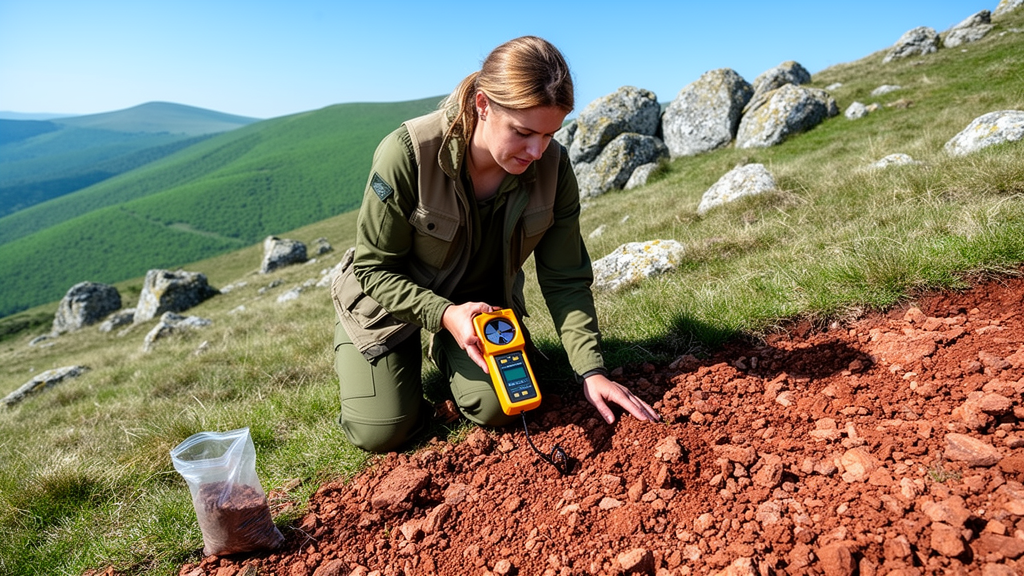
The Eastern Rhodopes of southern Bulgaria have long carried a reputation written in ore. Lead and zinc were pulled from the hills around Madzharovo, gold is mined at Ada Tepe near Krumovgrad, and a lead-zinc complex still operates at Kardzhali, while fertilizer production at Neochim in Dimitrovgrad and quarries for gneiss and marble scar the landscape. All of these activities share a common undercurrent: the region’s soil-forming rocks, chiefly granites, marble, gneiss and shale, are naturally enriched in uranium and other radioactive elements. Whether decades of mining and industry have pushed the radiation background above safe levels has, until now, been largely unmeasured. A new study published in the journal BioRisk provides the first systematic gamma-spectrometric survey of soils from these unexplored corners of the mountain range, and the verdict is reassuring.
The research team set out to study undisturbed soils, meaning soils unaffected by industrial activity, collected from areas in close proximity to industrial sites. The logic is elegant: by sampling near but not within anthropogenically affected zones, the investigators could assess whether human activity had spilled radionuclides into the surrounding environment. Four expeditions covered the liquidated Madzharovo lead-zinc mines, the Ada Tepe gold mine, the Kardzhali mining complex, the Neochim fertilizer plant, gneiss extraction sites and marble quarries. At each representative point, five samples were collected according to the Bulgarian standard BSS 17.4.5.01:1985, following ISO 18589-2,3 (2007) protocols. Surface layers from 0 to 5 centimeters were taken to monitor contamination, while samples down to 20 centimeters characterized the process in depth.
Preparation followed a rigorous pipeline. Soil samples were air-dried, homogenized, ground and sieved through a 2-millimeter mesh before being packed into 0.5-liter Marinelli containers with 4π geometry, a configuration that surrounds the detector and maximizes counting sensitivity. The analytical heart of the study was gamma spectrometry with a CANBERRA DSA 1000 multichannel analyzer coupled to an ultra-pure germanium detector with 35 percent efficiency and 1.8 keV resolution. This setup allows simultaneous and direct measurement of numerous gamma emitters across energies from 50 to 2000 keV. To achieve statistical reliability, each sample was measured for 19 to 24 hours, an unusually long acquisition time that tightens the uncertainty on every reported value.
The technique exploits the fact that each radionuclide emits gamma rays at characteristic energies. Uranium-238 was quantified through its daughter product thorium-234, detected at 63.3 keV and 92.3 keV. Radium-226 was determined from the peak at 186.3 keV, with careful correction for the overlapping uranium-235 line at 185.6 keV. Lead-210 was measured by its gamma line at 46.6 keV, thorium-232 through its daughter actinium-228 at 911.0 keV, and potassium-40 by the full energy peak at 1461 keV. The technogenic isotope cesium-137, the fingerprint of nuclear tests and the Chernobyl accident, was identified by its signature line at 661.6 keV. From these specific activities, expressed in becquerels per kilogram of dry soil, the team calculated two standard indicators of radiological risk.
The first is the radium equivalent activity, Ra_eq, computed as the sum of the radium-226 activity plus 1.43 times the thorium-232 activity plus 0.077 times the potassium-40 activity, following Beretka and Mathew’s 1985 formulation. The maximum permissible level is 370 Bq/kg. The second is the external hazard index, H_ex, defined by Krieger’s 1981 formula as the uranium-238 activity divided by 370, plus the thorium-232 activity divided by 259, plus the potassium-40 activity divided by 4810, with a limit of 1. Both indices assume uniform exposure to gamma radiation from the soil and are widely used to translate raw activity concentrations into a population-level hazard estimate.
The results span a wide but familiar range. Across the studied points, specific activities were: uranium-238 from 9 to 62 Bq/kg, radium-226 from 11 to 92 Bq/kg, thorium-232 from 16 to 82 Bq/kg, potassium-40 from 260 to 1432 Bq/kg, and lead-210 from 26 to 64 Bq/kg. Compared with the world averages reported by the United Nations Scientific Committee on the Effects of Atomic Radiation, roughly 35 Bq/kg for uranium-238 and radium-226, 30 Bq/kg for thorium-232 and 400 Bq/kg for potassium-40, the Eastern Rhodopes values sit within background amounts and are comparable to global averages. They also fall within the ranges cited for Bulgaria as a whole, which vary from 8 to 190 Bq/kg for uranium-238 and 40 to 800 Bq/kg for potassium-40.
Some of the highest potassium-40 values appeared near the Ada Tepe gold mine and the Madzharovo mine, where measured activities were twice the world average, reaching over 1400 Bq/kg. The explanation is geological rather than industrial: sedimentary rocks rich in organic remains, characteristic of the region’s past as a water basin with active underwater volcanism, concentrate potassium. The predominance of sedimentary rocks in the Eastern Rhodopes, especially those of biogenic origin with very low radioactive element content, also accounts for the differences observed between the Eastern and Western Rhodopes. The wide potassium-40 range is characteristic of the cinnamon forest soils predominant in the region, reflecting the great variety of soil-forming rocks.
One subtle geochemical signal emerged: a shift in the radioactive equilibrium between uranium-238 and radium-226, with higher radium content in some samples. This disequilibrium likely reflects the lower mobility of radium in soils, the low humus content, and the greater solubility of uranium salts, which allows uranium to migrate along the soil profile. Notably, no significant differences were found between arable and non-arable soils, and the measured radionuclide levels correspond to average or slightly above-average values typical for Bulgaria’s geographical latitude, within the values cited in the literature as normal for the respective regions.
The technogenic story is a Chernobyl echo. Cesium-137 entered the environment through nuclear tests in the 1960s and the 1986 accident, and southern Bulgaria was the most affected part of the country, with four to five times higher activity concentrations than the north. The isotope bound to the surface soil layer and persisted thanks to its long half-life. In the present study, 35 years after Chernobyl, cesium-137 ranged from less than 1 to 87 Bq/kg, confirming the strong spatial inhomogeneity documented previously, where values varied between 3 and 1700 Bq/kg even within tens of square meters. The decline in surface activity is mainly due to radioactive decay. For context, before 1986 the average in southern Bulgaria was 26 Bq/kg, and by 1996 averages varied between 160 and 280 Bq/kg there, with the highest regional values ever registered in the Western Rhodopes, up to 261 Bq/kg.
Crucially, the hazard indices stayed within safe limits. The external hazard index did not exceed the permissible upper bound of 1 at any sampling point, and the radium equivalent activity remained low relative to the 370 Bq/kg threshold. With both indicators below their limits, the study area of the Eastern Rhodopes is within normal background amounts and does not pose a radiation hazard for the population or the biota. No additional pollution or impact of industrial activities on radionuclide content was detected. Yet the authors caution that the region is one of the richest territories in biodiversity in Europe, home to many Balkan endemics and highly endangered species, close to Natura 2000 sites, and of growing interest for tourism. Because most industrial sites lie near surface water bodies, and migration of uranium, radium-226, lead-210 and thorium-232 through surface water is a major contamination pathway, the team recommends a radiological assessment of ground and surface water in the studied areas, particularly given the systematic use of unregulated drinking water sources in the region.
Subject of Research: Environmental radioactivity survey of soils in the Eastern Rhodopes, Bulgaria
Article Title: Radiation status of soils from the region of the Eastern Rhodopes (Southern Bulgaria)
Article References: Hristozova, M., & Lazarova, R. (2022). Radiation status of soils from the region of the Eastern Rhodopes (Southern Bulgaria). BioRisk, 17, 45-57. https://doi.org/10.3897/biorisk.17.77432
Image Credits: AI Generated
Keywords: Eastern Rhodopes, Bulgaria, gamma spectrometry, natural radionuclides, cesium-137, Chernobyl fallout, soil contamination, mining, radium equivalent activity, external hazard index, Radiation, status
Cite Scienmag News
Violet Maxwell. (October 19, 2026). Soils of Bulgaria’s Eastern Rhodopes Show No Hidden Radiation Threat. Scienmag. https://scienmag.com/soils-of-bulgarias-eastern-rhodopes-show-no-hidden-radiation-threat/
Violet Maxwell. "Soils of Bulgaria’s Eastern Rhodopes Show No Hidden Radiation Threat." Scienmag, 19 October 2026, https://scienmag.com/soils-of-bulgarias-eastern-rhodopes-show-no-hidden-radiation-threat/. Accessed 19 October 2026.
Violet Maxwell. "Soils of Bulgaria’s Eastern Rhodopes Show No Hidden Radiation Threat." Scienmag. October 19, 2026. https://scienmag.com/soils-of-bulgarias-eastern-rhodopes-show-no-hidden-radiation-threat/


