


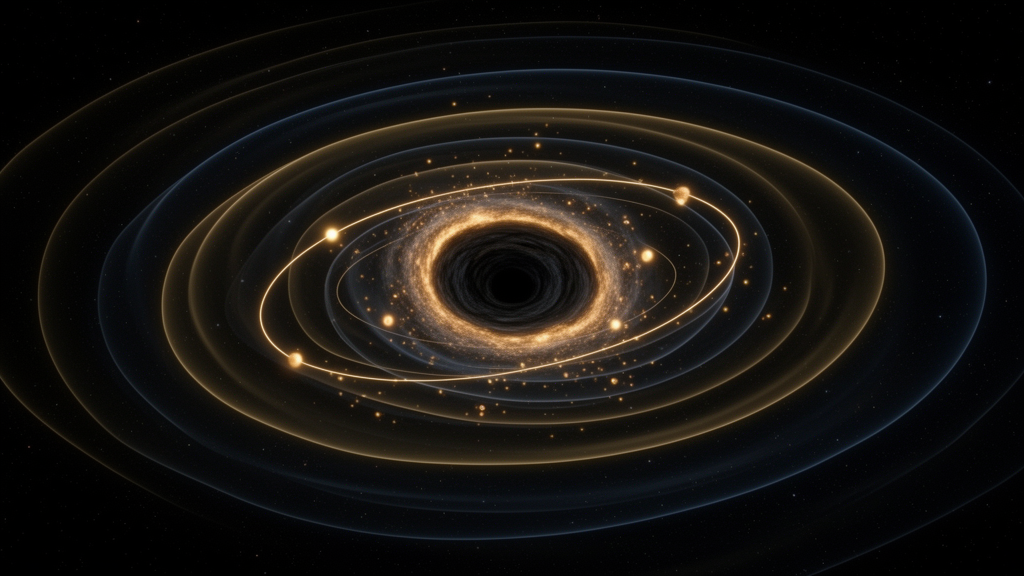
For more than a century, Albert Einstein’s general theory of relativity has stood as the definitive description of gravity, portraying it not as a force but as the curvature of spacetime itself. Yet physicists have long suspected that Einstein’s masterpiece may be incomplete, particularly in the extreme environments surrounding compact cosmic objects. Now, a team of theoretical physicists has taken a major step toward testing that suspicion, showing that a little-known scalar-tensor extension of general relativity leaves dramatic fingerprints on the way particles orbit a naked singularity — and on the gravitational waves those orbits produce. The findings, published in The European Physical Journal C, could offer a powerful new diagnostic for future space-based gravitational wave observatories.
The research, conducted by Dhruba Jyoti Gogoi, Jyatsnasree Bora, Himanshu Chaudhary, M. Yousaf, and G. Mustafa, focuses on Freund–Nambu scalar-tensor gravity, a framework first proposed in 1968 by Paul Freund and Yoichiro Nambu. Unlike Einstein’s purely geometric formulation, this theory introduces a dynamical scalar field that actively participates in gravitational interactions alongside the spacetime metric. The scalar field is not merely an auxiliary ingredient but an active geometric component that modifies the gravitational configuration itself, making it possible to investigate how scalar-induced corrections affect the background geometry, particle dynamics, and potentially observable strong-field phenomena.
To isolate the purely gravitational effects of the scalar interaction, the team derived an exact analytical solution in the vacuum limit of the theory, where matter is neglected and the scalar field is taken to be massless. The resulting spacetime generalizes the well-known Janis–Newman–Winicour (JNW) solution, a geometry that describes a naked singularity supported by a non-trivial scalar field profile. Unlike a black hole, which conceals its singularity behind an event horizon, a naked singularity is exposed to the universe — causal geodesics originating arbitrarily close to the singular region can extend to infinity without ever encountering a horizon. This makes the JNW spacetime a compelling theoretical laboratory for probing strong-field deviations from general relativity.
The researchers introduced two key coupling parameters that systematically modify the orbital landscape. The first, denoted q, controls the strength of the non-linear coupling between the scalar field and the spacetime geometry. The second, denoted g_s, governs a direct linear coupling between the massive test particle and the background scalar field, effectively altering the particle’s mass as it moves through the scalar field. Together with the spacetime parameter n — which arises from the presence of the scalar field and controls the scalar modification to the JNW metric — these parameters reshape the effective potential that dictates the allowed regions of motion for orbiting bodies.
Using the effective potential formalism, the team rigorously mapped the parameter space governing stable and marginally bound equatorial orbits. Their analysis reveals that the complex interplay between n, q, and g_s heavily distorts the effective potential barrier, systematically shifting the critical binding energies and the radial location of the Innermost Stable Circular Orbit (ISCO). Notably, they found that an attractive scalar-particle coupling (g_s > 0) pulls the ISCO deeper into the gravitational well, closer to the central naked singularity. This inward shift holds profound astrophysical implications, as it directly alters the inner edge of potential accretion disks and effectively enhances the radiative efficiency of accreting matter in these environments. Conversely, negative scalar couplings destabilize the orbits, pushing the ISCO outward and shrinking the permissible phase space for bounded oscillatory motion.
Beyond circular motion, the researchers cataloged families of bound periodic trajectories using a rational parameter that establishes a precise taxonomy based on the number of zooms, whirls, and vertices. These zoom-whirl orbits are among the most exotic phenomena in strong-field gravity: during the zoom phase, the particle moves through regions of relatively weak gravitational gradients, corresponding to extended intervals of low-frequency, low-amplitude gravitational wave emission. Conversely, during the whirl phase, the particle plunges deep into the strong-field regime and grazes the unstable circular orbit, where extreme radial acceleration and relativistic velocities trigger intense, high-frequency bursts of gravitational radiation. The team demonstrated that as a particle’s specific energy and angular momentum are tuned toward the separatrix limit, the scalar modifications induce intense periapsis precession, trapping the particle in pronounced zoom-whirl behavior.
To connect these orbital dynamics with observable signals, the researchers applied the Numerical Kludge methodology to synthesize the gravitational wave strains emitted by Extreme Mass-Ratio Inspiral (EMRI) systems — configurations in which a stellar-mass compact object of roughly ten solar masses orbits a supermassive central singularity of one million solar masses. Using the adiabatic approximation, which treats the orbital constants of motion as immutable over individual periodic cycles, the team projected the fully relativistic trajectories onto a pseudo-flat background where they act as source terms in the standard quadrupole formula. Their simulations clearly illustrate that the scalar-tensor corrections leave an indelible, macroscopic signature on the time-domain waveforms.
Crucially, even when the researchers rigorously preserved the spatial topology of an orbit by precisely tuning the orbital energy and angular momentum across different scalar parameters, the localized modifications to the gravitational field induced severe temporal dephasing during the high-frequency whirl bursts. Modifying n, q, or g_s alters the steepness and shape of the effective radial potential, which accelerates the particle differently as it falls into the whirl phase. Consequently, the proper time the particle spends traversing the strong-field region changes, manifesting in the waveforms as a severe and cumulative macroscopic dephasing. The arrival times of the intense high-frequency bursts shift systematically in the time domain as the scalar parameters are varied.
The team acknowledges that in a comprehensive scalar-tensor treatment, an inspiralling compact object would generically emit scalar dipole radiation in addition to tensor quadrupole radiation. Because dipole radiation represents an additional, highly efficient energy-loss channel, the total orbital energy dissipation rate would increase, accelerating the inspiral and enhancing the cumulative temporal dephasing observed in the high-frequency whirl bursts. While the pragmatic neglect of scalar radiation successfully isolated the pure kinematic imprint of the modified background geometry, incorporating dipole losses would make the waveforms even more sensitive to q and g_s, providing an even stronger discriminant for future detectors.
This cumulative phase shift highlights the exquisite sensitivity of EMRI waveforms to the presence of scalar hair. The distinct temporal dephasing generated by n, q, and g_s ensures that scalar-tensor modifications cannot simply mimic standard general relativistic effects without fundamentally altering the arrival times of the radiation bursts. In the era of precision gravitational wave astronomy, these unique temporal signatures will provide a robust theoretical template for future space-based interferometers, such as the Laser Interferometer Space Antenna (LISA). By capturing the rich phenomenology of zoom-whirl EMRIs, the results pave the way for utilizing future observational data to stringently constrain scalar-tensor extensions of Einstein’s theory and to search for the definitive hallmarks of naked singularities in the cosmos.
Subject of Research: Equatorial periodic orbits and gravitational wave phenomenology around spherically-symmetric vacuum solution in Freund–Nambu scalar–tensor gravity
Article Title: Equatorial periodic orbits and gravitational wave phenomenology around spherically-symmetric vacuum solution in Freund–Nambu scalar–tensor gravity
Article References: Gogoi, D. J., Bora, J., Chaudhary, H., Yousaf, M., & Mustafa, G. (2026). Equatorial periodic orbits and gravitational wave phenomenology around spherically-symmetric vacuum solution in Freund–Nambu scalar–tensor gravity. The European Physical Journal C, 86(10), Article 1188. https://doi.org/10.1140/epjc/s10052-026-16451-z
Image Credits: AI Generated
DOI: 10.1140/epjc/s10052-026-16451-z
Keywords: Equatorial, periodic, orbits, gravitational, wave, phenomenology, around, spherically-symmetric, vacuum, solution, Freund, Nambu
Cite Scienmag News
Grant Pearson. (October 19, 2026). Naked Singularity Orbits Could Reveal Hidden Scalar Fields in Gravity. Scienmag. https://scienmag.com/naked-singularity-orbits-could-reveal-hidden-scalar-fields-in-gravity/
Grant Pearson. "Naked Singularity Orbits Could Reveal Hidden Scalar Fields in Gravity." Scienmag, 19 October 2026, https://scienmag.com/naked-singularity-orbits-could-reveal-hidden-scalar-fields-in-gravity/. Accessed 19 October 2026.
Grant Pearson. "Naked Singularity Orbits Could Reveal Hidden Scalar Fields in Gravity." Scienmag. October 19, 2026. https://scienmag.com/naked-singularity-orbits-could-reveal-hidden-scalar-fields-in-gravity/


