


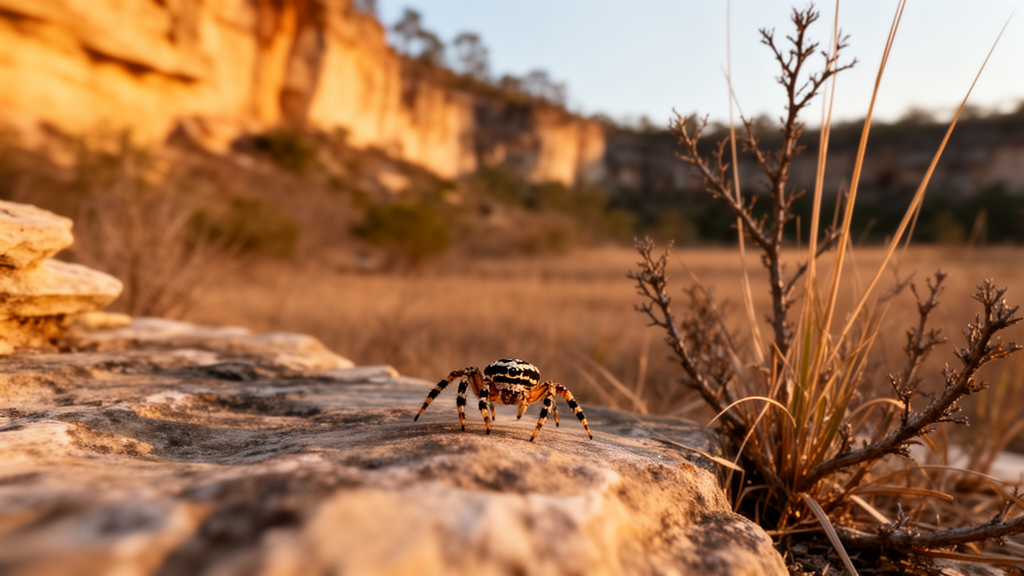
In the scorched semideserts of southeastern Georgia, where badlands glow ochre under a continental sun and mastic woodlands cling to rocky slopes, a team of arachnologists has just rewritten the spider map of the Caucasus. A four-day expedition to Vashlovani National Park and the neighboring Chachuna Managed Reserve, conducted between 19 and 23 May 2024, yielded 53 spiders representing 24 species, 22 genera, and 12 families. Among them were two species entirely new to science and ten species never before recorded in Georgia, six of which, along with three genera, are new to the Caucasus region as a whole.
The findings, published in the journal Caucasiana, come from the CaBOL (Caucasus Barcode of Life) project, which has been systematically surveying the region’s fauna using DNA barcoding alongside traditional morphology. Until recently, the spider fauna of these two protected areas was known from just three species. Expeditions in April 2022 and 2023 added 38 more, and the latest trip pushed the tally even higher, underscoring how much remains undocumented in one of Europe’s most biodiverse corners.
Vashlovani National Park covers roughly 35,000 hectares of steppe, semidesert, badlands, and river valleys in Georgia’s extreme southeast. Its continental climate brings scorching summers and temperate winters, creating a mosaic of habitats that supports endangered mammals such as the Caucasian leopard, Eurasian lynx, and goitered gazelle. Chachuna Managed Reserve borders the park to the southwest and shares much of the same ecological character. Yet despite this richness, the two territories had been almost entirely neglected by arachnologists before the CaBOL surveys began.
The two new species are Synema inexpectata, a crab spider in the family Thomisidae, and Prodidomus trihelicoides, a ground spider in the family Prodidomidae. Both were described from specimens collected in the semidesert habitats of Chachuna and Vashlovani. The male holotype of Synema inexpectata was found on vegetation at Osiaskheoba in Chachuna, while the female holotype of Prodidomus trihelicoides was collected from soil cracks at the same locality, with a paratype from Mijniskure in Vashlovani.
Synema inexpectata is a brightly colored crab spider whose male holotype measures just 3.82 millimeters in total length, with a dark-brown carapace and a dorsally bright-red abdomen bearing an extensive black pattern. The species resembles Synema utotchkini, known from Central Asia, but can be distinguished by a longer embolus with a strongly modified, wide embolic tip originating at the three o’clock position rather than two o’clock, and by a differently shaped retrolateral tibial apophysis. The specific epithet refers to the unexpected discovery of a new species of this genus in Georgia. Juveniles with identical red-and-yellow abdominal patterns had been collected in Chachuna the previous summer, hinting that the species was already present before its formal description.
Prodidomus trihelicoides is a small, orange, patternless spider whose females measure between 3.46 and 4.44 millimeters. The name refers to the three coils of the transparent insemination ducts, a feature that distinguishes the new species from the closely related Prodidomus redikorzevi, which has five coils. The genus Prodidomus is the largest in its family, with 53 valid species distributed across the Palaearctic, Afrotropics, Indomalaya, and Australasia, but only one species had previously been recorded in the Caucasus, from Azerbaijan. The male of the new species remains unknown.
Among the ten species recorded in Georgia for the first time, several stand out for their biogeographic significance. Turkozelotes attavirus, a ground spider previously known only from the Greek island of Rhodes, was found at Mijniskure in Vashlovani. The species bears a striking velvet ant-like abdominal pattern, with overlapping white subcircular patches and an oval transverse white patch at the posterior end, a form of mimicry documented in only a handful of spider species worldwide. The authors note that unidentified specimens from Azerbaijan depicted in earlier literature with very peculiar coloration resembling velvet ants may belong to the same species.
Other first records for Georgia include Berlandina nabozhenkoi, Cryptodrassus helvolus, Synaphosus palearcticus, Synaphosus turanicus, Talanites involutus, Marinarozelotes jaxartensis, Evarcha armeniaca, Lycosa soboutii, Rhysodromus rikhteri, and Sardinidion blackwalli. Synaphosus turanicus was previously known only from Central Asia, making its discovery in Vashlovani a remarkable range extension and the first record of the species in the Caucasus. Acanthinozodium parysatis, a zodariid spider previously known only from two provinces of Iran, was found at Mijniskure, representing the first record of the genus Acanthinozodium in the Caucasus region and the northernmost known occurrence of the species.
Perhaps the most significant single find is the first description of the male of Lycosa soboutii, a large fossorial wolf spider recently described from Iran based on females alone. The Georgian specimens, collected at night with flashlights and lured from burrows, allowed the authors to describe the male for the first time and to provide a detailed diagnosis distinguishing it from related Iranian species such as Lycosa elymaisa and Lycosa aragogi by features of the tegulum, embolus, and tegular apophysis. The species is the first record of the genus Lycosa in this combination from the Caucasus region.
The survey also produced the first photos of several preserved and alive species, along with detailed collecting data and diagnostic drawings based on microscope photographs. Specimens were preserved in 96 percent ethanol and stored at minus 22 degrees Celsius in the scientific collections of Ilia State University in Tbilisi. The authors emphasize that the semidesert habitats of Vashlovani and Chachuna remain understudied, and that further surveys are likely to reveal additional species new to science and to the region. The findings highlight the importance of these protected areas as refugia for a distinctive arid-adapted fauna at the crossroads of Europe, Asia, and the Middle East.
Subject of Research: Biodiversity
Article Title: New and interesting spiders ( Arachnida , Araneae ) from Vashlovani National Park and Chachuna Managed Reserve (Georgia)
Article References: Seropian, A., Bulbulashvili, N., Makharadze, G., & Baznikin, A. (2024). New and interesting spiders (Arachnida, Araneae) from Vashlovani National Park and Chachuna Managed Reserve (Georgia). Caucasiana, 3, 183-213. https://doi.org/10.3897/caucasiana.3.e132501
Image Credits: AI Generated
DOI: 10.3897/caucasiana.3.e132501
Keywords: spiders, arachnology, Georgia, Caucasus, new species, biodiversity, Vashlovani National Park, taxonomy, interesting, Arachnida, Araneae, Vashlovani
Cite Scienmag News
Margaret Porter. (October 19, 2026). Two New Spider Species and Ten First Records Emerge from Georgia’s Vashlovani National Park. Scienmag. https://scienmag.com/two-new-spider-species-and-ten-first-records-emerge-from-georgias-vashlovani-national-park/
Margaret Porter. "Two New Spider Species and Ten First Records Emerge from Georgia’s Vashlovani National Park." Scienmag, 19 October 2026, https://scienmag.com/two-new-spider-species-and-ten-first-records-emerge-from-georgias-vashlovani-national-park/. Accessed 19 October 2026.
Margaret Porter. "Two New Spider Species and Ten First Records Emerge from Georgia’s Vashlovani National Park." Scienmag. October 19, 2026. https://scienmag.com/two-new-spider-species-and-ten-first-records-emerge-from-georgias-vashlovani-national-park/


