


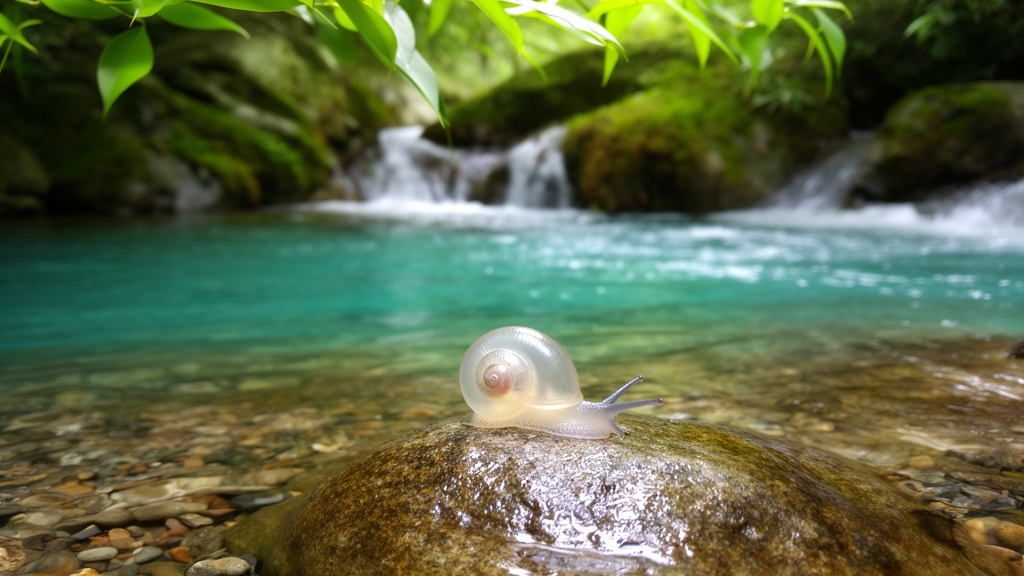
Deep in the karst landscapes of Yunnan Province, southwest China, a small spring-fed creek has yielded a species new to science. Researchers have formally described Hua luquanensis, a freshwater gastropod collected from Zhuanlong Dragon Spring in Luquan County, Kunming City, and published the description in the journal Zoosystematics and Evolution. The species belongs to the family Semisulcospiridae, a group of river and stream snails whose members are notoriously sensitive to water quality, making every new discovery both a taxonomic milestone and an ecological warning sign.
The story of the discovery began in April 2017, when specimens were gathered from the rocks of Zhuanlong Dragon Spring, a clear water body rising from the ground and flowing into a river of the Jinsha River basin. The water there reaches a maximum depth of about 60 centimeters, with a bottom of rocks and sand and stonewort as the dominant macrophyte. The snails were found clinging to the underside of stones. Although the species had been mentioned under the name Hua luquanensis in an earlier doctoral thesis, it had never been validly published, leaving it a so-called naked name until now.
Assigning the new species to its genus required careful anatomical detective work. The genus Hua was established in 1943 with the type species Hua telonaria, collected from the Daguan River in Yunnan. Today the genus comprises 38 described species confined to Sichuan, Yunnan, Guizhou, and Guangxi in China and northern Vietnam. Hua species are oviparous, and mature females possess a distinctive ovipositor pore, or egg-laying groove, below the right cephalic tentacle, a feature that separates them from the related genus Koreoleptoxis, whose females carry both a pore and a groove. The radula, the snail’s toothed feeding ribbon, provides another key: in Hua, the inner and outer marginal teeth bear different numbers of denticles, while in Koreoleptoxis they bear the same number.
Hua luquanensis fits this profile perfectly. Its shell is small to medium, smooth, conical or oval, thin, and yellow-brown, with four to six whorls and a maximum height of 13.4 millimeters. The aperture is ovate, with a whitish-blue columella and inner lip and a black outer lip. The operculum, the corneous trapdoor that seals the shell, is dark brown with four or five whorls. Under the scanning electron microscope, the radula revealed the decisive characters: outer marginal teeth with 14 flattened denticles, and central teeth with a W-shaped lower margin bearing a single weakly developed basal denticle at each lower outer corner. The central tooth is broadly rectangular, wider than tall, with one large central triangular cusp and two or three conical denticles on each side of the upper margin.
Body proportions add further discrimination. The new species has a body width of about 61.4 to 74.8 percent of shell height, and a large body whorl comprising about 79.8 to 91.7 percent of shell height. These measurements distinguish it from relatives such as H. jacqueti, whose body width is only 50.3 to 56.8 percent of shell height, and H. rotundata, whose body whorl proportions differ markedly. The smooth shell also separates it from sculptured congeners including H. aristarchorum, H. textrix, and H. pseudotextrix, while whorl counts rule out species like H. tchangsii with eight to nine whorls or H. kunmingensis with only three to four.
Morphology alone, however, is rarely enough in modern taxonomy, and the team backed the description with a substantial molecular dataset. Genomic DNA was extracted from foot tissue preserved in 99 percent ethanol, and partial sequences of the mitochondrial cytochrome oxidase subunit I gene, COI, a standard DNA barcode of 772 base pairs, were amplified by PCR. Beyond barcoding, the researchers sequenced complete mitochondrial genomes from 54 additional samples using Illumina paired-end technology, assembling them with tools such as GetOrganelle and NOVOPlasty and checking quality with FastQC.
The phylogenetic analysis drew on 224 mitochondrial sequences in total: 59 newly generated COI sequences and 54 mitochondrial genomes from this study, plus 132 COI sequences and five mitochondrial genomes downloaded from GenBank. Thirteen mitochondrial protein-coding genes were extracted, individually aligned with MAFFT, and concatenated into a combined dataset of 16,490 base pairs. Maximum likelihood tree reconstruction with IQ-TREE, using a seven-subset partition scheme selected under the corrected Akaike Information Criterion, placed the new species firmly within Hua as a distinct clade with high ultrafast bootstrap support. Melanoides tuberculata and Tarebia granifera served as outgroups to root the phylogeny.
Genetic distances told the same story. The average uncorrected p-distance between Hua luquanensis and its closely related congeners ranged from 3.7 to 5.4 percent, while distances to all congeners spanned 4.1 to 13.1 percent, averaging 10.3 percent. Combined with considerable geographical separation and clear morphological differences, these values support its status as a valid species. The study also resolved relationships within the genus that earlier Bayesian analyses had left uncertain, dividing Hua into four major clades with strong support. The new species falls into Clade B, a group of 15 species that includes H. telonaria, H. kunmingensis, and H. vultuosa.
The description brings the number of Hua species recorded in Yunnan Province to 26, underscoring how the province’s karst landscapes act as biodiversity hotspots. Isolated aquatic habitats scattered across limestone terrain drive high rates of endemism in gastropods, with springs and creeks functioning as evolutionary islands. Nine new Hua species were described in 2023 alone, and 17 new semisulcospirid species followed from southern China in 2024, including 12 new Hua species. The pace of discovery suggests that many more species await formal description in these fragmented freshwater systems.
Yet the new species’ future is already precarious. The habitat of Hua luquanensis at Zhuanlong Dragon Spring was destroyed in 2018, when a private home was built on the creek. Across Asia, many Semisulcospiridae species face severe survival threats from environmental pollution and waterway development, and several have disappeared due to eutrophication. The researchers hope the description will inspire conservation action, urging habitat restoration, legal protection of spring ecosystems, and community-based conservation programs in Luquan County and similar regions. For a species known from a single spring, formal recognition is the first, and perhaps most urgent, step toward survival.
Subject of Research: A new species of Hua (Gastropoda, Semisulcospiridae) from Yunnan, southwest China
Article Title: A new species of Hua ( Gastropoda , Semisulcospiridae ) from Yunnan, southwest China
Article References: Pang, L.-Z., Tong, X.-R., Zhao, C.-Y., Du, L.-N., & Kong, D.-J. (2026). A new species of Hua (Gastropoda, Semisulcospiridae) from Yunnan, southwest China. Zoosystematics and Evolution, 102(1), 27-34. https://doi.org/10.3897/zse.102.169723
Image Credits: AI Generated
Keywords: Hua luquanensis, freshwater snail, Yunnan biodiversity, Semisulcospiridae, mitochondrial phylogenetics, species discovery, species, Gastropoda, Yunnan, southwest, China, scientific research
Cite Scienmag News
Gavin Prescott. (October 19, 2026). New Snail Species Hidden in a Chinese Dragon Spring Reveals a Fragile Freshwater World. Scienmag. https://scienmag.com/new-snail-species-hidden-in-a-chinese-dragon-spring-reveals-a-fragile-freshwater-world/
Gavin Prescott. "New Snail Species Hidden in a Chinese Dragon Spring Reveals a Fragile Freshwater World." Scienmag, 19 October 2026, https://scienmag.com/new-snail-species-hidden-in-a-chinese-dragon-spring-reveals-a-fragile-freshwater-world/. Accessed 19 October 2026.
Gavin Prescott. "New Snail Species Hidden in a Chinese Dragon Spring Reveals a Fragile Freshwater World." Scienmag. October 19, 2026. https://scienmag.com/new-snail-species-hidden-in-a-chinese-dragon-spring-reveals-a-fragile-freshwater-world/


