


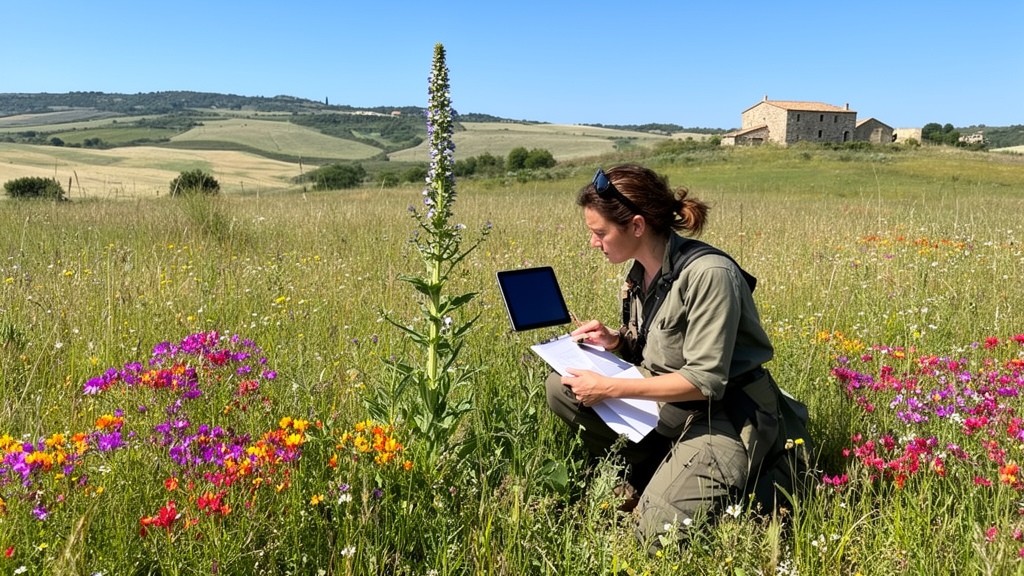
Italy’s botanical map has just been redrawn, at least in its fine details. The sixteenth instalment of the Notulae to the Italian alien vascular flora, published in the journal Italian Botanist, assembles a fresh batch of records, rediscoveries and status changes that together reveal how thoroughly non-native plants are weaving themselves into the country’s landscapes, from Sicilian sidewalks to Sardinian stream banks.
The notula format that underpins this series is a deliberately compact one. Each contribution is capped at roughly a thousand characters, and every claim about a new record or a status change must be anchored to a physical specimen. That specimen, together with a scan or photograph, is deposited at the FI Herbarium housed in the Museum of Natural History’s botany section in Florence, a requirement that turns each short note into a verifiable, citable unit of distributional knowledge. The practice reflects a long tradition in Mediterranean botany, where herbarium vouchers rather than field photographs alone remain the gold standard for documenting the presence of a species in a given territory. It also explains why the notulae appear in instalments rather than as a single monograph: the editors, coordinating records through botanists based in Florence and Milan, aggregate small observations from across the peninsula until they accumulate into a meaningful picture of change.
The distinction between a casual and a naturalized alien species, which recurs throughout the sixteenth instalment, is central to how invasion biologists interpret these records. A casual alien is one that appears sporadically, usually as a consequence of recent introduction, and that persists only through repeated arrivals of new propagules. A naturalized alien, by contrast, has demonstrated the ability to reproduce without human assistance and to sustain self-perpetuating populations over successive generations. The transition between the two categories is not merely semantic. It signals that a species has crossed a reproductive threshold, and it often precedes the further step to invasiveness, in which spread becomes rapid and ecological impacts measurable. Status changes therefore carry practical weight, informing risk assessments, regional watchlists, and the prioritization of management actions by environmental authorities.
Several of the status changes documented in this instalment illustrate how quickly that threshold can be crossed when a species finds suitable conditions. The madagascar rubber vine relative Anredera cordifolia, recorded in Abruzzo along roadsides near Chieti, had been known in the region only as a casual alien, but field surveys in 2022 and 2023 revealed three stable nuclei within a kilometre of one another, each expanding and gradually displacing native vegetation. Its capacity for vegetative propagation through aerial tubers makes it a particularly effective colonizer of ruderal habitats, where disturbance continually opens new ground. Similarly, the ornamental succulent hybrid Kalanchoë × houghtonii in Sardinia has shifted from casual to naturalized status, a change attributed to its remarkable ability to reproduce from leaf propagules that root readily on road margins and other disturbed sites. These examples underline a recurring pattern in Mediterranean invasion ecology: species that combine ornamental popularity with efficient clonal reproduction are disproportionately represented among recent naturalizations.
Urban environments emerge from the records as significant staging grounds for alien establishment. The box elder, Acer negundo, a North American maple long used as a street tree, has now been confirmed as naturalized in Sicily, with young individuals germinating in the cracks of Palermo’s sidewalks and additional plants scattered through residential streets. The finding is notable because Sicily’s warm, dry climate might be expected to limit a species associated with temperate riparian forests, yet urban irrigation, shaded pavements, and the mosaic of microhabitats in a Mediterranean city can collectively mimic the conditions it needs. In Milan, the story of Celtis occidentalis is even more striking. Within a cemetery decommissioned and abandoned in the 1960s, this North American hackberry has formed an uneven-aged stand of roughly four thousand two hundred square metres, with trees regularly fruiting. The site functions as a natural experiment in spontaneous forest succession on urban land, demonstrating how decades of neglect can allow an introduced tree to rebuild an entire stand structure without any planting.
Ornamental horticulture remains the dominant pathway of introduction visible in these records. The majority of the species reported, from the ferny foliage of Gazania rigens on a seaside promenade in Marche to the winter-flowering jasmine Jasminum nudiflorum escaping beneath a castle in the Florentine hills, were originally planted for decoration. The pattern is consistent with global analyses showing that ornamental trade is the single largest source of naturalized plants in temperate regions. What the notulae add is geographic resolution: they show that escape from cultivation is happening not only in major cities but in small towns, along rural roads, and even within protected landscapes. The bamboo Phyllostachys aureus, newly confirmed as naturalized in Sardinia, exemplifies how long a misidentification can obscure the true picture. Populations across several Sardinian regions had been attributed for years to a different bamboo, and only recent surveys revealed that the widespread plant was in fact the running bamboo Phyllostachys aurea, a species notorious elsewhere for its aggressive rhizomatous spread.
Not all introductions are ornamental. The white lupin, Lupinus albus subsp. albus, a crop species cultivated for millennia in the Mediterranean basin, has been upgraded from casual to naturalized in Sicily, where stable populations now persist in the lowland belt of the Madonie mountains despite the fact that the plant has not been commonly grown there for more than three decades. Its persistence suggests feral populations that no longer depend on agricultural sowing, an outcome that raises interesting questions about the persistence of crop gene pools outside cultivation. Tobacco, Nicotiana tabacum, appears as a single individual near a dry channel in Abruzzo, almost certainly a remnant or seedling from past cultivation in a landscape where the crop was once widespread. Such single-plant records are biologically fragile, but they document the continuing rain of propagules from historical and current human activity.
Some records hint at more unexpected dispersal routes. The prickly Alternanthera pungens, found spontaneously flowering in a meadow near Cagliari among Washingtonia palms, was probably introduced accidentally with garden soil, a pathway that is notoriously difficult to monitor because contaminated soil moves with landscaping, construction, and nursery trade. The smooth cypress relative Hesperocyparis glabra, observed regenerating in an artificial conifer plantation on the hills above Turin, represents a different kind of establishment: the plantation itself, dating from the 1920s as a memorial park, has become a source population from which young trees now recruit naturally among the alien conifers. This illustrates how historical plantings, even those made for commemorative rather than ornamental reasons, can seed long-term ecological change.
Fire and disturbance also feature in the background of several records. The Cryptomeria japonica saplings found in a burnt pine plantation in Calabria germinated from seeds of mature ornamental trees nearby, suggesting that fire, by opening the canopy and preparing a seedbed, can facilitate the recruitment of alien species that were previously only present in gardens. The tobacco record in Abruzzo likewise sits within a pine stand affected by a recent fire. These observations align with a growing body of evidence that disturbance regimes, whether from fire, flooding, or construction, create windows of opportunity during which alien species can move from casual presence to genuine establishment.
Geographically, the instalment spans the full latitudinal and climatic range of the country, from alpine Trentino to the shores of Sicily and Sardinia. The appearance of Mazus pumilus, a small creeping herb of East Asian origin, in parking lots and public squares across Trentino shows how a species can spread locally through a network of human-made habitats, each site functioning as a stepping stone. The presence of Lonicera fragrantissima in a riparian woodland in Lombardy, represented by only two individuals, is a reminder that many casual records never progress further, and that distinguishing between transient escape and genuine establishment requires repeated observation over years. The notulae series, by accumulating such observations annually, provides exactly the temporal depth needed to make those distinctions with confidence, and it is this cumulative, specimen-backed, region-by-region accounting that makes the Italian alien flora one of the best-documented in Europe.
Subject of Research: New records and status changes of alien vascular plant species in the Italian flora
Article Title: Notulae to the Italian alien vascular flora: 16
Article References: Galasso, G., Domina, G., Adorni, M., Angiolini, C., Baccheschi, L., Bacchetta, G., Barone, G., Bartolucci, F., Calvia, G., Costantini, S., Cuena-Lombraña, A., De Fine, G., Del Guacchio, E., Di Gristina, E., Fanfarillo, E., Fiaschi, T., Fois, M., Laface, V. L. A., Lallai, A., … Lastrucci, L. (2023). Notulae to the Italian alien vascular flora: 16. Italian Botanist, 16, 73-87. https://doi.org/10.3897/italianbotanist.16.115302
Image Credits: AI Generated
DOI: 10.3897/italianbotanist.16.115302
Keywords: alien flora, invasive species, Italy, vascular plants, floristics, biodiversity, naturalization, botany, Sicilia, Sardegna, Notulae, Italian
Cite Scienmag News
Drew Townsend. (October 19, 2026). Italy’s alien flora grows as botanists log dozens of new records and status upgrades. Scienmag. https://scienmag.com/italys-alien-flora-grows-as-botanists-log-dozens-of-new-records-and-status-upgrades/
Drew Townsend. "Italy’s alien flora grows as botanists log dozens of new records and status upgrades." Scienmag, 19 October 2026, https://scienmag.com/italys-alien-flora-grows-as-botanists-log-dozens-of-new-records-and-status-upgrades/. Accessed 19 October 2026.
Drew Townsend. "Italy’s alien flora grows as botanists log dozens of new records and status upgrades." Scienmag. October 19, 2026. https://scienmag.com/italys-alien-flora-grows-as-botanists-log-dozens-of-new-records-and-status-upgrades/


