


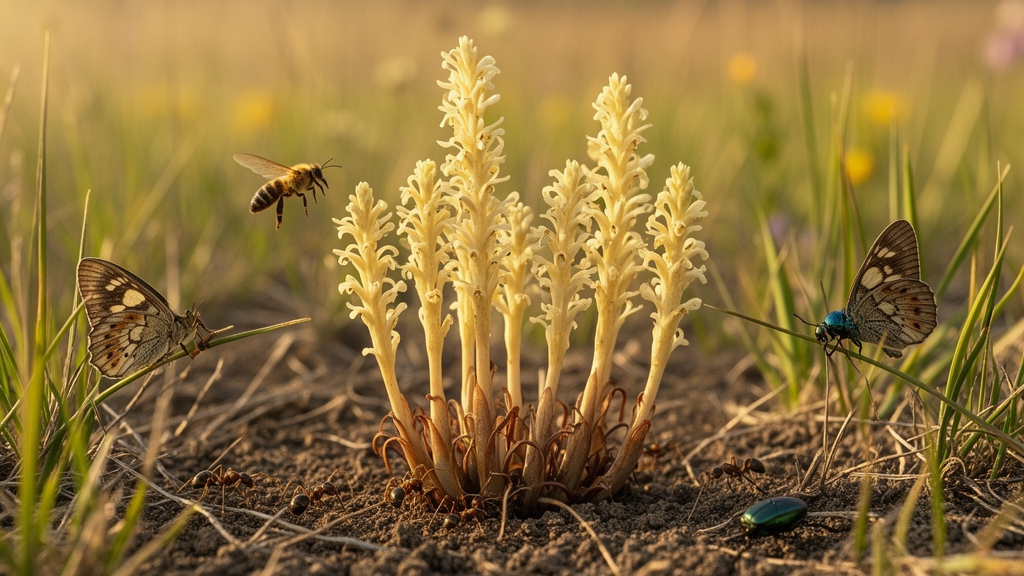
Plants that have abandoned photosynthesis entirely are among the strangest organisms in the plant kingdom, and a new global study reveals that they are also far more important to animals than anyone suspected. A team led by researchers at Jan Kochanowski University in Kielce, Poland, has compiled the first worldwide synthesis of the animals associated with holoparasitic plants of the family Orobanchaceae, the largest parasitic plant family. Drawing on nearly twenty years of fieldwork, DNA barcoding, literature reviews and public biodiversity databases, the study assembled more than 1,370 observations from 76 countries across five continents, documenting 667 animal species from 34 orders, 163 families and 434 genera interacting with 130 species across 16 holoparasitic genera.
Holoparasitic Orobanchaceae, which include the familiar broomrapes of the genus Orobanche as well as genera such as Cistanche, Phelipanche, Phelypaea, Aphyllon, Hyobanche and Lathraea, are achlorophyllous plants that draw all their water and nutrients from the roots of their hosts through specialised organs called haustoria. Because they cannot photosynthesise, they appear above ground only as fleshy, often brilliantly coloured flowering shoots, and many are rare, endangered or, in agricultural settings, notorious weeds. Until now, knowledge of the animals that visit, feed on, shelter in or develop inside these plants has been scattered across isolated reports, mostly concerning a handful of pest insects and occasional pollinator sightings.
The new database shows that arthropods dominate the associated fauna, accounting for roughly 91 percent of recorded species. Within this group, Hymenoptera, the order containing bees, wasps and ants, is by far the largest, with 198 species recorded, followed by Diptera with 72, Coleoptera with 115, Hemiptera with 70, and spiders with 50. Beyond insects, snails and slugs of the order Stylommatophora make up about 4 percent of species, while mammals, birds and reptiles contribute small but ecologically striking numbers of records. The plants most frequently exploited were Orobanche, Phelipanche and Cistanche, which together attracted the richest and most diverse visitor assemblages.
Pollination emerges as a central theme. Bees, particularly bumblebees of the genus Bombus and sweat bees of the genus Lasioglossum, are the primary pollinators across most of the family’s range, visiting tubular, bilabiate flowers that offer nectar deep within the corolla. The study also documents more surprising pollination systems. In southern Africa, red-flowered species of Phelypaea are pollinated by glaphyrid beetles of the genus Pygopleurus, apparently lured by dark spots on the petals that mimic beetle elytra, a likely case of deceptive sexual mimicry. Hawkmoths of the genus Hyles pollinate Cistanche in the Mediterranean and southwest Asia, and on the oceanic Bonin Islands of Japan the endemic Orobanche boninsimae is pollinated by passerine birds, a rare shift from insects to birds within the genus.
Herbivory is equally pervasive. The monophagous fly Phytomyza orobanchia mines stems and seed capsules of dozens of broomrape species and can reduce seed production by 30 to 80 percent, making it one of the most effective biological control agents against invasive broomrapes, though it also attacks rare and endangered relatives. Hoverfly larvae of the genus Eumerus burrow into the massive tubers and stems of Cistanche species in desert and semi-desert habitats, sometimes devastating populations of endangered endemics such as Cistanche armena. Aphids, thrips, beetle larvae and moth caterpillars all feed on the succulent tissues, and florivorous caterpillars can destroy large proportions of flowering populations, as observed with Ammoconia senex on Phelypaea coccinea in Georgia.
The plants also function as hunting grounds and shelters, creating multitrophic webs that extend well beyond simple plant-insect pairs. Crab spiders of the family Thomisidae ambush flower visitors, orb-weavers anchor their webs to stiff inflorescence shoots, and mildly venomous spiders of the genus Cheiracanthium build silken retreats inside the large red flowers of Phelypaea. Dense glandular trichomes trap small flies and aphids, providing carrion for predators, a phenomenon the authors suggest may be a widespread indirect defence strategy in these plants. Ants are ubiquitous visitors, tending aphids for honeydew on both above-ground and underground plant parts, and in some cases nesting in tunnels excavated by mining larvae in the fleshy stems of Cistanche.
Seed ecology adds another layer of complexity. Holoparasitic Orobanchaceae produce some of the smallest seeds in the plant world, and their dispersal has traditionally been attributed to wind and water. The new synthesis highlights evidence that animals matter too: camel crickets and ground beetles disperse viable seeds of Phacellanthus tubiflorus in Japanese forest understoreys, deer pass viable seeds of Conopholis americana through their digestive tracts, ants may disperse seeds of Lathraea squamaria, the only known elaiosome-bearing holoparasite in the family, and slugs have been shown to swallow and defecate undamaged seeds of the same species. Bears, meanwhile, consume flowering shoots of Conopholis and Boschniakia in North America, with squawroot making up as much as 10 to 15 percent of the diet of bears in the southern Appalachians in spring.
Molecular tools played a key role in the study. The team generated 355 mitochondrial COI barcode sequences from 469 specimens using both Sanger sequencing and Oxford Nanopore technology, assigning them to 141 Barcode Index Numbers, 24 of them unique. DNA barcoding proved indispensable for identifying eggs, larvae and pupae that could not be determined morphologically, and the high proportion of unique BINs in the Caucasus, 19 of 24, hints at substantial undiscovered diversity in this hotspot of holoparasite evolution. The authors note that several divergent lineages within Phytomyza orobanchia may represent distinct species awaiting formal description.
Placing the results in an evolutionary framework, the researchers compared visitor assemblages across the three clades in which holoparasitism arose independently within Orobanchaceae. The oldest and most species-rich clade, Orobancheae, is dominated by hymenopteran visitors and shows the highest taxonomic richness. The intermediate clade Buchnereae, which includes the southern African genera Hyobanche and Harveya, displays the greatest heterogeneity, with substantial contributions from gastropods, birds and mammals, consistent with mixed pollination syndromes and transitions between insect, bird and mammal pollination. The youngest clade, containing only Lathraea, is pollinated almost exclusively by bumblebees. These patterns suggest that pollination evolution in holoparasites may have been non-synchronous and linked to shifts in host plants, habitats and phenology.
The study also carries conservation implications. Most holoparasitic species are completely dependent on their hosts and on specific pollinators, making them vulnerable to environmental change, and pollinator declines worldwide threaten the reproduction of species that rely on bumblebees and other insects. At the same time, the authors identify major knowledge gaps: nearly 60 percent of holoparasitic species have no recorded animal associates, and entire genera such as Eremitilla, Gleadovia and Mannagettaea remain unstudied. By demonstrating that these leafless parasites sustain pollinators, herbivores, predators, parasitoids, detritivores and even large mammals, the research establishes holoparasitic Orobanchaceae as keystone components of terrestrial ecosystems whose protection requires safeguarding not just the plants and their hosts, but the intricate animal networks they support.
Subject of Research: Global diversity of animal interactions with holoparasitic plants of the family Orobanchaceae
Article Title: A multiverse of trophic networks and coevolutionary trajectories among holoparasitic Orobanchaceae and their animal associates: a global perspective
Article References: Piwowarczyk, R., Wiśniewska, K., Rewicz, T., Olbrycht, T., Salata, S., Fateryga, A. V., Nicewicz, Ł., Depa, Ł., Zając, K., Masarovič, R., Celary, W., Mielczarek, Ł., & Mátis, A. (2026). A multiverse of trophic networks and coevolutionary trajectories among holoparasitic Orobanchaceae and their animal associates: a global perspective. PhytoKeys, 275, 209-297. https://doi.org/10.3897/phytokeys.275.192014
Image Credits: AI Generated
DOI: 10.3897/phytokeys.275.192014
Keywords: Orobanchaceae, holoparasitic plants, broomrapes, pollination, herbivory, coevolution, DNA barcoding, plant-animal interactions, Phytomyza orobanchia, bumblebees, seed dispersal, biodiversity
Cite Scienmag News
Margaret Porter. (October 19, 2026). Broomrapes as Biodiversity Hubs: First Global Map of the Animal Worlds Surrounding Holoparasitic Plants. Scienmag. https://scienmag.com/broomrapes-as-biodiversity-hubs-first-global-map-of-the-animal-worlds-surrounding-holoparasitic-plants/
Margaret Porter. "Broomrapes as Biodiversity Hubs: First Global Map of the Animal Worlds Surrounding Holoparasitic Plants." Scienmag, 19 October 2026, https://scienmag.com/broomrapes-as-biodiversity-hubs-first-global-map-of-the-animal-worlds-surrounding-holoparasitic-plants/. Accessed 19 October 2026.
Margaret Porter. "Broomrapes as Biodiversity Hubs: First Global Map of the Animal Worlds Surrounding Holoparasitic Plants." Scienmag. October 19, 2026. https://scienmag.com/broomrapes-as-biodiversity-hubs-first-global-map-of-the-animal-worlds-surrounding-holoparasitic-plants/


