


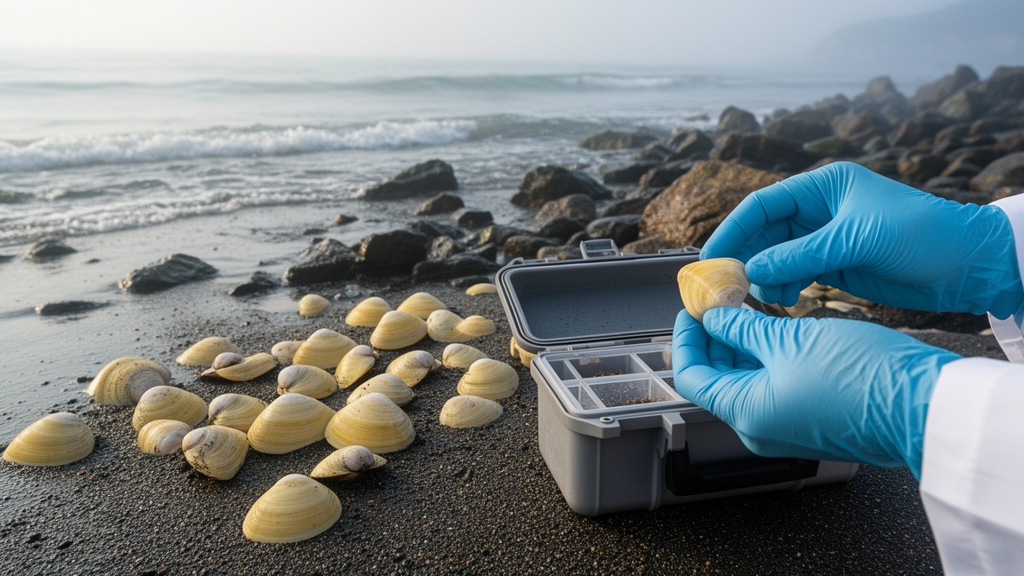
Polycyclic aromatic hydrocarbons, a family of persistent organic pollutants born from combustion and petroleum, are among the most troubling contaminants in the world’s seas. A new study of the Bulgarian Black Sea coast has now provided the first comprehensive picture of how much of this pollution is accumulating in the tissues of a small but commercially important bivalve: the wedge clam, Donax trunculus. The research, published in the journal BioRisk, measured thirteen PAH compounds in clams collected from twenty sampling points between May 2019 and September 2020, and its findings carry implications both for environmental monitoring and for the safety of seafood harvested from the region.
Marine bivalves have long been favored as bioindicators of pollution, and for good reason. Because they feed by filtering large volumes of phytoplankton and suspended particulate matter, they rapidly accumulate lipophilic contaminants such as PAHs, polychlorinated biphenyls, pesticides and heavy metals in their soft tissues. The wedge clam is particularly well suited to this role along the Bulgarian coast, where it dominates fine sandy habitats of the upper infralittoral subzone, typically between 1.0 and 6.5 meters depth, exposed to intense wave action and constant fluctuation of abiotic conditions. Although local consumers do not traditionally eat wedge clams, the species is increasingly harvested with dredges for export, driven by high prices on foreign markets, which makes its contaminant burden a matter of direct human-health relevance.
The research team gathered two to three kilograms of adult clams of similar shell length, averaging about 2.1 centimeters, from each location, spanning sites from Varna Bay in the north to Tsarevo and Elenite in the south. Soft tissues were removed, homogenized into 250-gram samples and stored at minus 20 degrees Celsius until analysis. Ten grams of homogenized tissue from each sample were spiked with internal standards, extracted with a hexane and dichloromethane mixture in a Soxhlet extractor for sixteen hours, and cleaned up on a multilayer silica column before being concentrated and reconstituted in hexane for instrumental analysis.
Quantification was performed by gas chromatography coupled with an ion-trap mass spectrometer, using a TG-5 ms capillary column and helium as carrier gas. The thirteen target compounds included acenaphthylene, fluorene, phenanthrene, anthracene, pyrene, benz[a]anthracene, chrysene, benzo[b]fluoranthene, benzo[k]fluoranthene, benzo[a]pyrene, benzo[ghi]perylene, indeno[1,2,3-cd]pyrene and dibenzo[a,h]anthracene. Each sample was analyzed in triplicate, procedural blanks were run between every five samples to monitor laboratory contamination, and limits of detection for individual compounds ranged from 0.075 to 0.294 nanograms per gram wet weight, based on three times the standard deviation of low-concentration measurements.
The results revealed a coast that is measurably, though not alarmingly, contaminated. Total PAH content, summed across the thirteen compounds, ranged from 5.59 to 50.50 nanograms per gram wet weight, a level the authors describe as comparable with other European studies. Phenanthrene was the dominant compound everywhere, ranging from 3.24 to 48.22 nanograms per gram, followed by fluorene. Four of the thirteen target PAHs appeared in almost all samples, while acenaphthylene, anthracene, benzo[a]anthracene, indeno[1,2,3-cd]pyrene and dibenzo[a,h]anthracene fell below detection limits throughout. The most carcinogenic of the group, benzo[a]pyrene, was detected in only 20 percent of the analyzed samples, with a mean of 1.30 nanograms per gram.
Perhaps the most diagnostic finding concerns the composition of the PAH mixture. Low molecular weight compounds with two and three aromatic rings accounted for 91 percent of the total, while high molecular weight compounds with four, five and six rings made up only about 8.9 percent on average. Because low molecular weight PAHs are characteristic of petrogenic sources, such as diesel and fuel oil spills, whereas high molecular weight compounds arise mainly from incomplete combustion of organic matter, the ratio between the two classes points to the origin of pollution. In this study the low-to-high molecular weight ratio was far above one, with a mean of 17.61, strongly indicating that petroleum, not combustion, is the principal source of PAH contamination along the Bulgarian Black Sea coast.
Geography told its own story. The highest total PAH burden appeared in clams from Tsarevo, at 87.29 nanograms per gram wet weight, followed by Arkutino and Nessebar, while the cleanest samples came from Elenite, at just 5.59 nanograms per gram. Elevated levels at Arkutino and Duni were most plausibly linked to the 2018 oil spill from the sunken ship SS Mopang near Sozopol, an interpretation reinforced by the strongly petrogenic molecular ratios measured in clams from those locations. Elevated benzo[a]pyrene in Varna Bay clams, meanwhile, reflected the ecological pressure of intensive maritime traffic and industrial activity around the harbor. The authors also suggest that discharges from the Danube River, carrying degraded petroleum and fresh oil, may explain why phenanthrene levels were significantly higher in clams from the northern coastal section than in the south.
Seasonal patterns added further nuance. The sum of the four regulated PAHs was significantly higher in autumn, with the difference significant for autumn 2019, while total PAHs peaked significantly in summer compared with spring 2020 and the autumn sampling periods. Low molecular weight PAH accumulation was lower in autumn, whereas high molecular weight compounds were higher, again significantly for autumn 2019. These shifts likely reflect the interplay of tourist-season traffic, weather-driven resuspension of contaminated sediments and the clams’ own seasonal physiology and lipid dynamics, which are known to modulate how lipophilic pollutants are retained in bivalve tissue.
From a regulatory standpoint, the news is reassuring. European Commission Regulation n.835/2011 sets an admissible limit of 35 nanograms per gram wet weight for the sum of benzo[a]pyrene, chrysene, benzo[a]anthracene and benzo[b]fluoranthene, known as Sum PAH4, in bivalve species. In the Bulgarian wedge clams, Sum PAH4 ranged only from 0.72 to 5.93 nanograms per gram, well below the legal threshold, with the highest value recorded in industrial Varna Bay and the lowest at Shkorpilovtsi, Primorsko and Elenite, sites far from urbanized and industrial areas. Benzo[a]pyrene, classified by the International Agency for Research on Cancer as a Group 1 carcinogen, never exceeded its admissible limit of 6 nanograms per gram, despite being detected in a fifth of samples.
The study also places the Bulgarian coast in a broader European context. Comprehensive PAH data for wedge clams are scarce; most published work concerns the Mediterranean mussel, Mytilus galloprovincialis, and the only substantial comparable wedge clam study comes from the Mediterranean Sea, where PAH levels of 247.4 nanograms per gram wet weight were reported, roughly fifty times higher than the 4.75 nanograms per gram mean found off Bulgaria. Earlier Black Sea work on bivalves from the Crimean Peninsula, Sevastopol Bay and the Turkish coast had already signaled regional contamination, and the new data confirm that pattern while showing that the Bulgarian stretch remains comparatively moderate. The authors conclude that the wedge clam can serve as a practical bioindicator for tracking PAH pollution levels and assessing the risk of human exposure along the coast, providing a baseline against which future changes, whether from shipping, tourism or accidental spills, can be measured.
Subject of Research: Bioaccumulation of polycyclic aromatic hydrocarbons in wedge clams as bioindicators of Black Sea coastal pollution
Article Title: Assessment of PAHs accumulation in Donax trunculus (Linnaeus, 1758) ( Bivalvia , Donacidae ) from the Bulgarian Black Sea Coast
Article References: Georgieva, S. K., Stancheva, M. D., Peteva, Z. V., Ivanova, T. I., & Alexandrova, A. V. (2022). Assessment of PAHs accumulation in Donax trunculus (Linnaeus, 1758) (Bivalvia, Donacidae) from the Bulgarian Black Sea Coast. BioRisk, 17, 95-104. https://doi.org/10.3897/biorisk.17.77343
Image Credits: AI Generated
Keywords: polycyclic aromatic hydrocarbons, wedge clam, Donax trunculus, Black Sea, bioindicators, petrogenic pollution, bivalves, benzo[a]pyrene, marine pollution, food safety, gas chromatography mass spectrometry, Bulgaria
Cite Scienmag News
Reese Ellison. (October 19, 2026). Wedge Clams Reveal Petrogenic PAH Pollution Along the Bulgarian Black Sea Coast. Scienmag. https://scienmag.com/wedge-clams-reveal-petrogenic-pah-pollution-along-the-bulgarian-black-sea-coast/
Reese Ellison. "Wedge Clams Reveal Petrogenic PAH Pollution Along the Bulgarian Black Sea Coast." Scienmag, 19 October 2026, https://scienmag.com/wedge-clams-reveal-petrogenic-pah-pollution-along-the-bulgarian-black-sea-coast/. Accessed 19 October 2026.
Reese Ellison. "Wedge Clams Reveal Petrogenic PAH Pollution Along the Bulgarian Black Sea Coast." Scienmag. October 19, 2026. https://scienmag.com/wedge-clams-reveal-petrogenic-pah-pollution-along-the-bulgarian-black-sea-coast/


