


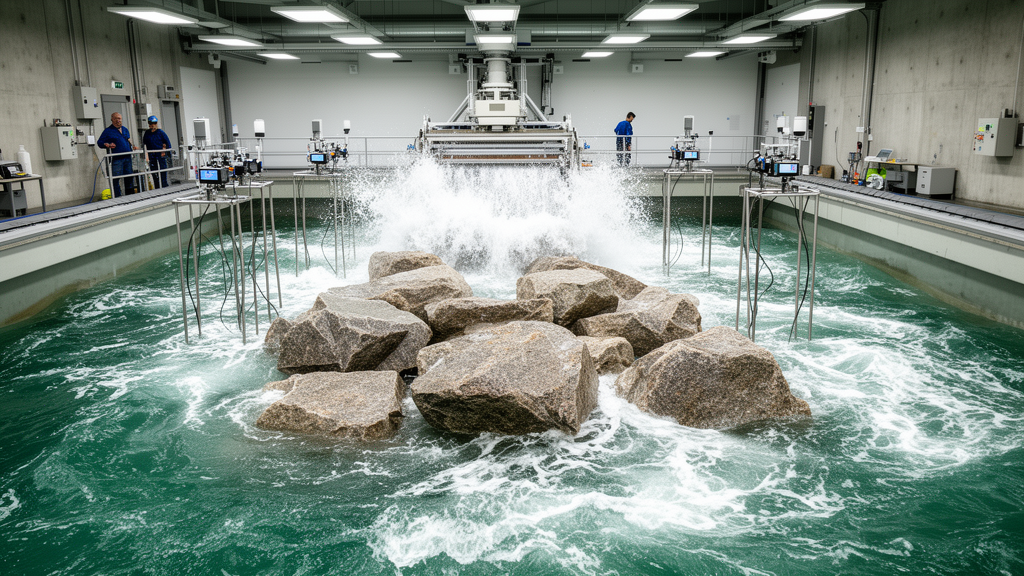
On the storm-battered cliffs of Ireland’s Aran Islands, limestone boulders weighing tens or even hundreds of tonnes sit perched on clifftops, hundreds of metres from where they began. For decades, scientists have debated what kind of waves could have moved such enormous masses, and whether the culprit was a tsunami or simply an exceptionally violent storm. Now, a team of researchers has brought the problem into the laboratory, using a wave tank to fit the hidden numbers inside the equations that govern boulder transport, and their findings could change how coastal hazard is assessed around the world.
The new study, published in Frontiers in Marine Science by James G. Herterich, Sara Rafter, and Rónadh Cox of University College Dublin and Williams College, tackles a deceptively simple question: when a model says a storm wave can move a boulder, how much should we trust it? The answer, it turns out, depends heavily on two things that most existing models treat crudely or ignore altogether: the shape of the boulder and the style of the wave impact.
Coastal boulder deposits are among the most dramatic archives of extreme wave activity on rocky shorelines. They occur from the tops of cliffs up to 50 metres above sea level to the backs of shore platforms hundreds of metres inland, and individual clasts can weigh from a few tonnes to hundreds of tonnes. Early studies assumed such masses were far beyond the reach of ordinary storms and must have been emplaced by tsunamis. But accumulating before-and-after imagery has since demonstrated that storm waves can and do transport these boulders, and with extreme wave events projected to become more common as the climate warms, understanding what the deposits record has taken on real urgency.
The mathematical models used to reconstruct past wave conditions from boulder positions rest on a force balance: drag, lift, inertia, gravity, buoyancy, and friction all compete to move or hold the clast. Each force carries a coefficient, and each coefficient has historically been assigned a constant value drawn from whatever literature the authors could find. The drag coefficient, for example, has been variously taken as 1.2, 1.95, or 2.0 in different studies, while the lift coefficient almost universally traces back to a 1949 experiment on fine pebbles in a shallow flume, a setting far removed from the turbulent, supercritical flows that batter coastal platforms. Friction coefficients are typically set at 0.7, even though measured values as low as 0.4 have been reported and the coefficient must in reality vary with the mode of motion, whether sliding, rolling, or saltation.
Gathering field data to constrain these numbers is extraordinarily difficult. Overtopping flows on steep coasts are multiphase, turbulent, and often supercritical, with Froude numbers routinely exceeding unity and reaching as high as 4.04 in recent accelerometer-based measurements on Inishmaan, Ireland. Wave runup is amplified nonlinearly by interactions between waves, cliffs, and bathymetry, so the flows that reach clifftop boulders can be several times larger than the incoming swell. This is precisely why controlled wave tank experiments add so much value: they allow researchers to measure everything that matters, repeatedly, under known conditions.
The team used data from dynamically scaled, Froude-balanced experiments at the Queen’s University Belfast wave tank, where a 1:100 scale model of the Aran Islands coastline featured a 10-metre cliff, a clifftop platform, and waves generated with a JONSWAP spectrum corresponding to 12-metre significant wave heights at full scale. Limestone pebbles a few centimetres across stood in for metre-scale prototype boulders, with the largest model clast equivalent to a 453-tonne boulder in the real world. From the campaign, the researchers isolated 41 transport events in which nine different boulders, including both machined rectangular blocks and natural pebbles collected from the Aran Islands, were moved by simple sliding. Each event came with a full record of boulder geometry, flow speed and depth at impact, observed impact type, and transport distance.
Crucially, the experiments captured two mechanically distinct styles of overtopping flow. In hammer-fist impacts, the collapsing water mass slams down onto the platform with severe loads, while dam-break impacts produce a smoother, collapsing sheet of green water. Of the 41 events, 25 were hammer-fist, 12 were dam-break, and the remainder were transitional or plunging. The researchers then fitted two model formulations to the displacement data: one that absorbed all the variability between experiment runs into effective fitting parameters, and a second that explicitly incorporated the measured flow characteristics, allowing predictions to vary with each event’s Froude number and flow depth.
The results revealed a clear hierarchy of reliability. Drag and friction coefficients came out consistent across nearly all groupings and fell within established ranges, suggesting these parameters are comparatively robust and can be constrained from transport data. The inertia coefficient, by contrast, proved acutely sensitive to model structure: it could not be resolved at all when experiment variability was fully embedded in the model, but converged to consistent values between roughly 0.64 and 0.76 when wave parameters were explicitly prescribed. This matters because inertia is often omitted from boulder transport models on the assumption that it is small, yet it becomes important for accelerations above about 2.5 metres per second squared, exactly the kind found in the bore fronts of overtopping waves.
The most striking finding concerned boulder shape. When the researchers split the boulders by flatness index, grouping cubic clasts separately from elongated and flat ones, the elongated group demanded drag coefficients roughly 50 percent lower and lift coefficients roughly 50 percent higher than the cubic group, along with inertia effects about twice as large in the explicit model. This echoes field observations after Super Typhoon Haiyan, where cubic boulders were transported greater distances than elongated ones and numerical models struggled to match what was seen on the ground. Meanwhile, for dam-break impacts, the lift coefficient came out as zero in both model formulations, indicating that this style of flow provides essentially no upward force on a sliding clast.
The broader lesson is that fitting a model to data and interpreting it physically are not the same problem. Two formulations reproduced the observed transport distances with similar accuracy while implying substantially different physics, and sensitivity analysis showed that uncertainty is greatest for the restorative force, which depends on boulder size and frictional interaction. For anyone reconstructing extreme wave conditions from coastal boulder deposits, the message is unambiguous: shape-dependent hydrodynamic coefficients must be accounted for explicitly, or model-based estimates of the waves that moved the boulders will carry systematic bias. As storms intensify in a warming world, the boulders scattered across the world’s rocky coasts are keeping score, and now scientists have a better toolkit for reading what they have written.
Subject of Research: Parameter fitting for coastal boulder transport models using wave tank experiments
Article Title: Parameter fitting for boulder transport with wave tank experiments
Article References: Herterich, J. G., Rafter, S., & Cox, R. (2026). Parameter fitting for boulder transport with wave tank experiments. Frontiers in Marine Science, 13, Article 1974801. https://doi.org/10.3389/fmars.2026.1974801
Image Credits: AI Generated
DOI: 10.3389/fmars.2026.1974801
Keywords: boulder transport, coastal boulder deposits, extreme waves, wave tank experiments, drag coefficient, lift coefficient, friction, parameter fitting, coastal hazards, storm waves, hydrodynamics, Aran Islands
Cite Scienmag News
Violet Maxwell. (October 19, 2026). Wave Tank Experiments Reveal How Boulder Shape Rewrites Storm Wave Models. Scienmag. https://scienmag.com/wave-tank-experiments-reveal-how-boulder-shape-rewrites-storm-wave-models/
Violet Maxwell. "Wave Tank Experiments Reveal How Boulder Shape Rewrites Storm Wave Models." Scienmag, 19 October 2026, https://scienmag.com/wave-tank-experiments-reveal-how-boulder-shape-rewrites-storm-wave-models/. Accessed 19 October 2026.
Violet Maxwell. "Wave Tank Experiments Reveal How Boulder Shape Rewrites Storm Wave Models." Scienmag. October 19, 2026. https://scienmag.com/wave-tank-experiments-reveal-how-boulder-shape-rewrites-storm-wave-models/


