

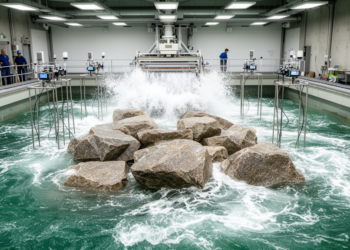
Wave Tank Experiments Reveal How Boulder Shape Rewrites Storm Wave Models
Wave tank experiments show that boulder shape and wave impact type exert first-order controls on the hydrodynamic coefficients used to ...
Wave tank experiments show that boulder shape and wave impact type exert first-order controls on the hydrodynamic coefficients used to ...

When carbon dioxide is squeezed past 74 bar and warmed above 31 degrees Celsius, it stops behaving like an ordinary ...
A new topological interlocking metamaterial converts axial compression into torsional sliding, dissipating energy through amplified friction while recovering its shape ...
Every time an engine starts, a hidden molecular drama unfolds on its metal surfaces. As lubricants grow thinner in the ...
Researchers have built a hybrid machine learning framework that predicts how graphene-enhanced grease heats up, wears down, and transitions between ...
Experiments and simulations reveal that frictional interfaces under shock loading activate globally and emit discrete, quantized longitudinal wave packets that ...
A week-long oscillating tribology study shows lubricant-filled microcapsules in polyoxymethylene cut friction by 37 percent and wear by 88 percent ...
By pairing friction experiments with sample-specific computer models of human knee cartilage, researchers show that brief lift-off phases sustain the ...
A new finite element model is the first to accurately simulate both sliding and gripping oblique impacts of softballs, showing ...
A new triboinformatics study uses gradient boosting, deep learning, and interpretable AI to accurately predict wear and friction in Nitinol ...

Embark on a thrilling journey of discovery with Scienmag.com—your ultimate source for cutting-edge breakthroughs. Immerse yourself in a world where curiosity knows no limits and tomorrow’s possibilities become today’s reality!