


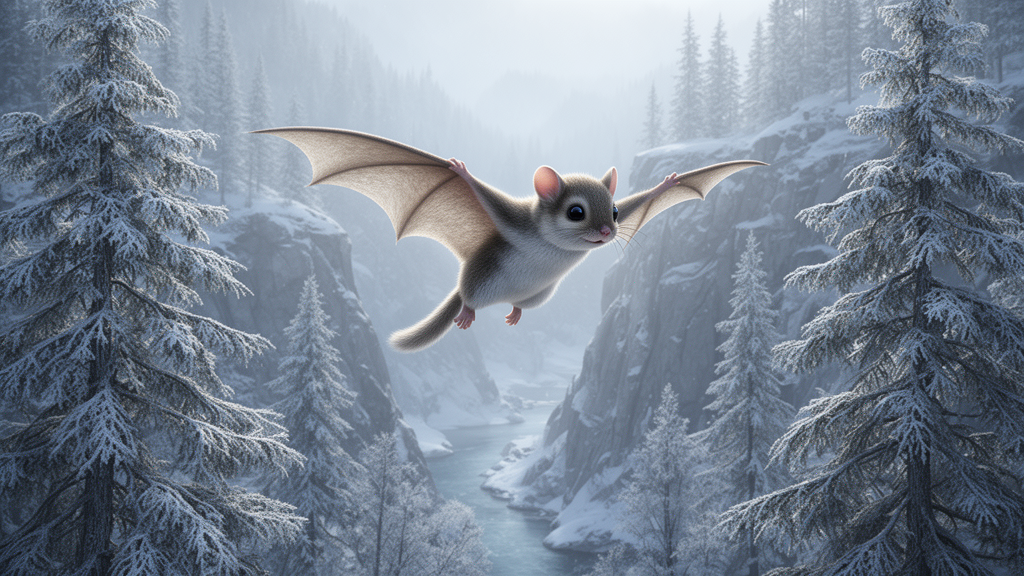
Deep inside a limestone hill in Wushan County, Chongqing Municipality, a cave called Yumidong has yielded one of the richest collections of fossil flying squirrels ever assembled from the Chinese Quaternary. A new study published in Fossil Record identifies four species from four genera among the Mid-Late Pleistocene remains: Pteromys volans, Trogopterus xanthipes, Belomys pearsonii and Aeretes melanopterus. The finding matters far beyond taxonomy. Because flying squirrels are strictly arboreal gliders tied to forest canopies, their presence in cave deposits acts as a biological archive of the trees that once surrounded the cave, and the Yumidong assemblage records a landscape that swung between cold coniferous forest and warmer mixed woodland as ice ages came and went.
The Yumidong Cave sits at about 1100 meters above sea level in the Miaoyu Basin at the northern foot of the Wushan Mountains, roughly four kilometers from the famous Longgupo Cave, a site central to Quaternary paleontology in China. The cave is a horizontal karst feature developed in limestone, and its stratigraphic sections interbed sandy clay with limestone breccia, recording alternating warm and cool phases that researchers have correlated with marine isotope stages from MIS 8 down to MIS 1. Dating results and faunal comparisons place the fossil-bearing layers in the Mid-Late Pleistocene. Flying squirrels rank among the most abundant groups in the mammalian fauna collected there, giving paleontologists excellent material for detailed morphological comparison of a group that has often suffered from misidentification in earlier studies.
The largest and most abundant species in the assemblage is Pteromys volans, the Siberian flying squirrel, a Palaearctic cold-adapted glider that today ranges from northeast Europe to the Korean Peninsula and Hokkaido. Specimens are plentiful in the cave, making up 9 percent of small mammalian fossils in layer ②-2 and a striking 46 percent in layer ④. The mandibles are very short, with length close to height, and carry a particularly marked angular process wider than the ascending ramus. The cheek teeth are brachyodont, with P3 small but bearing differentiated cusps, P4 fully molarised, and M3 lacking a metaloph and metaconule. On lower teeth, the mesoconid and entoconid are permanent, the trigonid basin remains open, and m3 is conspicuously elongated. These features distinguish the Yumidong material from other small Pleistocene flying squirrels of south China, such as Hylopetes electilis with its pitted cheek tooth enamel, and from the Early Pleistocene Pteromys huananensis known only from Longgupo Cave.
Trogopterus xanthipes, the complex-toothed flying squirrel endemic to China, is the second species identified. It still survives in the region today, living from temperate subalpine coniferous forest to subtropical broad-leaved forest at altitudes of 1360 to 2750 meters. The Yumidong mandibles are high and strong, with a deep pterygoid muscle fossa and a vascular notch that is extensive. The upper cheek teeth carry a well-developed mesostyle connecting paracone and metacone, an enlarged metaconule, and numerous cristae dividing the anterior and posterior valleys into several enamel loops. Lower molars develop metalophids and folds in the talonid basin, making the occlusal surface more complex than that of p4. The genus is diagnosed by this complex dentition and by size: Trogopterus is significantly larger than its closest relative Belomys, with almost no overlap in cheek tooth measurements.
Belomys pearsonii, the hairy-footed flying squirrel, is the third species. It is widely distributed today in south China, northeastern South Asia and Southeast Asia, but has completely disappeared from the Wushan area, although subfossils were reported from the Neolithic Dahekou site in Chongqing. The mandible and teeth closely resemble Trogopterus xanthipes, but the species is much smaller and more lower-crowned. Several dental differences separate the two: P3 of Belomys sits closer to the protocone of P4; the protocone of P4-M2 is more developed while the hypocone is weaker; and the hypocone and metaloph of M3 are absent, whereas in Trogopterus the hypocone is permanent and connects with the metaconule by a straight metaloph. Within the genus, the Early Pleistocene Belomys parapearsoni is smaller with a lower crown, and the Thai Late Pleistocene Belomys thamkaewi falls within the size range of Chinese fossil B. pearsonii, so the Yumidong material is confidently assigned to B. pearsonii.
The fourth species, Aeretes melanopterus, is the largest flying squirrel in the assemblage and one of the rarest mammals in China today, confined to the northeastern Qinghai-Tibet Plateau, the Hengduan Mountains, the Qinling Mountains and a small population near Beijing. It inhabits coniferous and broad-leaved mixed forest at 2500 to 3000 meters and nests on high trees. The Yumidong mandible is robust with a short diastemal portion, and the cheek teeth are subhypsodont with slightly rugose enamel, the lingual wall of upper teeth higher than the buccal wall. P4 is molariformed and triangular in outline, with a small protocone separated from the developed hypocone by a vertical anterolingual flexus extending to the crown base. The genus differs from Petaurista, whose M1/2 lacks a hypocone, and the Yumidong specimens fall within the size and morphological variation of the living species, though they are smaller than Pleistocene specimens from the Tianyuan Cave in Beijing.
Reading these four species together as environmental indicators produces a clear paleoecological signal. All four can adapt to coniferous and broad-leaved mixed forest and alpine coniferous forest, but Pteromys volans and Aeretes melanopterus are cold-adapted Palaearctic species that have completely vanished from the study area and its vicinity. Both were excavated mainly from layer ②-2 and layer ④, the cool phases correlated with MIS 2 and MIS 4, and neither appears in layers ③ and ⑤, the warm phases of MIS 3 and MIS 5. The conclusion is that during MIS 2 and MIS 4 the area around Yumidong Cave was dominated by subalpine evergreen coniferous forest or coniferous and broad-leaved mixed forest, colder and richer in conifers than today, resembling the vegetation now found on Wushan peaks above 2000 meters. During MIS 3 and MIS 5 the landscape was similar to the present subtropical environment.
The regional extinction of the cold-adapted species follows a pattern the authors trace through the glacial-interglacial cycle. Cold-adapted flying squirrels spread southwards during glacial periods and disappeared from the area during interglacials. They likely occupied the middle zone of the Wushan Mountains during the latest Pleistocene or the Last Glacial Maximum, but when the Holocene Megathermal arrived, their habitats contracted to higher peaks. Those limited ecological spaces could not sustain viable populations, and the squirrels died out regionally. Nearby caves reinforce the picture of vertical zonation controlling faunal divergence: Baotansi Cave at about 820 meters shares the same species combination, while Migong Cave at only 160 to 200 meters records a cool but sparser forest with no flying squirrel fossils at all, showing that altitude differences within the same period produced different habitats across the Three Gorges area.
The study also corrects earlier records that seemed to show cold-adapted flying squirrels surviving into the Holocene. Re-examination of material from the Dahekou Neolithic site in Fuling District shows that specimens originally identified as Trogopterus xanthipes should be Belomys pearsonii, that the records of Petaurista petaurista and Aeretes melanopterus appear to be an undetermined Petaurista species, and that the material called Hylopetes alboniger actually belongs to the subfamily Sciurinae and resembles Tamiops swinhoei. Current evidence therefore cannot demonstrate that Pteromys volans, Trogopterus xanthipes or Aeretes melanopterus persisted from the Last Glacial through the Holocene in the Three Gorges area, sharpening the extinction timeline for the cold-adapted fauna.
With four species of four genera identified from abundant maxillae, mandibles and isolated teeth, Yumidong Cave now stands as one of the richest flying squirrel localities of the Chinese Quaternary, and the detailed morphological descriptions set a new standard for a group long neglected in Pleistocene faunal lists. The assemblage demonstrates how a single cave sequence can track the interplay between climate oscillation, vertical mountain zonation and regional extinction. As ice ages deepened, coniferous forest climbed down the slopes and cold-adapted gliders followed; as warmth returned, the forest retreated upward and the squirrels with it, until the Holocene Megathermal pushed their refugia beyond the limits of survival. The fossil teeth of Yumidong thus preserve not just species but the rhythm of forests rising and falling across the mountains of the Three Gorges.
Subject of Research: Pleistocene flying squirrel fossils from Yumidong Cave, China
Article Title: Fossil flying squirrels ( Petauristinae , Sciuridae , Rodentia ) from the Yumidong Cave in Wushan County, Chongqing, China
Article References: Pang, L.-B., Chen, S.-K., Hu, X., Wu, Y., & Wei, G.-B. (2024). Fossil flying squirrels (Petauristinae, Sciuridae, Rodentia) from the Yumidong Cave in Wushan County, Chongqing, China. Fossil Record, 27(1), 209-219. https://doi.org/10.3897/fr.27.115693
Image Credits: AI Generated
DOI: 10.3897/fr.27.115693
Keywords: flying squirrels, Yumidong Cave, Pleistocene, paleoenvironment, China, Fossil Record, extinction, Petauristinae, Fossil, flying, squirrels, Sciuridae
Cite Scienmag News
Sloane Callahan. (October 19, 2026). Ice Age Flying Squirrels Reveal Cold Forests Once Covered China’s Three Gorges. Scienmag. https://scienmag.com/ice-age-flying-squirrels-reveal-cold-forests-once-covered-chinas-three-gorges/
Sloane Callahan. "Ice Age Flying Squirrels Reveal Cold Forests Once Covered China’s Three Gorges." Scienmag, 19 October 2026, https://scienmag.com/ice-age-flying-squirrels-reveal-cold-forests-once-covered-chinas-three-gorges/. Accessed 19 October 2026.
Sloane Callahan. "Ice Age Flying Squirrels Reveal Cold Forests Once Covered China’s Three Gorges." Scienmag. October 19, 2026. https://scienmag.com/ice-age-flying-squirrels-reveal-cold-forests-once-covered-chinas-three-gorges/


