


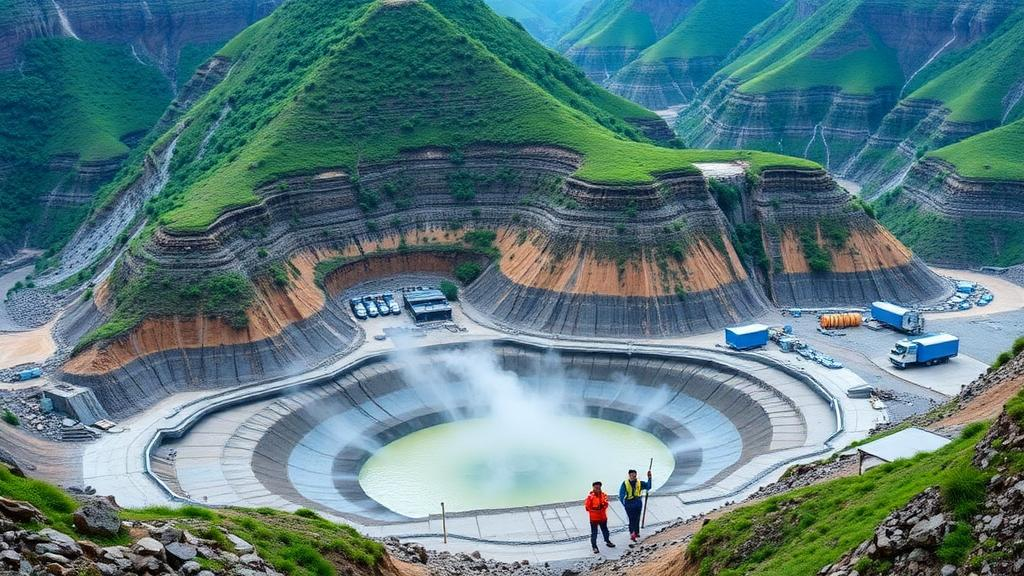
China has quietly rewritten the legal foundation of one of the world’s largest mining economies, and the consequences could ripple far beyond its borders. In 2024, the country enacted a sweeping revision of its Mineral Resources Law, the first major overhaul in decades, aiming to fuse three traditionally separate domains—resource allocation, ecological governance, and strategic mineral security—into a single legal architecture. A new peer-reviewed analysis published in Humanities and Social Sciences Communications examines what this reform actually does, how it works mechanically, and where it might fail. The study, led by Xinqian Li of Shanghai Maritime University with collaborators at Tsinghua University and Jinan University, offers one of the first mechanism-based accounts of how a major mining jurisdiction is attempting to legislate its way out of the tension between economic growth, environmental repair, and resource security.
The stakes could hardly be higher. Minerals such as lithium, cobalt, nickel, and rare earth elements underpin batteries, wind turbines, electric vehicles, and defense technologies, making them the physical substrate of the global energy transition. China dominates much of the processing and refining of these materials, meaning that how it governs extraction domestically shapes supply chains worldwide. Yet mining is also among the most environmentally disruptive human activities, scarring landscapes, consuming water, and generating tailings that can leach toxins for generations. The 2024 reform represents China’s attempt to resolve this contradiction within law rather than leaving it to administrative improvisation, and the new study asks whether legal text can genuinely coordinate objectives that have historically pulled in opposite directions.
To dissect the reform, the researchers deployed what they call an institutional-coupling framework, a lens that identifies how specific legal mechanisms link different governance functions across the mining lifecycle. Rather than treating law as a monolith, the analysis breaks it into six operational categories: contractual, financial, informational, administrative, participatory, and remedial mechanisms. Contractual mechanisms govern how mineral rights are allocated and what obligations attach to them. Financial instruments include fees, bonds, and royalties designed to internalize environmental costs. Informational tools mandate disclosure and monitoring, while administrative mechanisms empower regulators to approve, condition, and revoke operations. Participatory provisions open decision-making to affected communities, and remedial mechanisms impose liability and restoration duties after damage occurs. The framework’s central claim is that sustainability emerges not from any single tool but from how tightly these mechanisms couple allocation decisions to lifecycle responsibility.
The method combined doctrinal legal analysis—reading the statutory text and tracing its institutional logic—with a purposively selected provincial case study of Guangxi, a region rich in minerals and representative of the implementation challenges facing subnational regulators. The researchers supplemented this with a functional comparison against two mature mining jurisdictions: the European Union and Australia. This triangulation allowed the team to assess whether China’s mechanisms perform functions that comparable legal systems have developed independently, and to spot design gaps that only become visible when viewed against international practice. The study drew exclusively on publicly available legislation, judicial decisions, policy documents, official reports, and published literature, including China’s Natural Resources Statistics Bulletins from 2022 through 2024.
The findings are cautiously optimistic but unsentimental. The analysis concludes that mineral law can indeed provide a legal and institutional basis for coordinating economic objectives, ecological responsibility, and long-term resource security—three goals that the previous legal regime treated largely in isolation. By embedding lifecycle ecological obligations directly into the allocation of mineral rights, the reform attempts to make environmental stewardship a condition of access rather than an afterthought. Similarly, by integrating strategic mineral provisions into the same framework, the law acknowledges that supply security and environmental protection must be governed together, not traded off against each other in ad hoc administrative decisions. This represents a meaningful conceptual shift in how a major mining power structures its legal relationship with the subsurface.
However, the study also identifies serious implementation risks that temper any celebration. The most prominent is the gap between formal compliance and actual ecological outcomes—the possibility that operators satisfy paperwork requirements while environmental degradation continues unchecked. This is a familiar pathology in regulatory systems worldwide, where monitoring capacity, enforcement resources, and political incentives determine whether legal text translates into on-the-ground change. The researchers also flag insufficient coordination between supply-security measures and environmental safeguards, warning that the urgency of securing critical minerals could override ecological constraints unless the coupling mechanisms are enforced rigorously. In other words, the law’s architecture is sound on paper, but its performance depends on administrative capacity and political will that the legal text alone cannot guarantee.
By situating China’s reform within broader scholarly debates, the article connects legal design to some of the most contested questions in resource governance. The resource curse literature documents how mineral wealth can paradoxically undermine development through corruption, conflict, and institutional decay. Just transition scholarship asks how societies can shift toward sustainable economies without abandoning workers and communities dependent on extractive industries. Lifecycle governance research argues that environmental responsibility must attach to every stage of resource use, from exploration through closure and remediation. Critical minerals studies highlight the geopolitical scramble for materials essential to decarbonization. The Chinese reform engages all four debates simultaneously, and the study’s mechanism-based account shows how legal integration attempts to address them within one framework rather than through fragmented sectoral rules.
The comparative dimension adds practical texture to the analysis. The European Union has developed its own critical minerals strategy alongside environmental directives, while Australia operates a mature federal mining regime with established environmental assessment and indigenous consultation requirements. Comparing China’s mechanisms against these systems reveals both convergence and divergence: all three jurisdictions grapple with the same underlying challenge of coupling mineral access to ecological and social responsibility, but they deploy different institutional tools shaped by distinct legal traditions and political economies. The comparison suggests that no jurisdiction has fully solved the coordination problem, and that China’s reform represents one experiment—ambitious in scope, untested in performance—within a global search for workable governance models.
The authors are explicit about the limits of their conclusions, which remain confined to legal design and early administrative implementation. The reform is too recent for its long-term ecological and economic effects to be measurable, and the study does not claim to predict outcomes. What it does offer is a rigorous map of the legal machinery now in place, identifying which mechanisms exist, how they are intended to interact, and where implementation could falter. For policymakers in other mining jurisdictions watching China’s experiment, the analysis provides a transferable framework for evaluating whether their own legal systems adequately couple mineral allocation to lifecycle responsibility and strategic security. For researchers, it opens questions about how institutional coupling performs under real administrative pressure.
As the global race for critical minerals intensifies, the governance choices of major mining powers will shape whether the energy transition reproduces the environmental harms of the fossil era or breaks from them. China’s 2024 Mineral Resources Law reform is one of the largest legal experiments in this domain, and the new study provides the first detailed mechanism-based reading of what it attempts and where it could stumble. The verdict is neither triumph nor failure but something more useful: a clear-eyed account of how law can structure the relationship between extraction, ecology, and security, and a warning that the hardest work—making legal text deliver ecological outcomes on the ground—lies ahead.
Subject of Research: Toward sustainable mineral resource governance: policy implications of China’s 2024 Mineral Resources Law reform
Article Title: Toward sustainable mineral resource governance: policy implications of China’s 2024 Mineral Resources Law reform
Article References: Li, X., An, D., Wu, J., & Du, R. (2026). Toward sustainable mineral resource governance: policy implications of China’s 2024 Mineral Resources Law reform. Humanities and Social Sciences Communications. https://doi.org/10.1057/s41599-026-09244-y
Image Credits: AI Generated
DOI: 10.1057/s41599-026-09244-y
Keywords: Toward, sustainable, mineral, resource, governance, policy, implications, China, Resources, reform, scientific research
Cite Scienmag News
Courtney Benton. (October 19, 2026). China Rewrites Its Mining Rulebook for the Green Energy Age. Scienmag. https://scienmag.com/china-rewrites-its-mining-rulebook-for-the-green-energy-age/
Courtney Benton. "China Rewrites Its Mining Rulebook for the Green Energy Age." Scienmag, 19 October 2026, https://scienmag.com/china-rewrites-its-mining-rulebook-for-the-green-energy-age/. Accessed 19 October 2026.
Courtney Benton. "China Rewrites Its Mining Rulebook for the Green Energy Age." Scienmag. October 19, 2026. https://scienmag.com/china-rewrites-its-mining-rulebook-for-the-green-energy-age/


