


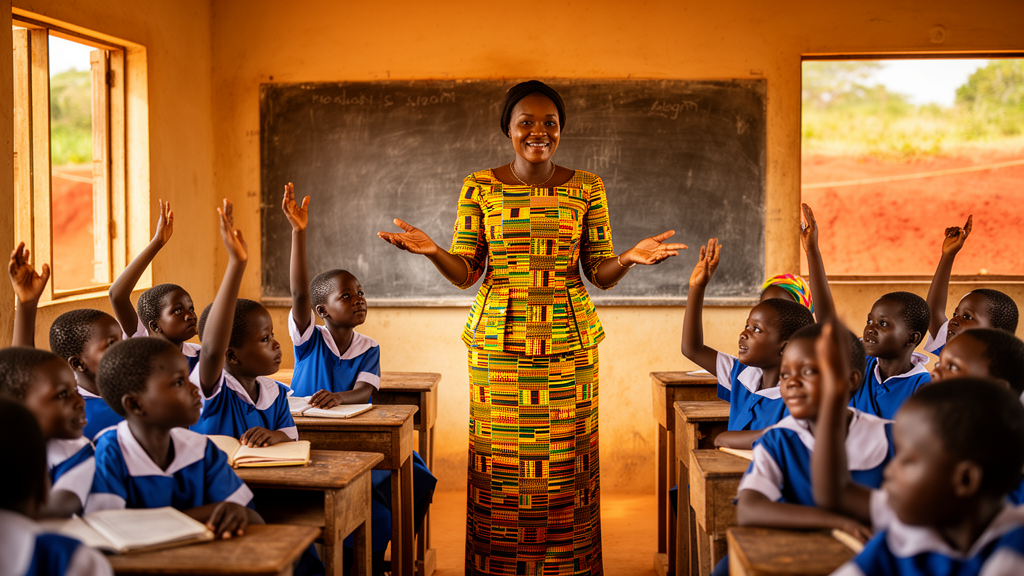
In the rural districts of northern Ghana, where poverty, early marriage, and entrenched gender norms have long constrained girls’ schooling, a new study offers a detailed account of how contact with female role models can transform the educational ambitions of adolescent girls. The research, published in SN Social Sciences by Clement Adamba, Justina Addai, Ama Boafo-Arthur, and Patience Adiikanbasi, examined girls across five districts—Nanumba North, Saboba, Tolon, West Gonja, and West Mamprusi—and traced how their narratives about school, work, and the future shifted after engagement with a role model intervention. The findings arrive at a moment when governments and NGOs across sub-Saharan Africa are investing heavily in mentorship programmes, yet rigorous evidence about how such interventions actually reshape aspiration in low-income rural settings remains scarce.
The study is anchored theoretically in Nilanjana Dasgupta’s Stereotype Inoculation Model, a framework from social psychology that proposes exposure to ingroup experts and peers can act as a kind of social vaccine, inoculating individuals against the corrosive effects of negative stereotypes about their group. When girls in male-dominated fields see women who resemble them succeeding, the model predicts, their self-concept strengthens, stereotype threat diminishes, and confidence in their own potential grows. Prior experimental work, including studies of female peer mentors in engineering programmes in the United States and female leaders in Indian village councils, has lent empirical weight to the idea that visible same-gender success changes what young people believe is possible for themselves. The Ghanaian study extends this logic into a context where the barriers are not only psychological but also material, structural, and deeply social.
Methodologically, the researchers adopted a qualitative design built around in-depth interviews and focus group discussions. Their sample comprised 46 programme beneficiaries—adolescent girls who had participated in the role model intervention—alongside 25 parents and 5 district education officers. Rather than attempting to measure causal effects statistically, the team analysed interpretive patterns in participants’ accounts, comparing how girls described their educational goals before and after their engagement with the programme. This narrative-shift approach is well suited to a phenomenon like aspiration, which is difficult to quantify but richly expressed in the stories people tell about their futures. The researchers drew on established qualitative practices of triangulation and thematic analysis, and they acknowledged their own positionality in interpreting the accounts, a reflexive move increasingly expected in critical qualitative research.
The central finding is striking in its coherence: locally grounded female role models broadened girls’ educational horizons, strengthened their confidence, and equipped them with interpretive resources for navigating the social norms and material constraints that surround them. In practical terms, this meant that girls who had previously imagined truncated futures—leaving school early, marrying young, or drifting into informal work—began to articulate ambitions that extended through secondary school and beyond. The role models mattered not simply as distant celebrities but as women with recognisable biographies: women who had grown up in similar villages, faced similar pressures, and nonetheless completed their education and built professional lives. That proximity, the authors suggest, is precisely what makes the inoculation effective. A role model who is too remote in origin or circumstance may inspire admiration without altering a girl’s sense of what is attainable for someone like her.
This emphasis on local grounding resonates with a broader body of scholarship on aspiration formation. Anthropologist Arjun Appadurai famously described the ‘capacity to aspire’ as a cultural capacity that is unevenly distributed, arguing that the poor are often denied the navigational knowledge—the sense of plausible pathways—that wealthier groups take for granted. Sociologists of education have similarly argued that aspirations are not individual possessions but relational and socially produced achievements, emerging from networks, conversations, and the visible examples available in a community. The Ghanaian findings fit this sociocultural picture closely. Girls’ ambitions did not change in isolation; they changed because the intervention inserted new figures into their social world, figures who made alternative futures narratable and, crucially, credible.
Yet the study is careful not to overclaim the power of mentorship alone. A second key finding concerns the role of complementary financial support. The researchers found that financial assistance was associated with sustaining the aspiration change that role model contact initiated. This distinction between initiating and sustaining is analytically important. A mentor can expand a girl’s imaginative horizon, but if her family cannot pay school fees, buy materials, or absorb the loss of her labour at home, the newly articulated ambition may collapse under material pressure. The qualitative evidence suggests that aspiration and affordability operate as interlocking constraints: psychosocial empowerment without economic support risks producing frustration, while cash without confidence may leave girls unable to imagine what the money should be used for. The most durable changes appeared where the two forms of support arrived together.
This integrated conclusion aligns with a growing international evidence base on ‘cash plus’ interventions. Randomised trials in Liberia, where a gender-transformative mentoring programme was combined with cash transfers, and in Bangladesh, where psychosocial stimulation accompanied unconditional transfers, have both found that combined approaches outperform single-component designs. Economic experiments in Somalia and Madagascar have shown that role model and information interventions can shift youths’ educational choices and gender attitudes, while work in rural Ethiopia has linked aspiration formation to forward-looking economic behaviour. The Ghanaian study contributes a qualitative, ground-level perspective to this quantitative literature, illuminating the mechanisms—confidence, narrative, navigational knowledge—through which combined interventions may work.
The context of northern Ghana makes these findings particularly consequential. The region records some of the country’s highest poverty rates and lowest indicators of girls’ educational participation, shaped by structural economic disadvantage, long distances to schools, and gendered expectations that assign girls heavy domestic burdens and early marriage. National policy debates in Ghana have repeatedly circled these questions, from the re-entry of pregnant girls and teenage mothers into school to the persistence of sexist discourse around girls’ academic achievement, as documented in analyses of the country’s National Science and Math Quiz. Within the education system itself, female teachers have been identified as a form of representative bureaucracy whose presence affects girls’ outcomes. The new study adds a mechanism-level account of why visible female success matters, and what it takes for that visibility to translate into changed behaviour.
For programme designers, the implications are concrete. First, role model interventions should prioritise mentors whose life trajectories are recognisably local, since similarity appears to be the active ingredient in the stereotype-inoculation process. Second, mentorship should not be deployed as a stand-alone solution; pairing it with financial support addresses the material dimension of educational exclusion that inspiration alone cannot overcome. Third, the involvement of parents and district education officers—as reflected in the study’s sample—signals that aspiration change must be negotiated within families and institutions, not merely within individual girls. Parents’ accounts in the study suggest that community-level buy-in conditions whether a girl’s renewed ambition can be acted upon at home.
The authors are appropriately measured about the limits of their design. As a qualitative study focused on interpretive patterns among programme beneficiaries, it cannot establish causal effects or generalise statistically to other settings, and the researchers frame their contribution as exploratory rather than definitive. Data from the study are not publicly available, though the authors indicate they may be shared on reasonable request. Nevertheless, the study’s theoretical framing and its convergence with experimental evidence from multiple countries give its conclusions considerable weight. It reframes educational aspiration not as a private virtue that girls in poor rural communities simply lack, but as a social resource that can be cultivated—through visible, local female success and through the economic scaffolding that lets ambition survive contact with reality. In districts where a generation of girls has been told, implicitly and explicitly, what futures are not for them, that reframing may prove to be the study’s most enduring contribution.
Subject of Research: The influence of female role model mentorship on the educational aspirations and agency of adolescent girls in rural northern Ghana
Article Title: Female role models shaping educational aspirations among adolescent girls in rural northern Ghana
Article References: Adamba, C., Addai, J., Boafo-Arthur, A., & Adiikanbasi, P. (2026). Female role models shaping educational aspirations among adolescent girls in rural northern Ghana. SN Social Sciences, 6(9), Article 395. https://doi.org/10.1007/s43545-026-01678-0
Image Credits: AI Generated
DOI: 10.1007/s43545-026-01678-0
Keywords: female role models, educational aspirations, adolescent girls, rural education, Ghana, mentorship, stereotype inoculation model, girls' education, educational inequality, cash plus interventions, qualitative research, psychosocial support
Cite Scienmag News
Courtney Benton. (October 19, 2026). Female Role Models Reshape Girls’ Educational Dreams in Rural Ghana. Scienmag. https://scienmag.com/female-role-models-reshape-girls-educational-dreams-in-rural-ghana/
Courtney Benton. "Female Role Models Reshape Girls’ Educational Dreams in Rural Ghana." Scienmag, 19 October 2026, https://scienmag.com/female-role-models-reshape-girls-educational-dreams-in-rural-ghana/. Accessed 19 October 2026.
Courtney Benton. "Female Role Models Reshape Girls’ Educational Dreams in Rural Ghana." Scienmag. October 19, 2026. https://scienmag.com/female-role-models-reshape-girls-educational-dreams-in-rural-ghana/


