


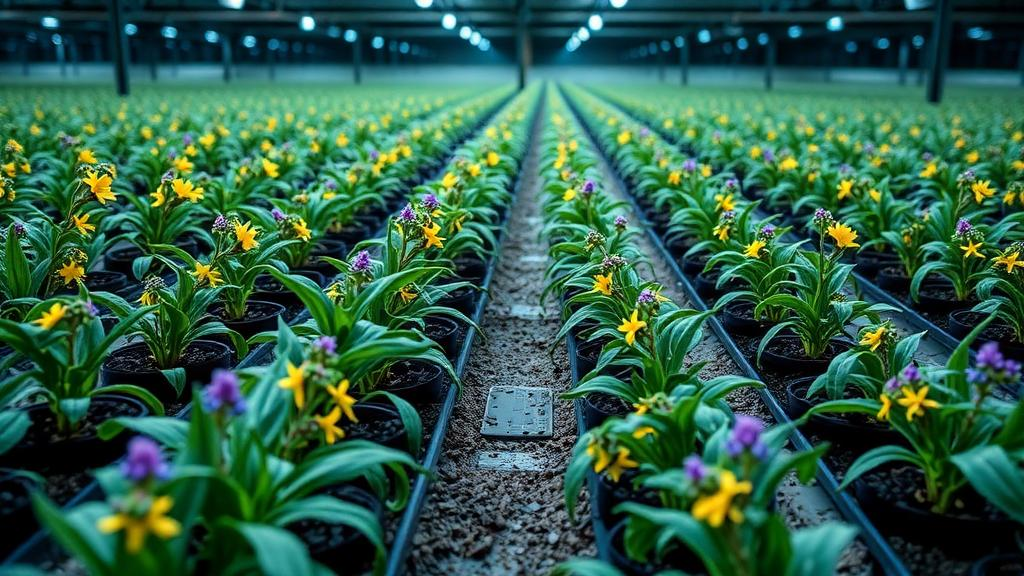
When the 2026 Nobel Prize in Physiology or Medicine was awarded to Karl Deisseroth of Stanford University, Peter Hegemann of Humboldt University of Berlin, and Georg Nagel of the University of Würzburg for their discoveries of light-gated ion channels and the birth of optogenetics, most headlines focused on the brain. The technique that lets researchers switch individual neurons on and off with pulses of light has transformed neuroscience over the past two decades. But an editorial published in Advanced Biotechnology argues that the same molecular toolkit is now pointing in an unexpected direction: toward crops, pests, and the chemistry of the field.
The story begins with green algae. Hegemann and Nagel identified channelrhodopsins, a family of light-sensitive proteins embedded in the membranes of unicellular algae, and characterized them as ion channels that open when illuminated with blue light. Their landmark papers in 2002 and 2003 showed that channelrhodopsin-1 acts as a light-gated proton channel and that channelrhodopsin-2 is a directly light-gated, cation-selective membrane channel. In other words, these proteins convert photons into electrical and ionic signals with remarkable precision, a capability that algae use to navigate toward favorable light conditions.
Deisseroth’s contribution was to transplant this algal machinery into animal neurons. By expressing channelrhodopsins in specific cells and delivering light through optical fibers, researchers gained the ability to control the activity of defined neural circuits in living animals with millisecond precision. The 2007 demonstration of in vivo control of rodent motor cortex using an integrated fiberoptic and optogenetic interface established optogenetics as a foundational technology of modern neuroscience. Light, unlike drugs or electrodes, can be switched on and off instantly, targeted spatially, and dosed with extraordinary temporal resolution.
What the editorial by Zhan-Yan Zhang, Qing-Qing Liu, B. Marambe, Barana C. Jayawardana, Ge-Fei Hao, and Wen-Chao Yang makes clear is that this light-based control of ion fluxes is not confined to neurons. Plants, too, are governed by ionic signals. Calcium influxes trigger immune responses, anion effluxes drive stomatal closure during drought, and membrane potential gradients guide the growth of pollen tubes. If a light-gated channel can be expressed in plant cells, the same logic of optogenetic control applies: shine light of the right wavelength, and a specific ionic event unfolds at a chosen time and place.
Recent work shows how powerful this can be. A study published in Nature in 2024 by Ding and colleagues examined two engineered channelrhodopsins in plant leaf cells. The cation channel XXM 2.0, activated by green light, mediates calcium influx that sets off a cascade resembling a pathogen attack: bursts of reactive oxygen species, activation of the defense hormones jasmonic acid, salicylic acid, and ethylene, and ultimately programmed cell death. These are the hallmarks of a plant immune response, produced not by a microbe but by a beam of light. The same study showed that the light-gated anion channel ACR1 2.0 triggers an entirely different program. When illuminated, it drives anion efflux that mimics drought stress, causing stomata to close and abscisic acid to accumulate.
The implications for basic plant science are considerable. Plant signaling pathways are notoriously tangled: hormones cross-regulate each other, ion fluxes feed back on gene expression, and responses to pathogens overlap with responses to drought. Optogenetic tools offer a way to isolate variables. By varying the duration and frequency of light stimulation, researchers can dial calcium influx or anion efflux up and down independently of any pathogen or water deficit, then measure exactly how reactive oxygen species, phytohormone levels, and cellular damage respond. Combined with cell-type-specific expression, transcriptomic profiling, and functional validation of candidate genes, this approach could pinpoint the key regulatory nodes that connect ion signaling to defense and stress tolerance. The editorial suggests that pathogen inoculation and drought assays could then test whether the pathways identified optogenetically actually confer resistance in the field.
Agricultural chemistry stands to benefit as well. Insect nervous systems run on ion channels, and many of the most effective insecticides work by disrupting them. Voltage-sensitive sodium channels, gamma-aminobutyric acid receptors, ryanodine receptors, nicotinic acetylcholine receptors, and glutamate-gated chloride channels are all established targets of commercial agrochemicals. Screening new compounds against these channels has traditionally required electrical recordings or indirect assays that are slow and difficult to scale. A doctoral project at the University of Bonn described in the editorial took a different approach: by co-expressing channelrhodopsin 2 with the insect voltage-sensitive sodium channel, short light pulses could precisely control channel opening, creating a light-activated, high-throughput screening platform for compounds that act on this critical target.
Complementing this screening strategy is the emerging field of photopharmacology applied to agrochemicals. Rather than using light to open a channel, photopharmacology builds photoswitches, such as azobenzene groups, directly into insecticide molecules. The resulting compounds can be toggled between active and inactive states with specific wavelengths of light, giving researchers optical control over multiple insect ion channel targets. A 2023 review in Advanced Agrochemicals catalogued how this strategy could be applied across the major insecticide target classes. Together, optogenetics-assisted screening and photopharmacological design offer two complementary routes toward novel insecticidal lead compounds and, just as importantly, toward a clearer mechanistic understanding of how they work once found.
Perhaps the most striking agricultural application involves reproduction. In 2021, Zhou and colleagues demonstrated in Nature Plants that the light-gated anion channel ACR1 2.0 could control pollen tube growth in plants. Under uniform green-light illumination, anion efflux and membrane depolarization in pollen tube cells reversibly inhibited growth. When only part of a pollen tube was illuminated, growth redirected away from the light, revealing that anion efflux and membrane potential gradients contribute to the directional guidance of pollen tube tip growth. Since pollen tube guidance determines whether fertilization succeeds, understanding and potentially manipulating this process touches directly on seed set, one of the most important agronomic traits in crop production.
The editorial sketches a research agenda built on these foundations. In crop breeding, the ACR1 2.0 result provides a starting point for dissecting the relationships among anion fluxes, membrane potential changes, pollen tube guidance, and fertilization. Genetic variation analysis and genome editing could then validate candidate regulatory factors and determine their effects on seed set and yield. None of this suggests that farmers will soon shine lasers on their fields, and the authors are careful to frame channelrhodopsins as research tools rather than products. But the trajectory is familiar: optogenetics began as a curiosity of algal photobiology, became the defining technique of circuit neuroscience, and is now generating hypotheses, screening platforms, and molecular designs relevant to plant immunity, pesticide discovery, and breeding. The 2026 Nobel Prize honors a technology that taught us to talk to neurons in the language of light. The editorial’s argument is that plants, pests, and pollen tubes are listening too.
Subject of Research: Applications of Nobel Prize-winning channelrhodopsins and optogenetics in plant signaling, pesticide discovery, and crop breeding
Article Title: From medicine to fields: what the 2026 nobel prize means for agricultural biotechnology
Article References: Zhang, Z.-Y., Liu, Q.-Q., Marambe, B., Jayawardana, B. C., Hao, G.-F., & Yang, W.-C. (2026). From medicine to fields: what the 2026 nobel prize means for agricultural biotechnology. Advanced Biotechnology, 4(4), Article 43. https://doi.org/10.1007/s44307-026-00142-7
Image Credits: AI Generated
DOI: 10.1007/s44307-026-00142-7
Keywords: optogenetics, channelrhodopsins, Nobel Prize 2026, plant signaling, agricultural biotechnology, pesticide discovery, crop breeding, ion channels, pollen tube growth, plant immunity, photopharmacology, abscisic acid
Cite Scienmag News
Alan Morgan. (October 19, 2026). Nobel-winning light-gated ion channels find new life in agriculture. Scienmag. https://scienmag.com/nobel-winning-light-gated-ion-channels-find-new-life-in-agriculture/
Alan Morgan. "Nobel-winning light-gated ion channels find new life in agriculture." Scienmag, 19 October 2026, https://scienmag.com/nobel-winning-light-gated-ion-channels-find-new-life-in-agriculture/. Accessed 19 October 2026.
Alan Morgan. "Nobel-winning light-gated ion channels find new life in agriculture." Scienmag. October 19, 2026. https://scienmag.com/nobel-winning-light-gated-ion-channels-find-new-life-in-agriculture/


