


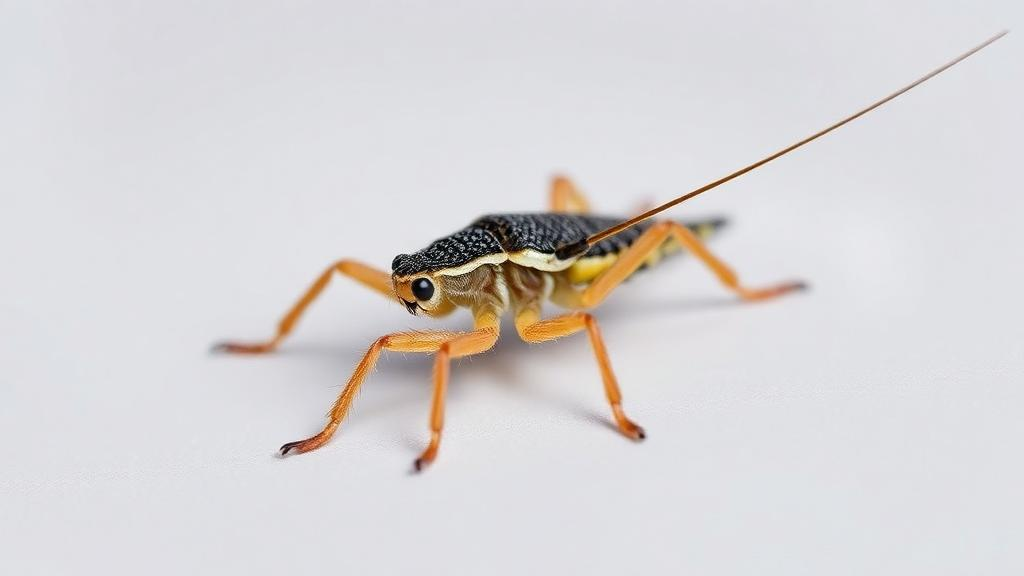
The hairy scale-cricket, Arachnocephalus vestitus, has finally been confirmed in Georgia, and the confirmation did not come from a chance sighting alone. A team working under the Caucasus Barcode of Life project combined careful morphological examination with DNA barcoding to document the species in the country for the first time. The finding, published in the journal Caucasiana in October 2022, closes a conspicuous gap in the distribution map of a small, secretive insect that has long been suspected of lurking in the Caucasus but never formally recorded there.
Arachnocephalus vestitus belongs to the family Mogoplistidae, a group of small, non-flying crickets whose bodies are cloaked in numerous squamellae, tiny scale-like structures that give the animals a hairy, shimmering appearance. The family is most diverse in tropical forests, but its members occur across a much broader range. Worldwide, Mogoplistidae comprises 31 extant genera, and the genus Arachnocephalus alone contains 26 species distributed on every continent except North and South America. Within this genus, A. vestitus is the only representative known from the region stretching from the Iberian Peninsula and western North Africa through the Mediterranean, from southern France and Corsica up to Romania, Crimea, the Caucasus and Asia Minor.
Despite this broad range, the species has remained remarkably difficult to pin down. It is generally described as quite common but hard to find, and no information on its population trend is available. The cricket favors dry grassland, bushes and trees, and its cryptic dwelling lifestyle means it can easily escape the notice of even dedicated surveyors. The species was first observed in the Caucasus region in Azerbaijan as far back as 1940, yet historic surveys of Georgian orthopteran fauna, including work published in 1951 and 1956 as well as recent compilations, had never recorded it from Georgia. That absence left researchers wondering whether the cricket truly stopped at the Georgian border or had simply been overlooked.
The answer emerged during fieldwork in 2020 and 2021, supported by the BMBF-funded Caucasus Barcode of Life project, known as CaBOL. Three female specimens were collected by hand in the surroundings of Tbilisi and Gori, both in eastern Georgia. The collectors preserved the animals in 96 percent ethanol and later stored them in a freezer at minus 30 degrees Celsius, preparing them for DNA barcoding at the Institute of Ecology of Ilia State University in Tbilisi. A fourth record, from the village of Dzirkoki, rests on photographic material posted by Giorgi Cankashvili in the Facebook group Wildlife in Georgia. That specimen was determined from the images, and a georeferenced location was added to the Georgian Biodiversity Database, demonstrating how citizen science can supplement formal field surveys in documenting a country’s fauna.
The sampling sites tell a story of their own. The Tbilisi specimen was collected on 2 November 2020 at an altitude of 710 meters above sea level, at coordinates 41.7300 degrees north, 44.7048 degrees east. The first Gori specimen came on 31 October 2020 at 664 meters, and a second Gori individual followed on 19 September 2021 at 634 meters. The Dzirkoki photograph was taken on 26 July 2021 at 450 meters. All four records fall within steppe habitats, a detail that matters when considering how widely the species might roam. Voucher specimens and extracted DNA samples were deposited in the scientific collections of Ilia State University, and the two successfully sequenced individuals received CaBOL identifiers 1010346 and 1010358, with BOLD process IDs ORTGE001-22 and ORTGE002-22.
Morphologically, the specimens fit the classic profile of the hairy scale-cricket. The body is generally brown and hairy, measuring between 6 and 9 millimeters in length, and is covered with small scales that fall off on contact, a diagnostic trait that also makes the animals tricky to handle without losing evidence. The head carries a projection between the antennae that is divided by a longitudinal incision. The posterior tibiae are saw-shaped but lack distinct spines, and the ovipositor is sinuous and shorter than the cerci. These features, drawn from established descriptions of the species, allowed the researchers to identify the Georgian females with confidence even before genetic analysis began.
The genetic work provided the decisive validation. Genomic DNA was extracted from tissue samples using the Quick-DNA Miniprep Plus Kit from Zymo Research, applied to 25 milligrams of tissue. Partial sequences of the cytochrome oxidase subunit I gene, the standard COI barcode region, were amplified by polymerase chain reaction using the primer pair LCO1490-JJ and HCO2198-JJ. The thermal protocol began with denaturation at 95 degrees Celsius for one minute, followed by a first cycle set of 15 cycles at 94 degrees for 30 seconds, annealing at 55 degrees for one minute with the temperature dropping one degree per cycle, and extension at 72 degrees for one minute and 30 seconds. A second set of 25 cycles ran at 94 degrees for 35 seconds, 45 degrees for one minute and 72 degrees for one minute and 30 seconds, before a final extension at 72 degrees for five minutes.
PCR amplicons were visualized on 1 percent agarose gels using 1.7 microliters of PCR product, and sequencing of the unpurified PCR products in both directions was conducted at the Beijing Genomics Institute in Hong Kong using the amplification primers. Sequence analysis was performed with Geneious Prime 2022.1.1, and quality sequences were uploaded to BOLD Systems, the international reference library for DNA barcodes. The resulting sequences were 658 base pairs long, and the BOLD identification tool placed the Georgian specimens within the barcode index number BIN AAP5182, a cluster that includes A. vestitus specimens from Bulgaria and France. The average distance within the BIN was 0.45 percent p-distance, the maximum within-BIN distance was 0.87 percent, and the distance to the nearest neighbor BIN was 2.41 percent, figures that confirm the Georgian animals sit comfortably inside the known genetic variation of the species while remaining clearly distinct from any other barcode cluster.
Digital imaging played a supporting role in the documentation. Photos of the preserved specimen were taken with a Canon EOS 90D camera fitted with a Canon EF-S 60 millimeter f/2.8 Macro USM lens, and the digital images were prepared using Zerene Stacker image stacking software together with Adobe Photoshop CS6. The stacking technique merges multiple focal planes into a single sharp image, an essential approach for a 6 to 9 millimeter insect whose fine scales and surface structures would otherwise be impossible to render clearly. One of the resulting photographs shows the Gori specimen from 2 November 2020 against a 1 millimeter scale bar, capturing the dense squamellae that define the family.
The confirmation of Arachnocephalus vestitus in Georgia carries implications beyond a single species checklist entry. Given the sampling sites and the cricket’s cryptic dwelling lifestyle, the researchers assume that the species is not so rare and might be found elsewhere in the country. They suggest that it is widely distributed in at least eastern Georgia and has been overlooked in the past, mainly due to the lack of biodiversity research in the country. The case also illustrates the power of combining traditional morphology with COI barcoding and citizen-submitted photographs: a species that evaded formal detection for more than eighty years in the Caucasus was documented with four records in two field seasons, three of them supported by voucher specimens and two by full DNA barcode sequences now permanently available in BOLD Systems for future comparisons across the Mediterranean and Caucasus ranges.
Subject of Research: First DNA-confirmed record of the Mediterranean cricket Arachnocephalus vestitus in Georgia
Article Title: First DNA-based record of Arachnocephalus vestitus Costa, 1855 ( Orthoptera : Mogoplistidae ) from Georgia
Article References: Arsenashvili, E., Bulbulashvili, N., & Japaridze, L.-G. (2022). First DNA-based record of Arachnocephalus vestitus Costa, 1855 (Orthoptera: Mogoplistidae) from Georgia. Caucasiana, 1, 17-19. https://doi.org/10.3897/caucasiana.1.e85093
Image Credits: AI Generated
DOI: 10.3897/caucasiana.1.e85093
Keywords: DNA barcoding, Orthoptera, Mogoplistidae, Georgia, Caucasus, biodiversity, First, DNA-based, record, Arachnocephalus, vestitus, Costa
Cite Scienmag News
Margaret Porter. (October 19, 2026). DNA Barcoding Reveals Elusive Hairy Scale-Cricket in Georgia for the First Time. Scienmag. https://scienmag.com/dna-barcoding-reveals-elusive-hairy-scale-cricket-in-georgia-for-the-first-time/
Margaret Porter. "DNA Barcoding Reveals Elusive Hairy Scale-Cricket in Georgia for the First Time." Scienmag, 19 October 2026, https://scienmag.com/dna-barcoding-reveals-elusive-hairy-scale-cricket-in-georgia-for-the-first-time/. Accessed 19 October 2026.
Margaret Porter. "DNA Barcoding Reveals Elusive Hairy Scale-Cricket in Georgia for the First Time." Scienmag. October 19, 2026. https://scienmag.com/dna-barcoding-reveals-elusive-hairy-scale-cricket-in-georgia-for-the-first-time/


