


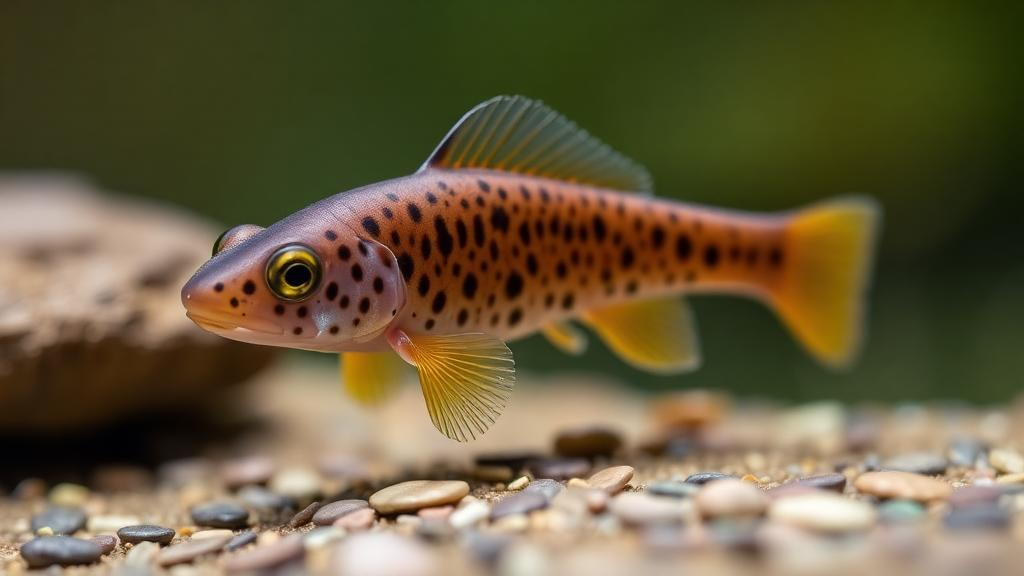
In the flooded forests of lowland Bolivia, a small fish with a striking black blotch on its flank has defied expectations. Moema claudiae, an annual killifish listed as Critically Endangered and widely feared to be extinct, has been rediscovered alive in a temporary pond roughly 100 kilometers northwest of the only place it was ever known to occur. The finding, published in the journal Nature Conservation, ends a drought of more than two decades without a confirmed sighting in the wild and offers conservationists an unexpected second chance to save a species that many had already written off.
The story of Moema claudiae is, in many ways, the story of seasonal fishes in crisis. Rivulids, the family to which this species belongs, are among the most remarkable of all freshwater fishes. Several lineages have evolved to complete their entire lives in water bodies that exist for only a few weeks or months each year. Their embryos survive the dry season buried in the muddy substrate, sealed inside a state of metabolic and developmental arrest known as diapause. When the rains return and the pond refills, development resumes, the eggs hatch, and a new generation races to grow, court, spawn, and die before the water evaporates again. This extraordinary life cycle is precisely what makes them so vulnerable: the small, temporary wetlands they depend on are easy to drain, plow, and pave.
Bolivia illustrates that vulnerability with particular force. Of the 32 rivulid species recorded in the country, 19 are endemic, and nine are known only from their original collection sites. Of the 20 species assessed for the IUCN Red List, eight fall into some threatened category. Moema claudiae, described by Wilson Costa in 2003, is the sole Bolivian member of the family classified as Critically Endangered, under criterion B2ab(iii), reflecting its tiny area of occupancy, its known presence at a single location, and the ongoing degradation of its habitat quality. The type locality lay in the floodplains of the río San Pablo beside the Santa Cruz–Trinidad road, about 60 kilometers north of Ascención de Guarayos in the Iténez/Guaporé River basin. That place no longer exists as the fish knew it. A village was built on the site, and the surrounding landscape was transformed into extensive agroindustrial fields, stripped of forest, altered in hydrology, and contaminated with herbicides, insecticides, and fertilizer.
Repeated collecting expeditions to the vicinity of the type locality failed to find the species. The effort was not in doubt; other rivulids from the same area, including Moema beucheyi, Pterolebias longipinnis, and Spectrolebias filamentosus, continued to turn up both in scientific collections and in the ornamental fish trade, demonstrating that the habitat, degraded as it was, could still support seasonal killifishes. Yet M. claudiae itself remained invisible. A photograph of the original type locality, published in 1997 in connection with S. filamentosus and probably depicting the same site or one very close to it, showed dense vegetation that can no longer be found for kilometers around. Absence of evidence, combined with catastrophic habitat loss, was stacking up into evidence of absence.
In April 2024, two researchers set out with dual goals: to rediscover M. claudiae in the surroundings of its type locality or, failing that, to gather additional evidence of its likely extinction. What they found exceeded both objectives. In a seasonal blackwater pool in the drainage of the Mocovi River, part of the Ibaré River basin in the Marbán province of the Beni department, they collected specimens that matched every diagnostic character of M. claudiae as laid out in the original description. The site sits roughly 100 kilometers northwest of where the species was first found, and within a small forest remnant surrounded by crops.
The rediscovery location is as biologically remarkable as the fish itself. The biotope is a temporary flooded-forest pool no more than 0.4 meters deep, its bottom a layer of leaf litter over grey clay, with no submerged or floating aquatic vegetation and only sparse emergent grasses along the riparian edge. Alongside M. claudiae, the researchers documented six other syntopic rivulid species: M. beucheyi, Neofundulus aff. splendidus, Papiliolebias habluetzeli, Pterolebias longipinnis, S. filamentosus, and Trigonectes rogoaguae. That brings the total to seven seasonal killifish species coexisting in a single water body, the highest number ever recorded. Previous studies had documented at most five species together, with six considered possible if species from nearby water bodies were included. The ecological explanation proposed by the authors is geographic convergence: the site lies where the watersheds of the Mamoré and Iténez/Guaporé sub-basins of the upper Madeira meet, and where Amazonian forest collides with the savannas of the Llanos de Moxos, allowing species from different biogeographic traditions to share the same temporary pond, each exploiting a subtly different functional niche.
The specimens themselves provided the first live photographs ever published of the species. Until now, the only image of M. claudiae was a greyscale drawing in the original description. The new images confirm the hallmark that distinguishes M. claudiae from all its congeners in the same color-pattern species group: a conspicuous, large, vertically elongated black humeral blotch in males, a feature that is absent, inconspicuous, or much smaller in related species. Males in the collected series reached up to 39.1 millimeters in standard length and females up to 32.7 millimeters. The team documented live coloration using controlled lighting and preserved voucher specimens, deposited in the Ichthyological Collection of the Museo de Historia Natural Noel Kempff Mercado in Santa Cruz de la Sierra under catalog numbers MNKP-16794 and MNKP-16795, with collection conducted under authorization from Bolivia’s national competent authority.
Behind the celebration, however, lies a sobering arithmetic. Between 2001 and 2024, Bolivia lost nearly 9.8 million hectares of tree cover, with more than half of that loss in primary humid forests, according to Global Forest Watch data cited in the study. The deforestation has been concentrated in the lowlands of northern Santa Cruz and, more recently, in southern Beni, precisely the region where M. claudiae survives. In 2024 alone, more than 1.8 million hectares of tree cover vanished, mostly primary forest, taking with them countless potential habitats for seasonal killifishes. The drivers are largely political and economic: policies promoting agroindustrial expansion in eastern Bolivia have accelerated clearing in recent years, and the authors see little prospect that the trend will slow in the near future. Every hectare of temporary wetland converted to soy or pasture is a hectare in which diapausing eggs in the soil have no chance of ever hatching.
This is what makes the rediscovery both exhilarating and precarious. The pond where M. claudiae clings to existence lies within a small forest remnant hemmed in by crops, meaning the entire known global population occupies a habitat island under constant pressure. Because the species is an annual fish, its persistence depends on the continued annual flooding and drying of this exact site; a single drainage alteration, a diverted watercourse, or a bulldozer’s pass through the remnant could extinguish it permanently. At the same time, the discovery of seven coexisting rivulid species makes the site arguably the most important known locality for the family in South America, a convergence of hydrography, forest, and savanna that has no documented parallel.
The authors hope that the location will be formally protected in the near future, both to preserve the only known living population of M. claudiae and to safeguard the most diverse seasonal killifish assemblage yet recorded on the continent. For now, the species has moved from presumed extinct to critically imperiled but alive, and science has gained its first true look at a fish that survived, unseen, in a shrinking patch of flooded forest while the world around it changed faster than any life cycle evolved for drought could have anticipated.
Subject of Research: Rediscovery of the critically endangered annual killifish Moema claudiae in Bolivia after more than two decades without a confirmed wild sighting
Article Title: Rediscovery of a thought to be extinct beauty: a second chance for conservation
Article References: Drawert, H. A., & Litz, T. O. (2025). Rediscovery of a thought to be extinct beauty: a second chance for conservation. Nature Conservation, 60, 115-124. https://doi.org/10.3897/natureconservation.60.160386
Image Credits: AI Generated
DOI: 10.3897/natureconservation.60.160386
Keywords: Moema claudiae, annual killifish, Rivulidae, Bolivia, rediscovery, Critically Endangered, diapause, temporary wetlands, deforestation, habitat loss, Llanos de Moxos, freshwater biodiversity
Cite Scienmag News
Margaret Porter. (October 19, 2026). Back From the Brink: Critically Endangered Bolivian Killifish Rediscovered After 20 Years. Scienmag. https://scienmag.com/back-from-the-brink-critically-endangered-bolivian-killifish-rediscovered-after-20-years/
Margaret Porter. "Back From the Brink: Critically Endangered Bolivian Killifish Rediscovered After 20 Years." Scienmag, 19 October 2026, https://scienmag.com/back-from-the-brink-critically-endangered-bolivian-killifish-rediscovered-after-20-years/. Accessed 19 October 2026.
Margaret Porter. "Back From the Brink: Critically Endangered Bolivian Killifish Rediscovered After 20 Years." Scienmag. October 19, 2026. https://scienmag.com/back-from-the-brink-critically-endangered-bolivian-killifish-rediscovered-after-20-years/


