


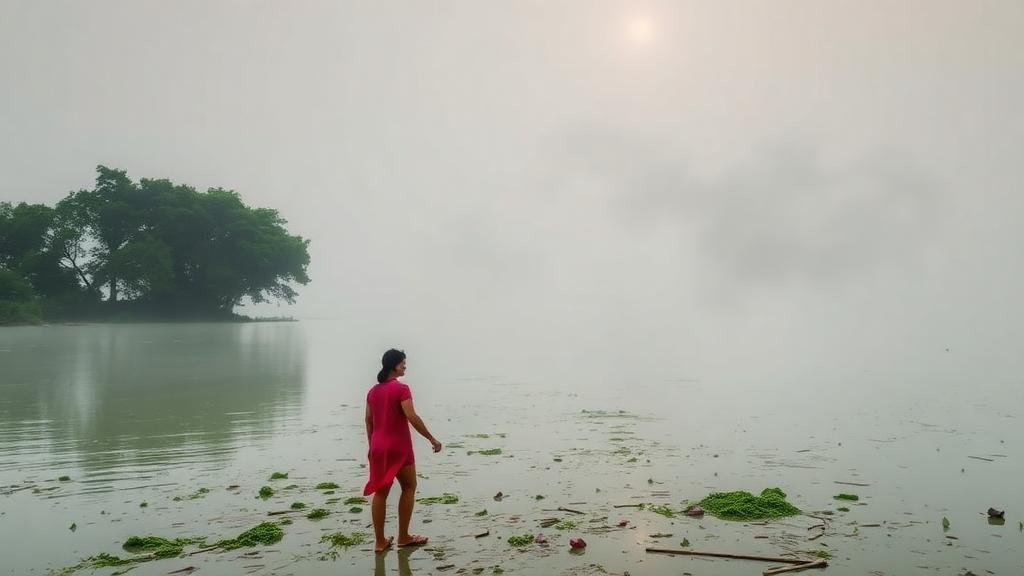
When smoke from landscape and peatland fires drifts across Malaysian Borneo, not every community faces the recurring hazard on equal footing. A new community-based study from Sarawak, published in BMC Public Health, finds that perceived resilience to recurrent haze varies sharply across the state’s zones and settlement types, and that the biggest drivers of that variation are not geography alone but knowledge, risk perception, and the practical costs of protecting oneself. The findings arrive as Southeast Asia’s haze episodes continue to recur under climate- and weather-sensitive conditions, making the question of who can prepare and who cannot increasingly urgent for public health planners.
The research team, led by Sam Froze Jiee of Universiti Malaysia Sarawak (UNIMAS) with collaborators from the Ministry of Health Malaysia and the Sarawak State Health Department, surveyed 481 adults between June 2024 and May 2025. Participants were recruited through multistage stratified cluster sampling, a design intended to capture the diversity of Sarawak’s urban, suburban, and rural communities. Rather than treating resilience as a vague sentiment, the researchers measured it across four distinct domains: connection and caring within the community, access to resources, transformative potential, and disaster management capacity.
The headline numbers reveal a striking pattern. Mean total resilience scored 63.20 on the study’s scale, with a standard deviation of 7.86. More telling was how that average broke down geographically: resilience differed significantly across Sarawak’s zones (F=22.09, p<0.001) and across settlement types (F=9.53, p<0.001). Counterintuitively, urban respondents reported the lowest mean resilience of any settlement type, trailing both suburban and rural communities. In an era when cities are often assumed to be best resourced for disaster response, the result suggests that material infrastructure does not automatically translate into a community’s collective capacity to face haze.
To understand what lay behind these differences, the researchers built a hierarchical multiple linear regression model with HC3 robust standard errors, a technique that guards against distortion from outliers and heteroscedastic data. The results were dramatic in one respect: when haze-related psychosocial and informational factors entered the model, they alone increased the explained variance by 35.2 percentage points. The final model accounted for 46.7 percent of the total variance in resilience scores (adjusted R²=0.442), a substantial share for a study of community-level attitudes and behaviors.
Within that model, several factors emerged as powerful predictors. Haze knowledge was positively associated with resilience, with each unit increase corresponding to a 1.26-point rise in resilience score (95% CI 0.98-1.55). In other words, people who understood what haze is, where it comes from, and what it does to the body were better positioned to respond collectively. This finding positions risk communication as a concrete lever for public health intervention rather than an afterthought.
Just as revealing were the factors that eroded resilience. Risk normalisation, the tendency to treat recurrent haze as an ordinary fact of life rather than an exceptional hazard, was associated with lower resilience (B=-0.40, 95% CI -0.66 to -0.14). Perceived economic and mobility costs, the sense that protective measures are too expensive or too disruptive to daily life, also predicted lower resilience (B=-0.53, 95% CI -0.87 to -0.18). Larger household size carried a similar penalty (B=-0.47, 95% CI -0.81 to -0.13), suggesting that households stretched across more members face compounding difficulties in mounting a coordinated response to smoke events.
Settlement context itself remained significant even after these psychosocial and household factors were accounted for. Compared with urban respondents, suburban respondents scored 5.31 points higher in adjusted resilience (95% CI 3.31-7.30), while rural respondents scored 2.18 points higher (95% CI 0.63-3.73). The persistence of this urban disadvantage after adjustment implies that something about the urban experience of haze, perhaps weaker neighborhood cohesion, greater reliance on institutional rather than communal support, or different exposure patterns, shapes how communities perceive their own capacity to cope.
The study’s framing around environmental health equity is what elevates it beyond a regional survey. Haze in Southeast Asia originates largely from landscape and peatland fires, with smoke transport governed by wind patterns and seasonal weather that are themselves sensitive to climate variability. The burden of that smoke falls unevenly, and this research demonstrates that the capacity to prepare for and respond to it is uneven too. Communities with lower knowledge, higher risk normalisation, greater practical barriers, and larger households are, by the study’s measures, less resilient, and those characteristics cluster in identifiable places and populations.
For policymakers, the authors point toward targeted risk communication, support for vulnerable households, and measures that reduce the barriers to exposure reduction and collective response. The finding that psychosocial and informational factors explain such a large share of variance suggests that interventions need not be limited to physical infrastructure like air filtration or clinic capacity; shifting how communities understand and respond to haze could yield measurable gains in resilience. Conversely, the negative association with risk normalisation warns that simply repeating hazard warnings year after year may backfire if residents grow accustomed to the smoke and stop treating it as a threat worth acting on.
The research, supported by UNIMAS’s Pilot Research Grant Scheme and approved by the university’s Medical Research Ethics Committee, offers one of the most granular pictures to date of how haze resilience is distributed within a single Malaysian state. As fire-driven smoke episodes continue to threaten the region under changing climatic conditions, the study’s central message is likely to resonate well beyond Sarawak: protecting communities from recurrent haze is not only a matter of cleaner air, but of ensuring that knowledge, resources, and the will to act collectively reach everyone who breathes the smoke.
Subject of Research: Community resilience and environmental health equity in relation to recurrent haze exposure in Sarawak, Malaysian Borneo
Article Title: Breathing unequally through recurrent haze: community resilience and environmental health equity in Sarawak, Malaysian Borneo
Article References: Jiee, S. F., Lim, J. H., Lim, S. H., Ngui, R., Johnny, W., Bihos, P. R., Hazmi, H., & Su, A. T. (2026). Breathing unequally through recurrent haze: community resilience and environmental health equity in Sarawak, Malaysian Borneo. BMC Public Health. https://doi.org/10.1186/s12889-026-29927-0
Image Credits: AI Generated
DOI: 10.1186/s12889-026-29927-0
Keywords: haze, community resilience, environmental health equity, Sarawak, Malaysian Borneo, air pollution, PM2.5, risk normalisation, public health, cross-sectional study, haze preparedness, climate-sensitive hazards
Cite Scienmag News
Phoebe Ingram. (October 19, 2026). Who Breathes Easiest When the Haze Returns? Sarawak Survey Maps Uneven Community Resilience. Scienmag. https://scienmag.com/who-breathes-easiest-when-the-haze-returns-sarawak-survey-maps-uneven-community-resilience/
Phoebe Ingram. "Who Breathes Easiest When the Haze Returns? Sarawak Survey Maps Uneven Community Resilience." Scienmag, 19 October 2026, https://scienmag.com/who-breathes-easiest-when-the-haze-returns-sarawak-survey-maps-uneven-community-resilience/. Accessed 19 October 2026.
Phoebe Ingram. "Who Breathes Easiest When the Haze Returns? Sarawak Survey Maps Uneven Community Resilience." Scienmag. October 19, 2026. https://scienmag.com/who-breathes-easiest-when-the-haze-returns-sarawak-survey-maps-uneven-community-resilience/


