


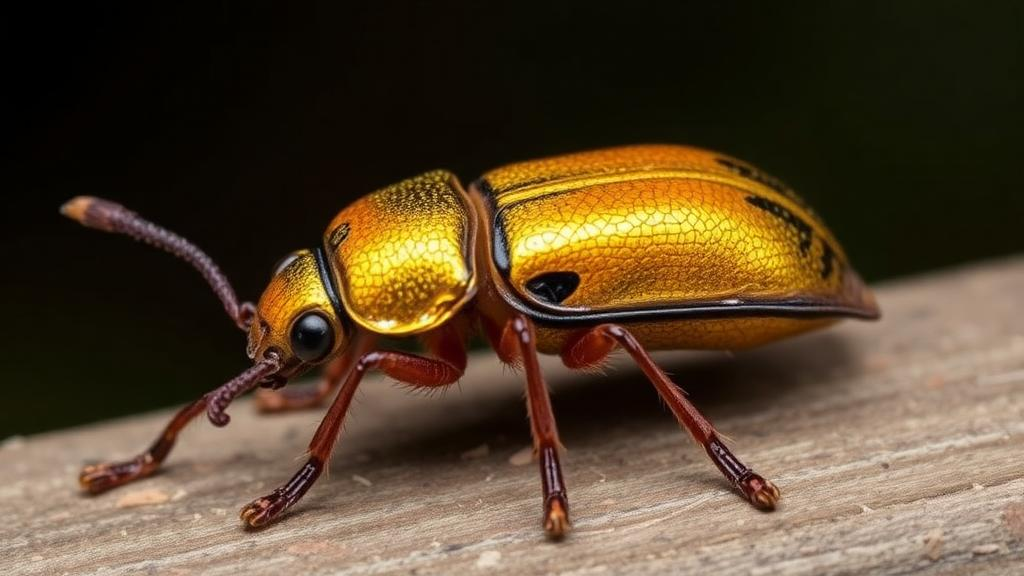
A single female beetle collected under a rock near farms in the village of Kumisi, Georgia, has turned out to be a species never before documented in the country. The darkling beetle Palorus subdepressus (Wollaston, 1864), a known secondary pest of stored products, was found during a short expedition organized under the Caucasus Barcode of Life initiative, or CaBOL, a regional effort to catalogue the biodiversity of the Caucasus using both classical taxonomy and DNA barcoding. The discovery, published in the journal Caucasiana, raises the number of Palorus species known from Georgia to three and adds a new piece to the puzzle of how this globally distributed insect has spread across the South Caucasus.
Darkling beetles, the family Tenebrionidae, are among the largest families in the entire beetle order Coleoptera, with tens of thousands of described species worldwide. Their greatest diversity is concentrated in arid landscapes, particularly the subtropical semi-deserts and deserts of the Palaearctic region, where they have radiated into an extraordinary array of forms adapted to dry, open habitats. In the Caucasus, a mountainous crossroads between Europe and Asia, the family is well represented, but the true richness of many groups remains poorly documented. The new record is a reminder of how much basic faunal inventory work is still to be done even in well-studied parts of the world.
The history of research on Georgian darkling beetles is sparse and episodic. One of the earliest lists of Caucasian beetles was published by the German naturalist Alfred Radde in 1899, and it included just a single species of the genus Palorus: P. ratzeburgi (Wissmann, 1848), recorded from Tbilisi, then known as Tiflis. More than a century later, the entomologist Dzhambazishvili, who studied Georgian darkling beetles for decades, produced the first comprehensive checklist of the family in the country in 2000, enumerating 87 species of Tenebrionidae. Once again, P. ratzeburgi stood as the only representative of the genus Palorus on Georgian territory.
Subsequent works gradually complicated that picture. In later catalogues published by Nikitski and colleagues in 2008 and by Abdurakhmanov and colleagues in 2011, a second species, P. depressus (Fabricius, 1790), was also indicated for Georgia. Meanwhile, a very recent survey of darkling beetles in the Lagodekhi Protected Areas, published by Japoshvili and colleagues in 2022, recorded no Palorus species at all. Taken together, these scattered reports paint a picture of a genus whose diversity and distribution in Georgia are simply not well understood, a gap that the new discovery begins to close.
The specimen that changed the tally was collected on 24 September 2021 by N. Bulbulashvili during a CaBOL expedition to Kumisi in the Gardabani Municipality, at coordinates 41.60794°N, 44.8655°E and an elevation of 498 metres above sea level. The beetle was found under a rock in heathland near farms, a habitat that hints at the species’ association with human-modified and agricultural landscapes. It was a single female, preserved immediately in 96 percent ethanol and stored in a freezer at minus 30 degrees Celsius, a protocol that keeps tissue in good condition for future DNA barcoding as part of the CaBOL programme.
Documentation of the specimen followed modern imaging standards. The preserved beetle was photographed with a Canon EOS 550D camera fitted with a Canon EF 100mm f/2.8 Macro USM lens and a Raynox DCR-250 Super Macro Snap-On attachment. Because a single macro photograph cannot keep the whole depth of a curved beetle body in focus, the researchers used Zerene Stacker image-stacking software to combine multiple frames into one sharp composite, with final touches made in Adobe Photoshop CS6. The resulting dorsal-view image of the female serves as a permanent visual record accompanying the publication.
Identification rested on a subtle but decisive anatomical character: the shape of the genae, the cheek regions of the head on either side of the eyes. In P. subdepressus, these structures are petaloid, meaning petal-shaped, and form two little horn-like projections, a feature described in earlier taxonomic treatments by Fleischer in 1900, Abdurakhmanov and colleagues in 2011, and Lillig and colleagues in 2012. Based on this diagnostic morphology, the Kumisi specimen was confirmed as P. subdepressus, making it the first record of the species for Georgia. The voucher specimen is kept at Ilia State University under the catalogue identifier CaBOL-ID 1010376, ensuring that the claim can be independently verified by any future researcher.
Why does a small brown beetle warrant attention? Palorus subdepressus, sometimes known as the depressed flour beetle, is a secondary pest of stored products. Unlike primary pests that can breach intact grain kernels, secondary pests such as Palorus typically exploit grain that is already damaged, mouldy or otherwise compromised, feeding on broken kernels, flour and processed products in mills, storehouses and pantries. The species is thought to have originated in Africa, as proposed by Halstead in 1967, but its lifestyle in close association with human food stores has carried it around the world, and it is today considered cosmopolitan in distribution.
Within the Caucasus region, previous records of P. subdepressus came from Krasnodar Kray in Russia, reported by Abdurakhmanov and colleagues in 2011, and from Azerbaijan, listed by Lobl and Lobl in 2020. Given those neighbouring records, the species’ presence in Georgia was arguably expected, and the authors note that the discovery indicates P. subdepressus is probably more widespread in the South Caucasus than previously thought. The find neatly fills a geographic gap between the Russian and Azerbaijani records and suggests that the beetle has quietly established itself across the region, likely moving with grain and other stored goods along trade and transport routes.
The authors emphasize that additional studies are needed to determine the full extent of the species’ distribution in the region and, importantly, the potential risks it could pose to the local economy. For a country with significant agricultural production and food-storage infrastructure, understanding where stored-product pests occur is a practical concern, not merely an academic one. The Kumisi record also underscores the value of targeted fieldwork and DNA-barcoding campaigns such as CaBOL: even a single specimen, carefully collected, preserved and photographed, can materially update scientific knowledge of a nation’s fauna and flag a pest species whose economic footprint in Georgia now deserves closer scrutiny.
Subject of Research: First record of the stored-product darkling beetle Palorus subdepressus in Georgia
Article Title: First record of Palorus subdepressus (Wollaston, 1864) ( Coleoptera : Tenebronidae ) from Georgia (Sakartvelo)
Article References: Japarashvili, S., Bulbulashvili, N., & Seropian, A. (2022). First record of Palorus subdepressus (Wollaston, 1864) (Coleoptera: Tenebronidae) from Georgia (Sakartvelo). Caucasiana, 1, 51-52. https://doi.org/10.3897/caucasiana.1.e83904
Image Credits: AI Generated
DOI: 10.3897/caucasiana.1.e83904
Keywords: Palorus subdepressus, Tenebrionidae, darkling beetles, Georgia, Caucasus, CaBOL, new record, stored-product pest, entomology, biodiversity, Kumisi, faunistics
Cite Scienmag News
Gavin Prescott. (October 19, 2026). Tiny Stored-Product Beetle Recorded in Georgia for the First Time. Scienmag. https://scienmag.com/tiny-stored-product-beetle-recorded-in-georgia-for-the-first-time/
Gavin Prescott. "Tiny Stored-Product Beetle Recorded in Georgia for the First Time." Scienmag, 19 October 2026, https://scienmag.com/tiny-stored-product-beetle-recorded-in-georgia-for-the-first-time/. Accessed 19 October 2026.
Gavin Prescott. "Tiny Stored-Product Beetle Recorded in Georgia for the First Time." Scienmag. October 19, 2026. https://scienmag.com/tiny-stored-product-beetle-recorded-in-georgia-for-the-first-time/


