


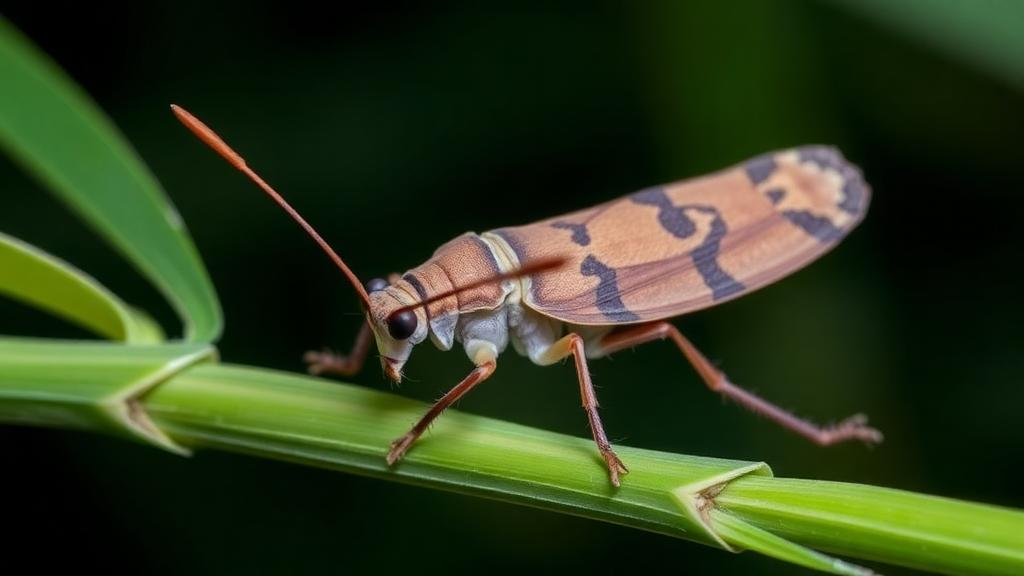
Deep in the forests of Shaowu City, in China’s Fujian Province, a small insect was clinging to bamboo stems, unnoticed by nearly everyone who passed. To the trained eye of an entomologist with a sweeping net, however, it was something special: a planthopper that did not match any species on record. A new taxonomic review of the cixiid planthopper genus Reptalus in China has now formally described this insect as Reptalus (Pererepa) inaequalis, a species new to science, and in doing so has lifted the number of known Chinese Reptalus species from six to seven. The work, published in the journal ZooKeys, also fills a conspicuous gap in the group’s biology by describing, for the first time, the female genitalia of two previously known species.
Reptalus belongs to the family Cixiidae, a lineage of planthoppers within the order Hemiptera, the true bugs. Cixiids are small, active insects that feed on plant sap through needle-like mouthparts, and their nymphs typically live in soil or leaf litter, often in association with plant roots. The genus Reptalus was established by the Russian taxonomist Emeljanov in 1971, with Cixius quinquecostatus Dufour, 1833 originally designated as its type species. Later work, informed by studies of the group’s morphology, transferred the type fixation to Flata artemisiae Becker, 1865, a change discussed in detail by specialists in 2024. Today the genus comprises four subgenera, Reptalus, Trepalus, Palvanus and Pererepa, and, with the new addition, 35 valid species distributed across the Palaearctic, Nearctic and Oriental regions.
What makes Reptalus recognisable is a distinctive combination of anatomical features. The vertex, the plate on top of the head between the eyes, is extremely broad and rectangular. The pygofer, a ring-like structure of the male genital capsule, is asymmetrical. The anal segment carries a caudal margin that is broadly and irregularly concave, and the apex of the gonostyli bears a characteristic large process on the inner side. Perhaps most telling is the aedeagus, the male intromittent organ, which carries a long process arising from a right-basal periandrial position, often accompanied by a smaller process at its base. These genital structures are the taxonomist’s primary toolkit in this group, because external appearance alone often fails to separate closely related species.
The new species, formally named Reptalus (Pererepa) inaequalis Lv, Li & Chen, sp. nov., was collected by sweeping in Shaowu City at coordinates 27°36’N, 117°49’E, with the holotype and paratypes, four additional males and eight females, gathered on 28 May 2012. All type material is deposited at the Institute of Entomology, Guizhou University in Guiyang. The species is a relatively large member of its genus: males measure 8.5 to 9.5 millimetres in total length and females 9.3 to 10.4 millimetres. Its body is black, with yellowish-brown carinae on the vertex, frons and pronotum, brown eyes, and semi-translucent forewings of light greyish brown marked with a dark brown stigma. The species name derives from the Latin word inaequalis, meaning unequal, a reference to the dorsal margin of the periandrium, which bears an unequally bifurcate spinose process at its apex.
Technically, R. inaequalis is diagnosed by a striking array of genital features. The hind tarsomere shows a chaetotaxy of 8/9 to 10, and the second tarsomere of the hind tarsi carries seven platellae, small plate-like sensilla on the foot. The pygofer is asymmetrical, with a fingerlike process at the middle of the left lobe, and both the anal segment and the gonostyli are asymmetrical, the latter bearing three lamellar processes at the apical part that curve inward. The aedeagus carries seven processes in total: the ventral margin of the periandrium bears two spinous processes, the shorter of which is shaped like a hawk’s beak and directed ventrocephalad, while the dorsal margin carries a forked process of unequal length. The endosoma, curved cephalad, bears three spinous processes at its basal ventral margin. In the female, the posterior vagina and associated structures, including the gonapophyses and the clavate gonoplac, are illustrated in detail, providing a morphological benchmark for future comparisons.
Beyond the new species itself, the review makes a significant contribution by describing and illustrating the female genitalia of Reptalus (Reptalus) arcbogdulus (Dlabola, 1965) and Reptalus (Pererepa) quadricinctus (Matsumura, 1914) for the first time. This matters because recent work on related cixiid genera such as Neocarpia, Oecleopsis and Tsauria has demonstrated that features of the posterior vaginal wall serve as key diagnostic characters for species-level identification. Pronounced sexual dimorphism has also been reported in R. iguchii, where males and females differ visibly in forewing coloration, underscoring how unreliable external appearance can be. Given how scarce female genitalic data have been for Reptalus, the new descriptions establish a reference framework that should make future systematic studies of the genus considerably more rigorous.
The review also delivers a complete checklist and an updated identification key to all seven Chinese species, a practical tool for anyone working with these insects in the field or the museum. The key separates the two subgenera present in China by whether the periandrium bears a dorsal tooth, then works through differences in forewing banding and the number, shape and position of aedeagal processes. Among the species covered, Reptalus (Reptalus) quinquecostatus boasts the widest global distribution, recorded from the United Kingdom and Spain across much of Europe and Asia to China’s Chongqing municipality, while Reptalus (Pererepa) quadricinctus is the most broadly distributed within China itself, known from fourteen provinces and municipalities stretching from Jilin in the northeast to Sichuan and Guizhou in the southwest.
The distributional data collected during the study carry their own headline. The known range of R. quadricinctus has now been extended to include Henan and Hebei provinces, confirming what the authors interpret as an ongoing range expansion within China. The seven Chinese species are spread across six zoogeographical subregions, from the Northeast and North China subregions to the Qinghai–Tibet, Southwest, Central and South subregions, suggesting that the genus has radiated into a wide variety of climates and habitats. The authors note that continued, intensified sampling is expected to extend the distribution of quadricinctus further and may well reveal additional, possibly undescribed taxa, a reminder that even relatively well-studied insect groups in China still hold surprises.
One of the most intriguing findings concerns what these insects eat. Among the documented host associations of Cixiidae, and indeed of planthoppers in general, Reptalus is the most extensively recorded genus, with larvae or adults collected from representatives of seventeen plant orders, ranging from grasses and legumes to roses, pines and nightshades. During the field surveys underpinning this review, adults of the new species R. inaequalis were collected from bamboo, the subfamily Bambusoideae within the grass family Poaceae. This indicates that bamboos may constitute an additional, previously unrecorded host resource for the species, adding a major group of plants to the genus’s already impressive host list and hinting at an ecological association worth investigating further.
For a group of insects most people will never notice, the Reptalus of China now tell a remarkably complete story. Seven species, a fully illustrated key, female genitalia described for three species, and a new bamboo-dwelling addition from Fujian together transform a poorly documented corner of the Chinese fauna into one of the better-characterized planthopper lineages in the region. The work also illustrates a broader truth of modern taxonomy: the characters that define a species often hide in fractions of a millimetre, in the forked tip of a spinose process or the proportions of a vaginal sclerite, and only patient morphological study, supported by careful fieldwork with a simple sweeping net, can bring them to light. As sampling intensifies across China’s provinces, the seven-species count for Reptalus may prove to be less a ceiling than a waypoint.
Subject of Research: Taxonomic review of the cixiid planthopper genus Reptalus in China, including the description of a new bamboo-associated species
Article Title: Review of the Chinese species of the genus Reptalus Emeljanov, 1971 ( Hemiptera , Fulgoromorpha , Cixiidae ), with description of a new species
Article References: Lv, S.-S., Li, Z.-Z., Zhi, Y., Zhang, Y.-B., Chen, X.-S., & Yang, L. (2026). Review of the Chinese species of the genus Reptalus Emeljanov, 1971 (Hemiptera, Fulgoromorpha, Cixiidae), with description of a new species. ZooKeys, 1290, 241-256. https://doi.org/10.3897/zookeys.1290.186750
Image Credits: AI Generated
DOI: 10.3897/zookeys.1290.186750
Keywords: Reptalus, Cixiidae, planthoppers, Hemiptera, new species, taxonomy, China, Fujian, female genitalia, bamboo, ZooKeys, entomology
Cite Scienmag News
Drew Townsend. (October 19, 2026). Hidden in the Bamboo: New Planthopper Species Pushes China’s Reptalus Count to Seven. Scienmag. https://scienmag.com/hidden-in-the-bamboo-new-planthopper-species-pushes-chinas-reptalus-count-to-seven/
Drew Townsend. "Hidden in the Bamboo: New Planthopper Species Pushes China’s Reptalus Count to Seven." Scienmag, 19 October 2026, https://scienmag.com/hidden-in-the-bamboo-new-planthopper-species-pushes-chinas-reptalus-count-to-seven/. Accessed 19 October 2026.
Drew Townsend. "Hidden in the Bamboo: New Planthopper Species Pushes China’s Reptalus Count to Seven." Scienmag. October 19, 2026. https://scienmag.com/hidden-in-the-bamboo-new-planthopper-species-pushes-chinas-reptalus-count-to-seven/


