


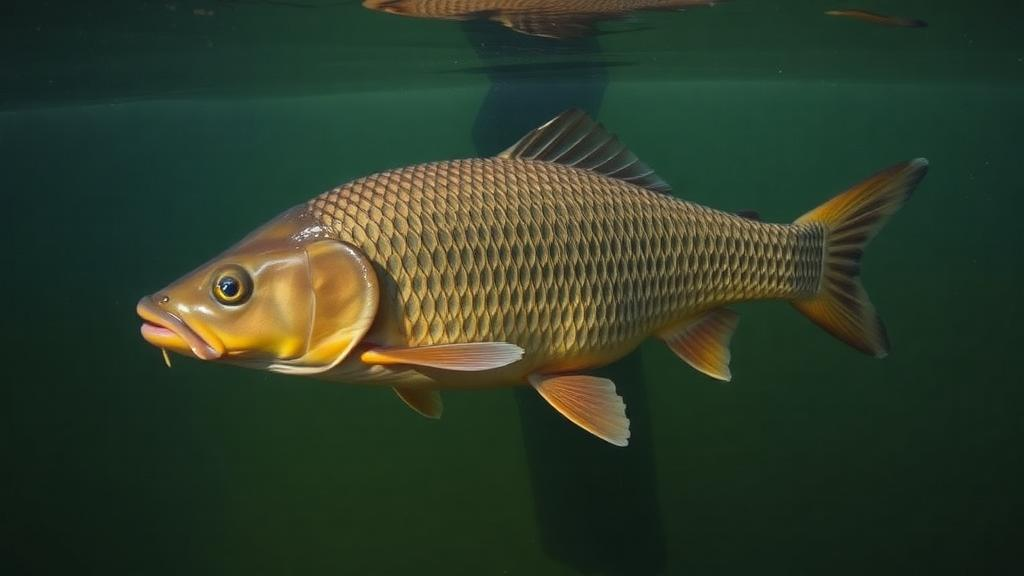
An invasive fish that has conquered freshwater systems across Eurasia is offering scientists an unusually clear window into how pollution reshapes the hidden world of parasites. In a multi-year study of Jandari Lake, a eutrophic transboundary lake straddling the border between Georgia and Azerbaijan, researchers examined 423 young gibel carp (Carassius gibelio) collected between 2014 and 2018. Their findings, published in the journal Caucasiana, show a parasite community that is strikingly poor in diversity yet dominated by hardy species with simple, direct life cycles — a biological fingerprint of a lake under sustained environmental stress.
The gibel carp is one of the most successful invasive fish species in Eurasia, thanks to strong adaptive capacity and high reproductive output that allow it to dominate nearly every kind of freshwater habitat. First reported in Georgia in 1985 and initially misidentified as the crucian carp, the species was later confirmed through morphological and genetic work to be C. gibelio. It has since spread rapidly through virtually all Georgian water bodies. Yet despite its ecological prominence, its parasite fauna in the country remained poorly documented, prompting the new investigation of the Georgian portion of Jandari Lake.
Jandari Lake, known historically also as Karaia and Gardabani Lake, sits at 290 meters above sea level in the Kvemo Kartli lowland within a temperate dry climate zone. Covering 10.6 square kilometers with a maximum depth of 7.2 meters, the lake is fed primarily by the Mtkvari River and is one of the most important eutrophic lakes in eastern Georgia’s Mtkvari River Basin. Eutrophication is ongoing, and dissolved oxygen levels are constrained by phytoplankton metabolism. The lake’s shores are largely swamped with reeds and bulrushes, and despite heavy organic pollution, the water body remains highly productive, supporting substantial zoobenthos biomass and serving as a stopover for up to 20,000 swimming birds during migration and wintering.
Between July 2014 and May 2018, the team collected young gibel carp — individuals up to four years old in three age groups (1+, 2+, and 3+) measuring 8 to 15 centimeters — using fishing nets across all seasons, examining at least 30 specimens per month. Each fish was immobilized, measured, weighed, and aged from its scales before standard parasitological dissection. Skin, fins, and gills were scraped and examined as mucus smears under the microscope for ectoparasites, while eyes and internal organs were inspected for endoparasites. Parasites were fixed and identified using established taxonomic keys, and infection levels were quantified as prevalence and intensity.
The results revealed that 20.3 percent of the examined fish — 86 individuals — harbored eleven parasite species belonging to five taxonomic groups: Protozoa, Monogenea, Trematoda, Nematoda, and Copepoda. Protozoa contributed three species (Trichodina sp., Ichthyophthirius multifiliis, and Dermocystidium sp.), Monogenea four (Dactylogyrus vastator, Gyrodactylus elegans, Ancyrocephalus sp., and Diplozoon paradoxum), Trematoda one (Diplostomum spathaceum), Nematoda two (Philometra sp. and Contracaecum sp.), and Copepoda one (Ergasilus sp.). Eight of these species — Ichthyophthirius multifiliis, Trichodina sp., Dermocystidium sp., Gyrodactylus elegans, Ancyrocephalus sp., Diplozoon paradoxum, Philometra sp., and Contracaecum sp. — were recorded for the first time in gibel carp from Georgian freshwater bodies.
Most infections were modest: 73.2 percent of infested fish carried a single parasite species, 16.2 percent carried two, and only 9.3 percent carried three simultaneously. The dominant taxa were the protozoan Trichodina sp. and the monogeneans Ancyrocephalus sp., Dactylogyrus vastator, and Gyrodactylus elegans. Notably, none of the parasites found were specific to gibel carp, and none posed any threat to human health. Differences in infection between female and male fish were negligible, with 37.5 percent of females and 35.8 percent of males infested — a pattern consistent with findings for the species in Croatia’s Lake Sakačaš.
Seasonal analysis showed that overall invasion was low throughout the study but peaked in spring, when 36.8 percent of sampled fish were infected, compared with 15.0 percent in autumn, 13.0 percent in winter, and just 8.3 percent in summer. Different parasites responded differently to the temperature regime: Trichodina invasion reached 16.5 percent in spring, monogeneans likewise peaked in spring (Ancyrocephalus at 14.2 percent, Gyrodactylus at 6.0 percent, and Dactylogyrus at 5.2 percent), while Contracaecum appeared only in winter (3.2 percent) and Dermocystidium was detected exclusively in winter (2.9 percent). Based on these patterns, the researchers grouped the parasites into those sensitive to seasonal temperature change — Trichodina, Dactylogyrus, Gyrodactylus, Ancyrocephalus, and Contracaecum — and those more uniform across the year, including Dermocystidium, Diplozoon, Philometra, and the copepods.
Age structure also shaped the parasite community. The youngest fish (age 1+) showed maximum invasion levels for Trichodina sp., Gyrodactylus elegans, Ancyrocephalus sp., and Philometra sp., all of which were detected across all three age categories. Dactylogyrus vastator occurred only in the 1+ and 2+ groups, while Diplostomum metacercariae appeared in minimal numbers in the youngest fish in spring but turned up in older individuals in autumn and winter. These findings align with classic ecological theory holding that young fish are primarily infested by monoxenic parasites — species with direct life cycles that require no intermediate host — while complex, multi-host parasites accumulate with age.
The most consequential story, however, is the long-term transformation of the lake’s parasite fauna. In the 1950s, 20 parasitic species were recorded in Jandari Lake’s fish, with the polyxenic cestode Ligula intestinalis — which requires multiple intermediate hosts — common among cyprinids. By the 1970s, dominant fish species still carried helminths of complex life cycles. Today, under strong eutrophication, the picture has changed completely: no ligulosis was detected at all, no acanthocephalans were found, and the community is dominated by ectoparasites of the gills and skin, namely Trichodina and monogeneans, which spread without intermediate hosts. Hydrobiological studies from the 2000s documented declining quality and quantity of zooplankton and zoobenthos due to organic pollution, and the researchers conclude that eutrophication has suppressed the copepod and amphipod intermediate hosts that heteroxenous helminths depend on. Resilient, directly developing parasites, by contrast, thrive under these regressive conditions.
The study also documented a striking synergistic association: in every spring and summer case, Trichodina appeared together with monogeneans on the gills, forming combined infections such as Trichodina plus Ancyrocephalus in 14 cases and Trichodina plus Dactylogyrus plus Gyrodactylus in 8 cases. Such co-occurrence of protozoans and monogeneans in the gill parasitocenosis has been noted before in Georgian cyprinids and appears to be a hallmark of freshwater systems under regressive change. Taken together, the results suggest that the invasive gibel carp is well adapted to Jandari Lake’s degraded ecosystem and may contribute to the spread of parasitic protozoa and helminths among commercial fish, while the lake’s eutrophication stands out as the single main ecological force determining which parasites persist — and which have vanished.
Subject of Research: Parasite ecology of invasive gibel carp in a eutrophic transboundary lake in Georgia
Article Title: Parasite ecology of Carassius gibelio (Bloch, 1782) in Jandari Lake (Georgia)
Article References: Murvanidze, L., Nikolaishvili, K., Lomidze, T., Japoshvili, B., Arabuli, L., & Asatiani, K. (2023). Parasite ecology of Carassius gibelio (Bloch, 1782) in Jandari Lake (Georgia). Caucasiana, 2, 15-23. https://doi.org/10.3897/caucasiana.2.e95777
Image Credits: AI Generated
DOI: 10.3897/caucasiana.2.e95777
Keywords: gibel carp, Carassius gibelio, parasites, eutrophication, Jandari Lake, Georgia, Monogenea, Protozoa, invasive species, freshwater ecology, fish health, seasonal dynamics
Cite Scienmag News
Gavin Prescott. (October 19, 2026). Invasive Gibel Carp in Georgian Lake Reveals Parasite Community Reshaped by Eutrophication. Scienmag. https://scienmag.com/invasive-gibel-carp-in-georgian-lake-reveals-parasite-community-reshaped-by-eutrophication/
Gavin Prescott. "Invasive Gibel Carp in Georgian Lake Reveals Parasite Community Reshaped by Eutrophication." Scienmag, 19 October 2026, https://scienmag.com/invasive-gibel-carp-in-georgian-lake-reveals-parasite-community-reshaped-by-eutrophication/. Accessed 19 October 2026.
Gavin Prescott. "Invasive Gibel Carp in Georgian Lake Reveals Parasite Community Reshaped by Eutrophication." Scienmag. October 19, 2026. https://scienmag.com/invasive-gibel-carp-in-georgian-lake-reveals-parasite-community-reshaped-by-eutrophication/


