


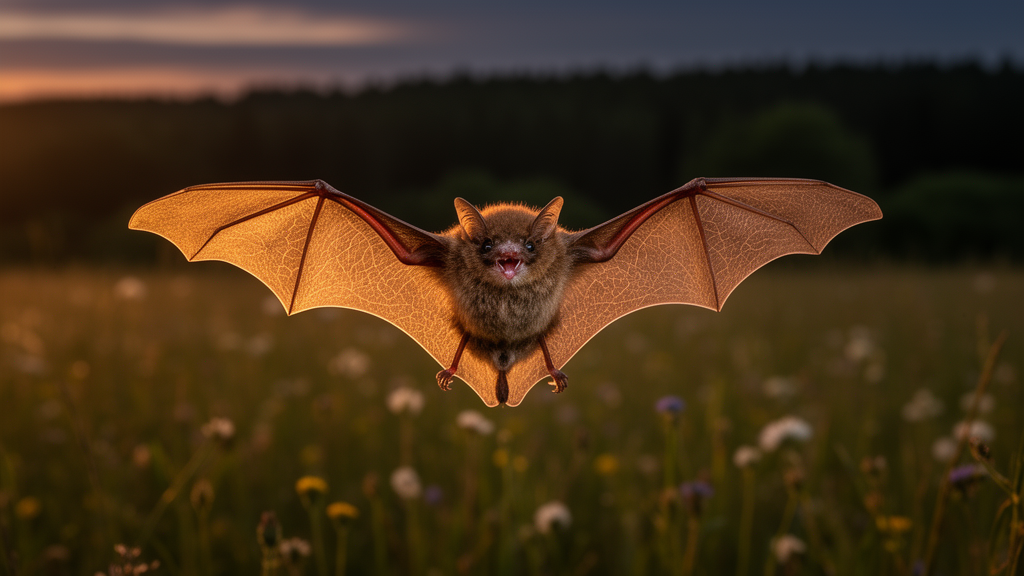
Bats, the only mammals on Earth capable of true powered flight, appear to have begun their evolutionary journey in Europe, according to one of the most ambitious comparative studies in modern mammalogy. A new analysis published in Nature by the international Bat1K consortium combined the largest collection of high-quality bat genomes ever assembled with a global survey of the fossil record, and concluded that the ancestors of today’s bats most likely originated on the European continent around 65 million years ago. The finding overturns decades of competing hypotheses that placed the origin of bats in Asia, Africa, or North America, and it rewrites the branching pattern of the bat family tree in the process.
The scale of the undertaking sets it apart from earlier attempts to resolve bat origins. An international team of 137 researchers from 64 countries contributed to the work, drawing on samples collected over decades from bats across the world. The genomic dataset covered 103 species and included representatives of every one of the 21 bat families currently recognised by science. Crucially, the sampling captured some of the rarest and most unusual bat lineages, animals collected from some of the most remote habitats on the planet. Alongside the genomes, the researchers integrated 44 fossil bats drawn from deposits across the globe, allowing living and extinct species to be analysed within a single analytical framework.
Technically, the study relied on state-of-the-art DNA sequencing paired with sophisticated computational methods to generate, compare, and annotate the genomes, identifying the genes each species carried. Rather than treating genetic data and palaeontological evidence as separate streams of information, the team modelled the evolution of fossil and living species together. Senior author Professor Liliana M Dávalos of Stony Brook University explained the distinctive power of this approach, noting that it can identify the oldest group of fossil bats while taking the genomic data into account, and uncover when and where bats originated. This joint modelling is what allowed the team to place both the timing and the geography of the bat origin with unprecedented confidence.
The results point to a two-stage expansion that shaped the modern global distribution of bats. After arising in Europe roughly 65 million years ago, the earliest descendants of the founding population dispersed into Africa, establishing a Europe-Africa hub. From that hub, bats subsequently expanded into Asia, the Americas, and Australia, producing the near-worldwide distribution seen today. This biogeographic narrative replaces a patchwork of regionally based origin stories and suggests that the deep history of mammalian flight is anchored to a single continental cradle rather than to multiple independent centres of emergence.
Beyond geography, the study also revised the shape of the bat evolutionary tree itself, resolving several long-running debates about how the major bat groups are related to one another. Scientists have struggled for decades with the most basic questions of bat phylogeny: how the families are connected, which lineages branched off first, and how the extraordinary traits of bats fit into that branching history. The new tree, grounded in whole genomes and tested against fossils, provides a revised framework that the authors say will serve as the reference point for future work on bat diversification.
One of the most consequential findings concerns echolocation, the biosonar system that allows most bats to orient and hunt in complete darkness using sound alone. The placement of the fossil bat Vielasia within the oldest branch of the bat family tree indicates that echolocation predates the diversification of modern bats. In other words, the ability to perceive the world through returning sound waves was already present in the ancestors of all living bat families. The finding suggests that two of the defining characteristics of bat biology, echolocation and powered flight, were established near the origin of the group itself, a combination that likely helps explain the extraordinary evolutionary success bats have enjoyed over the subsequent 65 million years.
To anchor these evolutionary inferences, the team also reconstructed the genome of the bat ancestor, producing a picture of what the first genome of a flight-capable mammal would have looked like. This ancestral genome now serves as a genomic map for how one lineage of mammals evolved powered flight, advanced biosonar, exceptional longevity, and unusual resistance to disease. Because the ancestor’s gene set can be compared systematically with those of living species, researchers can begin tracing which genetic changes accompanied each of these hallmark traits, and in what order they arose during the deep history of the lineage.
The implications of that map extend well beyond bats. Many bat species show remarkable resistance to disease and live exceptionally long lives for animals of their size, traits that have long fascinated biologists and medical researchers alike. The genomic resource built for this study gives scientists the first robust evolutionary framework for investigating the genes behind these characteristics. Understanding how bats manage ageing, immunity, and viral tolerance, within a properly resolved evolutionary context, could eventually inform human research into the same processes, from healthy ageing to disease resistance.
Senior author and Bat1K Director Professor Sonja Vernes of the University of St Andrews emphasised the significance of the collaborative achievement. Bats, she said, constantly surprise us and are one of evolution’s greatest experiments, and the extraordinary genomic resource, the culmination of years of international cooperation within Bat1K, is finally allowing researchers to understand how their remarkable biology evolved. Her remarks underscore a central theme of the project: that questions which resisted answer for generations became tractable only once genome-scale data from every bat family could be examined together.
The study also arrives at a moment when the wider importance of bats to ecosystems is increasingly recognised. With more than 1,500 species distributed across the globe, bats account for roughly one fifth of all living mammals and play vital roles in maintaining healthy ecosystems by pollinating plants, dispersing seeds, and consuming vast numbers of insect pests. A reliable evolutionary tree for such a large and ecologically consequential order of mammals is therefore more than an academic curiosity; it is a foundation for comparative biology, conservation planning, and biomedical research. By locating the cradle of bat evolution in Europe, dating the dawn of flight and echolocation to the group’s very beginning, and delivering an ancestral genome as a research template, the Bat1K consortium has transformed some of the oldest mysteries in mammalian evolution into solvable scientific questions, and it has done so with the largest combined genome and fossil dataset ever assembled for any comparable group.
Subject of Research: Evolutionary origins and phylogeny of bats based on combined genomic and fossil evidence
Article Title: New study reveals bats originated in Europe and rewrites the bat family tree
Article References: New study reveals bats originated in Europe and rewrites the bat family tree. (n.d.). Original publication
Image Credits: AI Generated
DOI: Not provided
Keywords: bats, Bat1K, evolution, phylogenetics, genomics, echolocation, powered flight, fossils, Europe, biogeography, Nature, ancestral genome
Cite Scienmag News
Juliet Wilcox. (October 18, 2026). Bats Took Flight in Europe, Massive Genome and Fossil Study Finds. Scienmag. https://scienmag.com/bats-took-flight-in-europe-massive-genome-and-fossil-study-finds/
Juliet Wilcox. "Bats Took Flight in Europe, Massive Genome and Fossil Study Finds." Scienmag, 18 October 2026, https://scienmag.com/bats-took-flight-in-europe-massive-genome-and-fossil-study-finds/. Accessed 18 October 2026.
Juliet Wilcox. "Bats Took Flight in Europe, Massive Genome and Fossil Study Finds." Scienmag. October 18, 2026. https://scienmag.com/bats-took-flight-in-europe-massive-genome-and-fossil-study-finds/


