


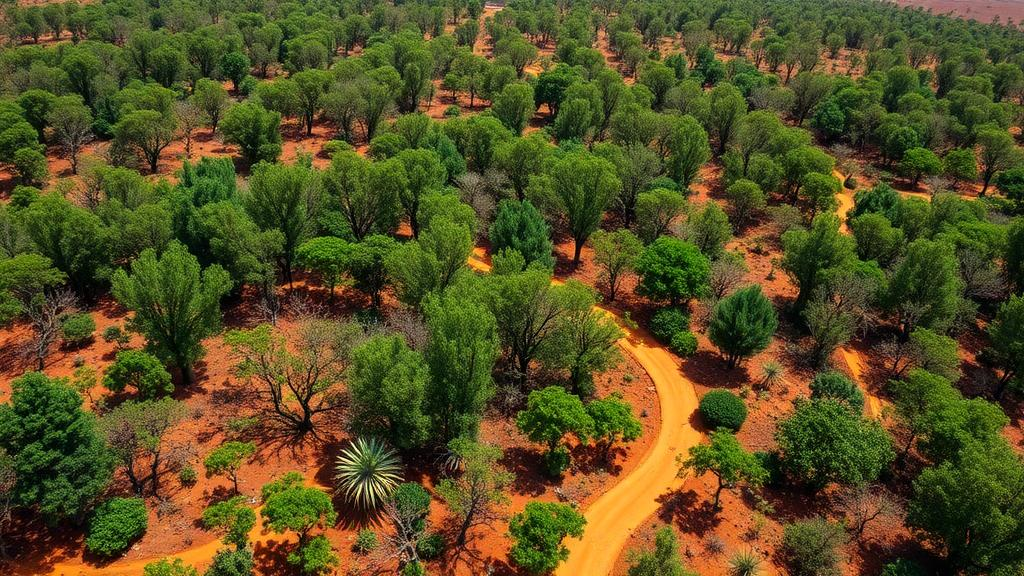
Brazil’s Cerrado, the vast savanna expanse that covers roughly 23 percent of the national territory, is being destroyed faster than almost any other ecosystem on Earth, and a sweeping new review argues that the world’s attention has failed to keep pace with the damage. The paper, published in Nature Conservation, offers a comprehensive assessment of the threats bearing down on the region and lays out a detailed agenda for slowing, and eventually reversing, its decline.
The Cerrado originally spanned approximately two million square kilometers, with about 98 percent of that area inside Brazil and small portions extending into Bolivia and Paraguay. Recognized as a global biodiversity hotspot, it harbors thousands of endemic species and underpins the health of the country’s major river basins. Yet more than 55 percent of its native vegetation has already been destroyed, an area exceeding one million square kilometers converted into pastures, monocultures, and cities, with the pace of conversion accelerating sharply from the 1980s onward.
Satellite monitoring data cited in the review show that between 1985 and 2023 the Cerrado lost roughly 380,000 square kilometers of native vegetation, equivalent to 19 percent of its original coverage. Since systematic monitoring began in 2001, more than 326,000 square kilometers have been cleared, an area nearly the size of Italy. Annual clearing rates peaked at nearly 29,000 square kilometers in 2003 and 2004, fell through the following decade, and then climbed again from 2019, reaching a recent peak of about 11,012 square kilometers in 2023 before declining to 7,235 square kilometers in 2025.
One of the review’s central arguments is that the Cerrado cannot be treated as a single, uniform savanna. The authors propose calling it an “ecodomain,” a term meant to capture its true heterogeneity: grasslands such as Campo Limpo and Campo Rupestre, savanna formations including Cerrado Denso and Vereda, and forests such as Cerradão, Mata Ciliar, and Mata Seca. These ecosystems occur in dynamic, interdependent mosaics, each with distinct vulnerabilities. Rocky grassland ecosystems, for example, occupy only about 7 percent of the Cerrado but host extraordinary endemism and feed the springs that make the region Brazil’s “water tank,” yet they are prime targets for mining of iron, niobium, gold, and quartz.
Fire is another axis of the crisis. Many Cerrado species evolved under natural fire regimes, developing thick bark, underground storage organs, and deep roots that allow them to resprout after burning. But the review stresses that roughly 99 percent of fires in Brazil are now of human origin, occurring with increasing frequency and intensity outside natural seasonality. Between 1985 and 2022, fire affected 40 percent of the Cerrado, and 63 percent of that burned area burned more than once. In 2024 the region recorded around 14.6 million hectares of burned land, the highest figure since 2012, a level the authors describe as a collapse of the ecological fire regime.
The hydrological stakes are equally severe. The Cerrado is the cradle of eight of Brazil’s twelve major river basins and sits atop three immense aquifers: Bambuí, Urucuia, and Guarani. Deep-rooted vegetation channels rainfall into the ground and sustains dry-season river flows. Irrigation for soybeans and other commodities, hydropower dams on once free-flowing rivers, and agrochemical runoff are depleting and contaminating these reserves, a fragility exposed during Brazil’s worst drought in nearly a century in 2021.
The biodiversity accounting is sobering. The region hosts more than 3,200 vertebrate species, around 13,000 angiosperm plants, and an estimated invertebrate fauna that may exceed 90,000 species. The authors estimate roughly 600 angiosperms and between 400 and 450 invertebrates are formally threatened, more than all threatened terrestrial vertebrates combined. Among 340 known endemic terrestrial vertebrates, only 57 have been officially assessed as globally threatened, and more than 20 percent remain unassessed or data deficient, meaning many species may vanish before science even records them.
Legal protections are a particular focus of criticism. The Forest Code requires landowners to preserve only 20 percent of native vegetation as a legal reserve in most of the Cerrado, versus 35 percent in the Legal Amazon, an asymmetry the authors call unjustified. Permanent protection strips along watercourses are set at 30 meters for rivers up to 10 meters wide, far narrower than the natural width of gallery forests, undermining their ecological function. Only about 8 percent of the Cerrado is effectively protected, and less than 3 percent in strictly protected areas, far short of the Kunming-Montreal Global Biodiversity Framework’s 30 percent target for 2030.
The review also highlights the role of Indigenous peoples, around 100,000 people from at least 83 ethnic groups living across roughly 109 recognized territories covering about 4.4 percent of the original Cerrado. The authors firmly reject narratives blaming Indigenous communities for degradation, describing them instead as guardians whose controlled burning practices and traditional knowledge support conservation. They warn that the 2023 “Marco Temporal” law, which conditions land rights on occupation as of 1988, and agribusiness proposals to legalize farming on Indigenous lands threaten to accelerate biodiversity loss.
The proposed way forward combines expanding conservation units and Indigenous lands, restoring degraded pastures and abandoned croplands using techniques such as biomass transposition, and shifting from extractive to regenerative economies built on premium native products, payments for ecosystem services, and carbon credits that recognize the Cerrado’s largely underground carbon stocks, which average about 158 tons per hectare with 87 percent stored belowground. The authors frame defending the Cerrado not merely as an ecological imperative but as an agenda for environmental justice, water security, and intergenerational responsibility, urging that the region be repositioned at the center of global discussions on conservation, climate, and sustainable development.
Subject of Research: Threats to and conservation pathways for the Cerrado biodiversity hotspot in Brazil
Article Title: The Cerrado crisis review: highlighting threats and providing future pathways to save Brazil's biodiversity hotspot
Article References: Pereira, C. C., Kenedy-Siqueira, W., Maia, L. R., Sperandei, V. D. F., Arantes-Garcia, L., Fernandes, S., Fernandes, G. F. C., de Castro, G. C., Rodrigues, D. D. J., Salm, R., & Fearnside, P. M. (2026). The Cerrado crisis review: highlighting threats and providing future pathways to save Brazil's biodiversity hotspot. Nature Conservation, 61, 29-70. https://doi.org/10.3897/natureconservation.61.168273
Image Credits: AI Generated
DOI: 10.3897/natureconservation.61.168273
Keywords: Cerrado, biodiversity hotspot, deforestation, Brazil, fire regime, water security, conservation units, Forest Code, Indigenous lands, ecological restoration, carbon sink, savanna
Cite Scienmag News
Margaret Porter. (October 18, 2026). Brazil’s Cerrado Faces Escalating Destruction as Scientists Map a Path to Save the Biodiversity Hotspot. Scienmag. https://scienmag.com/brazils-cerrado-faces-escalating-destruction-as-scientists-map-a-path-to-save-the-biodiversity-hotspot/
Margaret Porter. "Brazil’s Cerrado Faces Escalating Destruction as Scientists Map a Path to Save the Biodiversity Hotspot." Scienmag, 18 October 2026, https://scienmag.com/brazils-cerrado-faces-escalating-destruction-as-scientists-map-a-path-to-save-the-biodiversity-hotspot/. Accessed 18 October 2026.
Margaret Porter. "Brazil’s Cerrado Faces Escalating Destruction as Scientists Map a Path to Save the Biodiversity Hotspot." Scienmag. October 18, 2026. https://scienmag.com/brazils-cerrado-faces-escalating-destruction-as-scientists-map-a-path-to-save-the-biodiversity-hotspot/


