


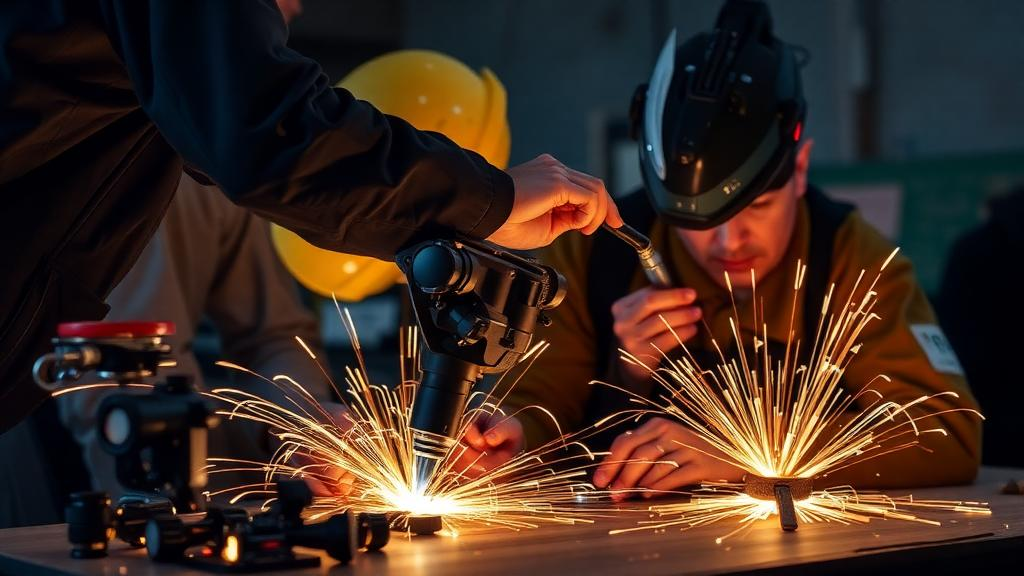
Mathematics teachers in technical and vocational schools have long struggled with a deceptively simple problem: how to make abstract equations feel relevant to students who spend their days welding metal. A new study published in Discover Education suggests that generative artificial intelligence tools, specifically ChatGPT and Meta AI, may offer a practical solution. The research, conducted by Philip Adjei Acheampong, Matilda Sarpong Adusei, and Leticia Nana Sam, explored whether these AI assistants could help mathematics teachers generate contextualised examples and tasks for welding and fabrication courses in Ghanaian second-cycle technical and vocational education and training institutions.
The motivation behind the study stems from a persistent gap in vocational mathematics education. Research indicates that all forms of skilled work involve some degree of mathematics, and the ability to apply mathematical concepts to real-world situations is critical to students’ success in their chosen trades. Studies have shown that designing mathematical content around students’ career pathways can increase their interest, conceptual understanding, and academic performance. Yet mathematics teachers encounter significant difficulties in contextualising mathematics within TVET trade areas because of inadequate training and limited teaching resources, including textbooks. Teachers typically spend considerable time contextualising mathematical content to communicate it effectively to their students, making contextualisation an important skill that teachers must develop.
Contextualised mathematics teaching in TVET institutions is a pedagogical approach intended to make mathematical concepts more meaningful and applicable to real-world situations. When contextualising mathematical content within welding and fabrication courses, teachers connect relevant topics including geometry, algebra, trigonometry, fractions, decimals, rates, ratios, and percentages to their practical applications in the trade. For example, when teaching volume and surface area, a teacher might ask students to calculate the volume and total surface area of a cuboid-shaped metal container measuring 7 feet by 5 feet by 4 feet that a welder wants to fabricate. This problem is more relevant to welding and fabrication students than an abstract question that merely provides the dimensions of a cuboid without any workplace connection.
The study adopted an exploratory case study research design, which was appropriate because it involved the potential use of AI tools in a specific educational context. Using purposive sampling, two mathematics teachers from two TVET institutions in Ghana were selected to generate mathematical questions and examples. Each teacher had at least 12 years of experience teaching mathematics to welding and fabrication students. The two institutions were selected because they had offered welding and fabrication programmes for more than 20 years, possessed the equipment required for practical training, and had collaborated with local and international organisations. Four experts were also purposively selected to evaluate the AI-generated outputs: a welding and fabrication teacher, a head of the welding and fabrication department, a welding and fabrication curriculum expert, and a member of the Sector Skills Body.
The mathematical content specific to welding and fabrication was selected from Fabrication Mathematics I and II of the American Welding Society and the Mathematics Curriculum for Welders of Northeast Wisconsin Technical College. The selected topics and subtopics were validated by the four experts, and following agreement among them, the content areas were consolidated into a single framework that guided the generation and evaluation of outputs. The two mathematics teachers used ChatGPT and Meta AI applications on their mobile phones to generate tasks and examples for each identified content area, following specific prompting guidelines to ensure consistency. For example, one prompt used to generate a question involving the addition of fractions asked the AI to provide a contextualised problem specifically related to welding and fabrication and appropriate for students in a second-cycle institution. The generation process was conducted over six days across three weekends because the teachers were available on Saturdays and Sundays.
The study was underpinned by the Technological Pedagogical Content Knowledge framework, developed by Mishra and Koehler by extending Shulman’s concept of pedagogical content knowledge to incorporate technological knowledge. The framework comprises seven interrelated knowledge domains covering content knowledge, pedagogical knowledge, technological knowledge, pedagogical content knowledge, technological content knowledge, technological pedagogical knowledge, and the integrated TPACK itself. The framework guided the study by indicating that mathematics teachers should know the mathematics concepts specifically related to welding and fabrication, and select either ChatGPT or Meta AI to input the correct statements that generate expected questions. Without this integrated knowledge, teachers may struggle to use the AI tools effectively in generating questions related to the trade area.
The results revealed that both ChatGPT and Meta AI generated high-quality, well-structured, and meaningful questions that demonstrated a good understanding of how to contextualise mathematical content within welding and fabrication courses. The questions generated across nine mathematical content areas, including decimal fractions, pre-algebra, algebra, measurement, fractions, triangular trigonometry, geometry, and percentages with rates and ratios, were meaningful and relevant mathematical problems. However, a clear pattern emerged in the comparative analysis: ChatGPT generated more detailed questions that required higher-order thinking and covered a broader range of real-world applications, whereas the questions generated by Meta AI were more straightforward and focused on basic concepts. For example, ChatGPT’s question on converting a decimal to a fraction applied the mathematical concept to interpreting a calliper reading, while Meta AI’s question involved only converting the diameter of a rod.
The experts’ evaluations further indicated that a high percentage of the generated questions were within the students’ level and catered to different levels of difficulty. The welding and fabrication teacher estimated that about 99 percent of all the questions generated by ChatGPT and Meta AI were within the level of the students, noting that the examples and tasks were of different levels of difficulty, making them easy to use during class instruction. The curriculum expert estimated that about 97 percent were within the level of senior high school students, with the remaining 3 percent slightly below the secondary school level. The head of the welding and fabrication department observed that the questions spanned different levels of Bloom’s taxonomy, covering knowledge, understanding, application, analysis, synthesis, and evaluation, allowing instructors to arrange them from less difficult to more demanding questions during teaching.
The experts also confirmed that the questions were relevant to the welding and fabrication course, supported the application and transfer of mathematical knowledge, and addressed the mathematical competencies required in the trade area. The curriculum expert estimated that about 99 percent of the examples generated by the two tools were directly linked to the welding and fabrication course. The head of department stated that the nature of the questions was exactly what the teaching syllabus required from mathematics instructors and that the examples aligned with the objectives and requirements of the mathematics syllabus. The Sector Skills Body expert concluded that the questions could provide students with the mathematical competencies required in the trade area, giving the example of a question about calculating the surface area of a cylindrical tank with a diameter of 4 feet and height of 6 feet, which could guide students in making cylindrical containers with minimal material waste.
The findings suggest that these AI tools can assist teachers in connecting theoretical mathematics to real-world trade applications, thereby facilitating students’ understanding and preparation for careers in welding and fabrication. The tools could help address some of the challenges mathematics teachers encounter when teaching in vocational trade areas, particularly for teachers who may be unfamiliar with welding and fabrication themselves. However, given the exploratory nature of the study and its limitations, including the use of specific AI tools and only two teachers from specific institutions, caution should be exercised when generalising the findings. Future research should investigate the effectiveness of AI-generated mathematics problems in actual classroom settings, exploring how they impact student interest, performance, and perceptions regarding the relevance of mathematics in the trade area. Considering the inherent limitations of Meta AI and ChatGPT in relation to contextualisation, reliability, and accuracy, educators should exercise caution when using AI-generated content and ensure that it is carefully reviewed and validated by experts before classroom use.
Subject of Research: Use of ChatGPT and Meta AI to contextualise mathematics content in welding and fabrication courses
Article Title: Enhancing mathematics teachers’ contextualization of mathematics content in welding and fabrication courses using ChatGPT and Meta AI
Article References: Acheampong, P. A., Adusei, M. S., & Sam, L. N. (2026). Enhancing mathematics teachers’ contextualization of mathematics content in welding and fabrication courses using ChatGPT and Meta AI. Discover Education, 5(1), Article 830. https://doi.org/10.1007/s44217-026-02067-8
Image Credits: AI Generated
DOI: 10.1007/s44217-026-02067-8
Keywords: ChatGPT, Meta AI, mathematics education, TVET, welding and fabrication, contextualisation, generative AI, TPACK, Ghana, vocational education, Enhancing, mathematics
Cite Scienmag News
Courtney Benton. (October 18, 2026). ChatGPT and Meta AI Help Teachers Bring Welding Math to Life. Scienmag. https://scienmag.com/chatgpt-and-meta-ai-help-teachers-bring-welding-math-to-life/
Courtney Benton. "ChatGPT and Meta AI Help Teachers Bring Welding Math to Life." Scienmag, 18 October 2026, https://scienmag.com/chatgpt-and-meta-ai-help-teachers-bring-welding-math-to-life/. Accessed 18 October 2026.
Courtney Benton. "ChatGPT and Meta AI Help Teachers Bring Welding Math to Life." Scienmag. October 18, 2026. https://scienmag.com/chatgpt-and-meta-ai-help-teachers-bring-welding-math-to-life/


