


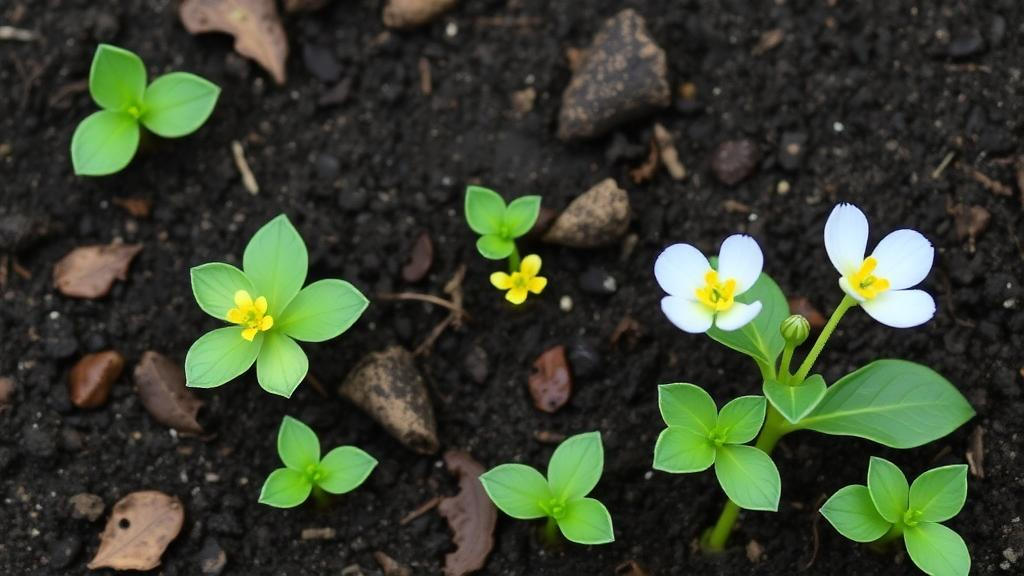
Seed germination is the most fragile moment in the life of a plant. A germinating seed cannot run from drought, cannot filter out salt, and cannot avoid heavy metals dissolved in the water it absorbs. Yet a simple, low-cost technique called seed priming can give seedlings a head start: seeds are soaked in a solution that partially hydrates them and switches on their stress defenses, without allowing the root to break through the seed coat. When the seed is finally sown, it has already begun the metabolic preparations that would normally only start after sowing. A new study published in the journal BioRisk has tested this approach on greater celandine (Chelidonium majus L.), a medicinal plant cultivated as a crop in parts of Central Europe, and the results reveal a nuanced picture of when priming helps and when its benefits remain hidden.
The research team, working with seeds collected from plants growing in their native habitat near the village of Mramor close to Sofia, Bulgaria, investigated whether priming with the amino acid proline or with the plant hormone methyl jasmonate could mitigate three major abiotic stresses: heavy metal contamination, soil salinization, and drought. Both proline and methyl jasmonate are compounds that plants themselves biosynthesize to cope with difficult conditions. Proline acts as an osmoprotectant, a metal chelator and an antioxidant, accumulating in plant tissues when they are exposed to salt, drought or toxic metals. Methyl jasmonate, meanwhile, functions as a signaling molecule that orchestrates plant responses to both abiotic and biotic challenges, and its exogenous application has been shown to elevate endogenous levels of protective compounds including proline itself.
The experimental design was meticulous. Two-year-old seeds of uniform size were divided into treatment groups: one soaked in distilled water (hydropriming), one in a 30 millimolar proline solution, and one in a methyl jasmonate solution at a concentration of 1 milligram per liter. All soaking lasted 24 hours at room temperature, after which the seeds were dried under a laminar air flow cabinet for an hour. Before priming, the seeds were surface sterilized in a multi-step procedure involving 70 percent ethanol, mercuric chloride, and diluted sodium hypochlorite, followed by repeated rinses in sterile distilled water. The sterilized seeds were then sown onto water agar medium solidified with plant agar and supplemented with different stress-inducing compounds.
The stress agents were applied at graded concentrations. Heavy metal stress came from lead nitrate, zinc sulfate and cadmium chloride, yielding 100, 150 and 250 milligrams per liter of lead or zinc ions and 1, 5 and 10 milligrams per liter of cadmium ions. Salt stress was imposed with sodium chloride at 50, 100 and 150 millimolar, while drought-like osmotic stress was simulated with polyethylene glycol 6000 at 1 and 5 percent. The petri dishes were sealed with Parafilm and incubated first in the dark at 8 degrees Celsius for a week, then at 23 degrees Celsius for two weeks, before being moved to a 16-hour light and 8-hour dark photoperiod. Each treatment was replicated three times with 20 seeds per replicate, and radicle emergence was scored as germination. The researchers measured germination percentage, root and hypocotyl length, tolerance index and phytotoxicity, analyzing the data with Student’s t-test using SigmaPlot software.
The heavy metal results contained a genuine surprise. Rather than suppressing germination, low concentrations of all three metals actually increased it across every seed variant, whether control, hydroprimed, proline-primed or methyl jasmonate-primed. For lead, higher concentrations produced higher germination percentages, suggesting that lead ions did not inhibit germination of celandine seeds at all. On zinc-supplemented medium, methyl jasmonate-primed seeds achieved the highest germination at every concentration tested, while increasing zinc reduced germination in hydroprimed and proline-primed seeds. Cadmium behaved differently: rising concentrations progressively reduced germination in all variants, with methyl jasmonate-primed seeds falling to 64.71 percent at the highest cadmium level. The researchers suggest that the seed coat may be impermeable to some heavy metals, shielding the embryo during germination even as the emerging seedling becomes vulnerable.
That vulnerability became starkly apparent in the seedling growth data. Although seeds germinated readily on heavy metal media, root and hypocotyl development was severely inhibited. On lead and zinc media, the radicles barely protruded from the seed coat, turned black and perished, and priming offered no protection against this growth collapse. Cadmium was also highly phytotoxic, though at the lowest concentration of 1 milligram per liter the roots continued to grow to a limited extent, and the tolerance indices of proline- and methyl jasmonate-primed seeds were higher than those of water-soaked seeds at that level. At 5 and 10 milligrams per liter cadmium, however, the advantage of elicitor priming vanished almost entirely. This pattern echoes earlier findings in Arabidopsis and wheat showing that heavy metals are generally more toxic to seedling growth than to germination itself, likely because roots are the first organ to contact the contaminated medium.
Salt stress told a different and more encouraging story. Sodium chloride significantly reduced the germination of hydroprimed seeds, an effect attributed to perturbed water imbibition, hyperosmotic stress and impaired mobilization of stored food reserves. But proline and methyl jasmonate priming clearly compensated: primed seeds germinated at higher percentages than hydroprimed seeds on the same salt media, revealing the beneficial effect of elicitor priming that remained hidden under heavy metal and drought treatments. The alleviating effect weakened as salt concentration rose, and above 50 millimolar NaCl the phytotoxicity and tolerance index values converged for all treatments. Seedling growth fared poorly under salt regardless of priming: at 150 millimolar NaCl the roots of hydroprimed seeds were completely suppressed, and the researchers note that salt accumulation, cytotoxic ion buildup and impaired stomatal closure all contribute to the damage.
Drought, simulated with polyethylene glycol 6000, proved to be the gentlest of the three stresses. Germination was not significantly affected by priming, and at the higher concentration of 5 percent PEG 6000 germination was actually slightly stimulated across all variants. Root and hypocotyl lengths remained close to control values, and proline-primed seeds grown on 1 percent PEG 6000 produced roots significantly longer than the control. Proline- and hydroprimed seeds showed high tolerance at the lower PEG concentration with essentially no phytotoxicity, while the positive influence of methyl jasmonate emerged at the higher concentration. The authors note that methyl jasmonate has previously been shown to alleviate osmotic stress in rice through changes in seedling physiology, consistent with their observations here.
The broader lesson from the study is that the value of seed priming depends critically on the type and intensity of the stress encountered. When a stress factor does not inhibit germination in the first place, as with heavy metals and PEG 6000 in this system, the protective effect of proline and methyl jasmonate remains masked, a phenomenon consistent with the long-standing observation that priming benefits are most visible under adverse rather than favorable conditions. Salt stress, by contrast, exposed the clear advantage of elicitor priming, while hydropriming alone failed to reduce salt damage. The degree of protection also depends on the concentration applied, the developmental stage of the plant and the mode of application, factors the authors say require further study to fully elucidate.
For greater celandine, a species valued for its anti-inflammatory, anti-tumor, anti-microbial and anti-viral properties and used in both conventional herbal remedies and homeopathic treatments for liver disorders, the findings carry practical weight. As cultivation of the species expands in a changing environment marked by drought, salinization and heavy metal pollution, understanding which pre-sowing treatments can safeguard its earliest life stages becomes increasingly important. This study demonstrates that proline and methyl jasmonate priming can meaningfully buffer germination against salt stress, even though it cannot rescue seedling growth from severe heavy metal toxicity. For growers and researchers alike, it is a reminder that in plant stress biology, the timing and nature of the challenge determine whether a seed’s chemical head start will make all the difference.
Subject of Research: Effects of proline and methyl jasmonate seed priming on germination and seedling growth of Chelidonium majus under heavy metal, salt and drought stress
Article Title: Influence of proline and methyl jasmonate priming on in vitro seed germination and seedling development of Chelidonium majus L
Article References: Doycheva, I. (2022). Influence of proline and methyl jasmonate priming on in vitro seed germination and seedling development of Chelidonium majus L. BioRisk, 17, 227-240. https://doi.org/10.3897/biorisk.17.77465
Image Credits: AI Generated
Keywords: seed priming, proline, methyl jasmonate, Chelidonium majus, heavy metal stress, salinity, drought, germination, seedling growth, abiotic stress, medicinal plants, PEG 6000
Cite Scienmag News
Alan Morgan. (October 18, 2026). Seed Priming with Proline and Methyl Jasmonate Helps Greater Celandine Germinate Under Salt Stress. Scienmag. https://scienmag.com/seed-priming-with-proline-and-methyl-jasmonate-helps-greater-celandine-germinate-under-salt-stress/
Alan Morgan. "Seed Priming with Proline and Methyl Jasmonate Helps Greater Celandine Germinate Under Salt Stress." Scienmag, 18 October 2026, https://scienmag.com/seed-priming-with-proline-and-methyl-jasmonate-helps-greater-celandine-germinate-under-salt-stress/. Accessed 18 October 2026.
Alan Morgan. "Seed Priming with Proline and Methyl Jasmonate Helps Greater Celandine Germinate Under Salt Stress." Scienmag. October 18, 2026. https://scienmag.com/seed-priming-with-proline-and-methyl-jasmonate-helps-greater-celandine-germinate-under-salt-stress/


