


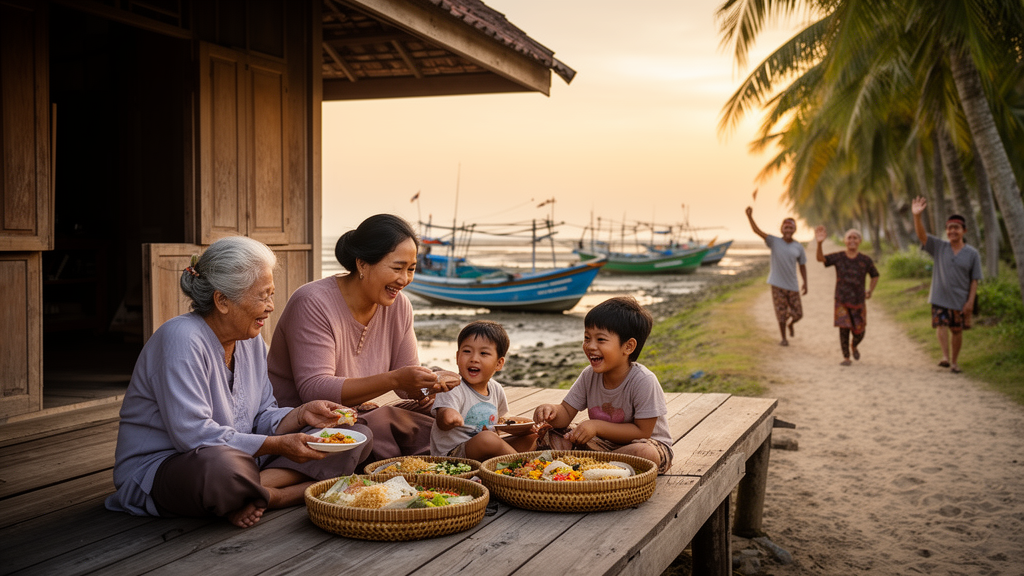
Researchers from Universitas Hasanuddin in Makassar, Indonesia, have published a qualitative study that challenges the prevailing Western-centric models of human well-being by demonstrating how maritime communities in South Sulawesi define their quality of life through relational and collective frameworks rather than individualistic metrics. Published in the open-access journal Discover Sustainability, the study, led by Muhammad Tamar, Syurawasti Muhiddin, and Hillman Wirawan, offers a critical perspective on the intersection of psychology, ecology, and social sustainability. The findings suggest that for these coastal populations, well-being is not a static state of individual happiness but a dynamic process rooted in family responsibility, social solidarity, and spiritual meaning, providing a new lens for understanding sustainable livelihoods in vulnerable maritime regions.
The research addresses a significant gap in the literature regarding the Sustainable Development Goals, specifically SDG 1 (No Poverty), SDG 3 (Good Health and Well-being), and SDG 14 (Life Below Water). Existing frameworks often rely on externally imposed indicators that fail to capture the nuanced realities of coastal life, limiting their utility for effective sustainability policy. By examining how local communities define and experience well-being, the study aims to provide an empirical basis for culturally grounded interventions. This approach is crucial for ensuring that sustainability efforts in maritime regions do not inadvertently disrupt the social fabrics that keep these communities resilient in the face of environmental and economic uncertainty.
To investigate these complex social dynamics, the research team employed a qualitative exploratory design, conducting semi-structured interviews with 104 participants from two purposively selected regencies in South Sulawesi: Takalar, associated with the Makassar ethnic group, and Pangkep, associated with the Bugis ethnic group. The study utilized inductive reflexive thematic analysis to identify patterns in the participants’ narratives. This methodological choice allowed the researchers to remain open to the specific cultural contexts of the participants, avoiding the imposition of pre-existing theoretical categories that might not align with local realities. The selection of these two regencies provided a comparative perspective on how different ethnic groups within the same geographic region conceptualize well-being, highlighting both convergences and divergences in their social structures.
The analysis revealed that well-being in these communities is a multidimensional and relational construct spanning family, economic, social, psychological, spiritual, and physical domains. While these domains largely converge with those reported in cross-cultural studies, the study identifies a distinctive organizational structure: family operates as the central axis around which all other domains are ordered. This finding suggests that individual well-being is inextricably linked to one’s role and responsibilities within the family unit. Material security, for instance, is not valued for its contribution to individual accumulation or personal luxury, but rather for its role in ensuring collective continuity and the ability to fulfill familial obligations.
A key technical aspect of the study involves the examination of locally institutionalized reciprocity systems that enact this ordering of well-being. The researchers highlight the punggawa-sawi system, a form of collective fishing labor, and the marriage exchange of uang panai’ as concrete mechanisms through which social and economic bonds are reinforced. The punggawa-sawi system illustrates how labor is shared and how the proceeds of maritime activities are distributed to support the broader community, thereby embedding economic activity within a web of social obligation. Similarly, the practice of uang panai’ in marriage exchanges serves to strengthen alliances between families, ensuring that social ties are maintained across generations. These systems demonstrate that economic and social well-being are produced through continuous acts of reciprocity and mutual support.
The study further emphasizes the role of social ties and spirituality as key coping resources under conditions of environmental and economic uncertainty. For the participants, spiritual meaning provides a framework for interpreting life’s challenges, while social solidarity offers practical support during times of crisis. This relational view of well-being contrasts sharply with individualistic models that prioritize personal autonomy and self-actualization. Instead, the research shows that in ecologically dependent settings, well-being emerges through the maintenance of strong social networks and a sense of purpose derived from spiritual beliefs. This perspective has important implications for mental health interventions, suggesting that community-based approaches that strengthen social cohesion may be more effective than individual-focused therapies in these contexts.
Theoretically, the study extends universalized and individualistic models of well-being by demonstrating that shared domains can be differently configured and produced in relational, ecologically dependent settings. This challenges the assumption that well-being is a universal construct that can be measured using the same indicators across all cultures. By highlighting the specific ways in which family, reciprocity, and spirituality shape well-being in South Sulawesi, the research contributes to a more nuanced understanding of human flourishing in diverse cultural contexts. It suggests that sustainability policies must be tailored to the specific social and cultural dynamics of the communities they aim to support, rather than relying on one-size-fits-all approaches.
Practically, the findings offer an empirical basis for designing culturally grounded sustainability interventions that strengthen family resilience, social cohesion, and sustainable livelihoods in maritime regions. Policymakers and development practitioners can use these insights to create programs that align with local values and social structures, thereby increasing their acceptance and effectiveness. For example, initiatives that support the punggawa-sawi system or other forms of collective labor could enhance economic sustainability while reinforcing social bonds. Similarly, programs that incorporate spiritual and cultural elements into their design may be better received by communities that view well-being as a relational and spiritual experience.
The study was funded by the 2025 Professorial Grant from Universitas Hasanuddin and received ethical approval from the Health Research Ethics Committee of the Faculty of Nursing. The authors, affiliated with the Psychology Study Program at the Faculty of Medicine, emphasize the importance of community-defined well-being in achieving sustainable development goals. By centering the voices of the participants, the research provides a powerful critique of top-down approaches to sustainability and advocates for a more inclusive, community-driven model. This approach not only respects the cultural integrity of the communities involved but also leverages their existing social capital to achieve long-term sustainability. The study serves as a model for future research in other maritime regions, highlighting the need for contextually grounded scholarship that bridges the gap between global sustainability goals and local realities.
Subject of Research: Community-defined well-being and sustainable maritime livelihoods in South Sulawesi, Indonesia
Article Title: Uncovering community-defined well-being for sustainable maritime livelihoods among Indonesia’s coastal communities
Article References: Tamar, M., Muhiddin, S., & Wirawan, H. (2026). Uncovering community-defined well-being for sustainable maritime livelihoods among Indonesia’s coastal communities. Discover Sustainability. https://doi.org/10.1007/s43621-026-04974-0
Image Credits: AI Generated
DOI: 10.1007/s43621-026-04974-0
Keywords: coastal communities, well-being, South Sulawesi, sustainable livelihoods, maritime culture, social solidarity, family resilience, qualitative research, SDG 14, Indonesia, Uncovering, community-defined
Cite Scienmag News
Violet Maxwell. (October 18, 2026). Indonesian Coastal Communities Redefine Well-Being Through Family. Scienmag. https://scienmag.com/indonesian-coastal-communities-redefine-well-being-through-family/
Violet Maxwell. "Indonesian Coastal Communities Redefine Well-Being Through Family." Scienmag, 18 October 2026, https://scienmag.com/indonesian-coastal-communities-redefine-well-being-through-family/. Accessed 18 October 2026.
Violet Maxwell. "Indonesian Coastal Communities Redefine Well-Being Through Family." Scienmag. October 18, 2026. https://scienmag.com/indonesian-coastal-communities-redefine-well-being-through-family/


