


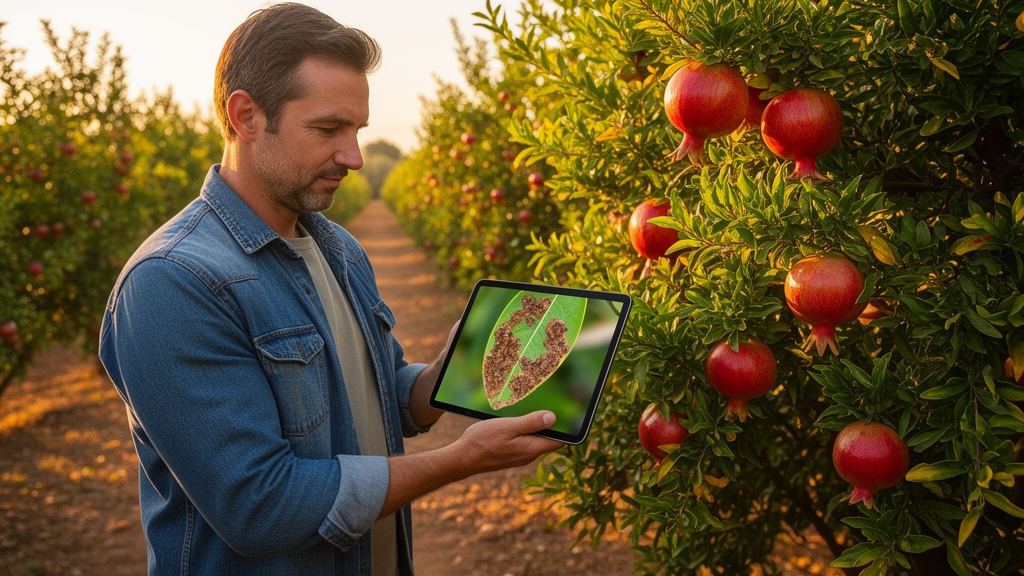
Pomegranates have earned their reputation as a superfood, prized in India and beyond for dense concentrations of antioxidants and vitamins. But the fruit’s journey from orchard to market is threatened by a suite of diseases that can quietly degrade quality long before harvest. Spotting infections early is essential, and researchers have long hoped that deep learning could automate the task. A new study from Dr. D. Y. Patil Vidyapeeth in Pune tackles a stubborn obstacle: the scarcity of high-quality, consistently annotated field images needed to train reliable disease-detection models.
The team, led by Rutuja Subhash Magar with Nilkanth Mukund Deshpande and Swati Sharma, published their work in BMC Plant Biology as an open-access article carrying the DOI 10.1186/s12870-026-09854-3. Their approach centers on a Dual GAN–Diffusion-based generative learning system that manufactures high-quality, diverse synthetic images to enrich pomegranate disease datasets. Rather than relying solely on scarce real photographs, the framework generates realistic samples that help classifiers distinguish healthy fruit from diseased ones under challenging real-world conditions.
The problem the researchers confronted is familiar to anyone working in agricultural computer vision. Field conditions are unforgiving: variable lighting, shadows, occlusions from leaves and branches, and inconsistent camera angles all conspire to degrade image quality. On top of that, dataset annotations are often inconsistent, with different annotators labeling the same symptoms differently. These issues limit the performance of deep learning models, which typically require large volumes of accurately labeled data to generalize well. The Pune team collected and processed real-time field data, then used a generative adversarial network to produce diverse and realistic images for detecting and diagnosing pomegranate diseases.
Technically, the system combines two powerful generative paradigms. Generative adversarial networks pit a generator against a discriminator in a competitive training loop, gradually producing images indistinguishable from real photographs. Diffusion models, which have transformed the field of generative learning in recent years, work by gradually adding noise to images and then learning to reverse the process, allowing fine-grained control over synthesis. By fusing these approaches in a hybrid framework, the researchers aimed to capture both the diversity of GANs and the stability and quality of diffusion-based generation, addressing a key weakness of each method when used alone.
Evaluating generative models requires specialized metrics, and the team reported results across several standard benchmarks. The system achieved a Fréchet Inception Distance of 22.40, a measure where lower values indicate synthetic images statistically closer to real ones. The Inception Score reached 49.75, reflecting the quality and variety of generated samples. LPIPS Diversity came in at 69.86%, indicating substantial perceptual variation among synthetic images, and classification accuracy hit 76%. These figures represent clear improvements over baseline GAN models, demonstrating that the hybrid approach generates more diverse, realistic samples than conventional generative techniques.
What makes this work particularly timely is the broader context of AI in agriculture. Machine learning models for plant disease detection have proliferated, but many are trained on curated laboratory datasets that fail to translate to field settings. The Pune researchers emphasize that their field-acquired, annotated dataset, combined with generative augmentation, makes healthy-versus-diseased classification more scalable and reliable in real-world agricultural environments. This matters for a crop like pomegranate, which holds significant economic and nutritional value in India and is vulnerable to diseases that can compromise both yield and fruit quality.
The implications extend well beyond pomegranates. The framework’s architecture—field data collection, careful annotation, and Dual GAN–Diffusion augmentation—could be adapted to other crops facing similar data scarcity challenges. As climate change intensifies pest and disease pressure on agriculture worldwide, tools that help farmers detect infections early become increasingly valuable. The researchers suggest their approach can improve systems for disease detection and diagnosis, offering a template for how generative learning might bridge the gap between limited field data and the robust models modern agriculture demands.
The study’s authors note that the code is available with R.M. and can be shared upon request, supporting reproducibility. The research received no external funding, with open access provided by Dr. DY Patil Vidyapeeth, Pune. Published on 16 September 2026 after acceptance on 26 August 2026, the article is fully open access under a Creative Commons license, allowing researchers worldwide to build on the findings without paywall barriers.
As generative learning continues to reshape fields from drug discovery to climate modeling, this study offers a concrete example of how synthetic data can address one of agriculture’s most persistent challenges: the shortage of high-quality, consistently annotated field images. For pomegranate growers and agricultural technologists alike, the work signals that AI-powered disease detection is moving closer to practical, reliable deployment in real orchards, not just controlled laboratory settings.
The choice of evaluation metrics in the study reflects established practice in generative model assessment. The Fréchet Inception Distance works by embedding both real and generated images through a pretrained Inception network and comparing the resulting feature distributions, so a score of 22.40 suggests the synthetic pomegranate images occupy a statistical space reasonably close to authentic field photographs. The Inception Score, by contrast, rewards images that are both individually confident in their class predictions and collectively varied across classes, which is why the reported value of 49.75 speaks to the diversity the hybrid generator achieved. LPIPS, or Learned Perceptual Image Patch Similarity, measures distance in a feature space designed to mimic human visual judgment, making the 69.86% diversity figure a meaningful indicator that the generated samples are not near-duplicates of one another—a common failure mode when generative models simply memorize their training data.
That concern about memorization is worth underscoring. One of the persistent risks in synthetic data augmentation is that a generator may reproduce training images with minor perturbations rather than learning the underlying distribution of disease symptoms. When that happens, augmented datasets add little new information and can even amplify annotation errors. The emphasis the Pune team placed on diversity metrics suggests awareness of this pitfall, and the combination of GAN-based generation with diffusion modeling is one strategy researchers have explored to push generators toward genuinely novel samples rather than interpolated copies.
The classification accuracy of 76% deserves careful interpretation. While it represents an improvement over baseline GAN models in the study, it also illustrates the gap that remains between laboratory benchmarks and the near-perfect performance often reported on curated datasets. Field-acquired imagery introduces confounders that laboratory images lack: fruit at varying stages of maturity, symptoms that overlap between distinct diseases, weathering and bruising that mimic infection, and background clutter from orchard canopies. A 76% accuracy figure on such data may be a more honest reflection of where the field actually stands than higher numbers reported under controlled conditions, and it highlights why realistic training data matters so much for deployment.
Pomegranate cultivation provides a fitting test case for this line of research. India is among the world’s largest producers of the crop, with major production concentrated in states such as Maharashtra, and the fruit’s economic value depends heavily on visual quality at market. Diseases affecting pomegranate can manifest as lesions, discoloration, and rot on both fruit and foliage, and symptoms that appear similar to the human eye often require expert knowledge to distinguish. Annotating such imagery consistently is labor-intensive and demands domain expertise, which is precisely why annotation inconsistency was identified as a barrier in the study. Generative augmentation cannot fix mislabeled data, but it can expand the volume of correctly labeled examples once a reliable annotated core exists.
The hybrid GAN–diffusion architecture also reflects a broader trend in generative research. Early GANs were prized for their speed and sharp outputs but notorious for training instability, mode collapse, and difficulty scaling to complex distributions. Diffusion models emerged as a more stable alternative with strong mode coverage, at the cost of computationally expensive iterative sampling. Combining the two paradigms attempts to capture the strengths of each, and agricultural imaging—with its textured surfaces, subtle symptom gradients, and high inter-class similarity—is a demanding domain for such systems. The reported improvements over baseline GANs suggest the hybrid design delivered measurable benefits in this setting.
For practitioners considering similar approaches, several lessons emerge from the study’s design. Field data collection should be planned with annotation protocols in place from the outset, since retrofitting consistent labels onto inconsistently captured imagery is difficult. Generative augmentation works best as a complement to, not a substitute for, real field data, because synthetic samples inherit whatever biases exist in the generator’s training distribution. And evaluation should span multiple metrics, as the study did, since no single number captures both fidelity and diversity of generated images. The open-access publication under a Creative Commons license, together with code available from the authors upon request, lowers the barrier for other research groups to replicate the pipeline on different crops, which may prove to be the study’s most lasting contribution to agricultural machine learning.
Subject of Research: A generative learning system combining GANs and diffusion models creates high-quality synthetic pomegranate disease images to improve field-based disease detection.
Article Title: A field-acquired annotated dataset for robust and generalizable pomegranate disease detection using generative learning
Article References: Magar, R. S., Deshpande, N. M., & Sharma, S. (2026). A field-acquired annotated dataset for robust and generalizable pomegranate disease detection using generative learning. BMC Plant Biology. https://doi.org/10.1186/s12870-026-09854-3
Image Credits: AI Generated
DOI: 10.1186/s12870-026-09854-3
Keywords: pomegranate, generative learning, GAN, diffusion model, synthetic data, plant disease detection, deep learning, computer vision, agriculture, FID, field-acquired, annotated
Cite Scienmag News
Alan Morgan. (October 18, 2026). Generative AI Teaches Computers to Spot Pomegranate Disease in the Field. Scienmag. https://scienmag.com/generative-ai-teaches-computers-to-spot-pomegranate-disease-in-the-field/
Alan Morgan. "Generative AI Teaches Computers to Spot Pomegranate Disease in the Field." Scienmag, 18 October 2026, https://scienmag.com/generative-ai-teaches-computers-to-spot-pomegranate-disease-in-the-field/. Accessed 18 October 2026.
Alan Morgan. "Generative AI Teaches Computers to Spot Pomegranate Disease in the Field." Scienmag. October 18, 2026. https://scienmag.com/generative-ai-teaches-computers-to-spot-pomegranate-disease-in-the-field/


