


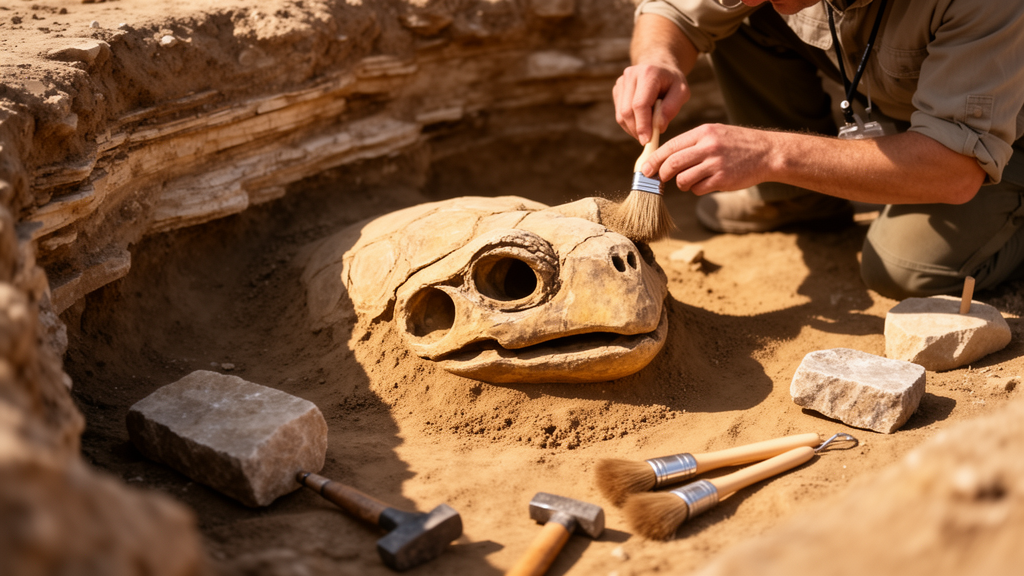
The first comprehensive neuroanatomical study of a marine pleurodire turtle has revealed significant convergent evolutions with other clades of pelagic turtles. This research focuses on Azzabaremys moragjonesi, a large bothremydid from the Paleocene of Mali, providing the first detailed reconstruction of the internal cranial structures of a putative sea pleurodire. By analyzing the holotype specimen housed in the Natural History Museum in London, researchers have identified specific anatomical modifications that distinguish this ancient reptile from its freshwater relatives and align it with modern and extinct marine turtles. The study, published in the Fossil Record, offers new insights into how different lineages of turtles independently adapted to life in the open ocean during the Mesozoic and Paleogene eras.
Azzabaremys moragjonesi belongs to the clade Nigeremydini, a group of bothremydid pleurodiran turtles that inhabited the African Trans-Saharian Seaway from the Maastrichtian to the Paleocene. While all extant pleurodires are freshwater species, some extinct lineages have been interpreted as coastal or marine forms based on sedimentary evidence. However, robust anatomical arguments for these interpretations have been scarce until now. The current study utilizes high-resolution micro-CT scanning to generate three-dimensional models of the skull and its internal neuroanatomical elements, allowing for a precise comparison with other turtle lineages. This methodological approach enables the identification of subtle structural differences that indicate functional adaptations to marine environments.
The neuroanatomical reconstruction reveals that Azzabaremys moragjonesi possesses several features that differ from those found in other bothremydid lineages, which are generally associated with freshwater habitats. Notably, the position of the geniculate ganglion within the canalis cavernosus, the absence of an anterior vidian canal piercing the pterygoid, and the presence of wide semicircular canals in the endosseous labyrinth are identified as key modifications. These traits are recognized as convergent modifications developed in Cryptodira, extinct clades with uncertain affiliations, and Pleurodira in response to the demands of marine life. The convergence suggests that despite their distant evolutionary relationships, these turtles faced similar selective pressures that shaped their cranial anatomy in comparable ways.
One of the most striking findings is the greatly expanded nasal cavity of Azzabaremys moragjonesi, which accounts for more than 54 percent of the total volume of the cranial cavities. In contrast, the nasal cavities of freshwater pleurodirans typically represent less than 30 percent of this volume. This expansion is consistent with the needs of marine turtles, which require enhanced olfactory capabilities to navigate and forage in saltwater environments. The olfactory nerve in Azzabaremys is also notably long, corresponding to 44 percent of the endocranial cavity length, a value that exceeds those documented in freshwater forms and aligns with measurements from extant sea turtles such as Chelonia mydas and Caretta caretta. These adaptations likely improved the turtle’s ability to detect chemical cues in the water, aiding in prey location and mate finding.
The inner ear structures of Azzabaremys moragjonesi also display characteristics associated with pelagic locomotion and diving. The semicircular canals of the endosseous labyrinth are relatively wide and short, a morphology that differs from the elongated and narrow canals found in freshwater bothremydids. This configuration is similar to that observed in the extant dermochelyid Dermochelys coriacea, a deep-diving sea turtle. The wide canals may be associated with a well-developed perilymphatic system, which could enhance balance and spatial orientation during deep dives and rapid movements in the open ocean. While the relationship between canal width and diving behavior is still under debate, the evidence supports the interpretation that Azzabaremys was well-adapted to a pelagic lifestyle.
Additional evidence for marine adaptation is found in the orbital region of the skull. The presence of a largely expanded interorbital foramen and a reduced processus inferior parietalis suggests the accommodation of enlarged lacrimal or salt glands. These glands are essential for osmoregulation in marine environments, allowing turtles to excrete excess salt. Similar structures have been inferred in other extinct marine turtles, including members of Protostegidae and Plesiochelyidae. The reduction of the septum orbitotemporale in Azzabaremys further supports the presence of these glands, as this feature is also observed in other marine bothremydids. The combination of these cranial modifications provides strong anatomical evidence that Nigeremydini were not merely coastal dwellers but were capable of inhabiting pelagic regions of the sea.
The study also highlights the conservation of certain neuroanatomical features within the Bothremydidae family. The angle between the forebrain and hindbrain, the presence of a dorsal dural peak, and the configuration of the carotid canals are shared with other bothremydids, indicating that these traits are plesiomorphic for the group. However, the specific modifications identified in Azzabaremys, such as the bifurcated canal for the glossopharyngeal nerve and the unique trajectory of the vidian nerve, are exclusive to this taxon among the studied bothremydids. These unique features, combined with the convergent marine adaptations, paint a picture of a highly specialized predator that occupied a distinct ecological niche in the Paleocene seas.
The findings of this research have broader implications for understanding the evolutionary history of marine turtles. By demonstrating that pleurodiran turtles independently evolved similar neuroanatomical adaptations to cryptodiran sea turtles, the study underscores the power of convergent evolution in shaping the morphology of marine reptiles. It also challenges previous assumptions that marine adaptations in pleurodires were limited to coastal environments, suggesting that some lineages were capable of true pelagic life. The availability of the 3D models and CT scan data on MorphoSource allows for further comparative studies, potentially revealing more about the sensory and physiological adaptations of extinct marine turtles.
In conclusion, the neuroanatomical study of Azzabaremys moragjonesi provides the first definitive evidence of marine adaptations in a pleurodiran turtle. The convergence of traits with other clades of pelagic turtles highlights the repeated evolution of specific cranial modifications in response to the challenges of marine life. This work not only fills a gap in our knowledge of bothremydid neuroanatomy but also contributes to a broader understanding of the ecological diversity of ancient marine ecosystems. As researchers continue to explore the fossil record, the integration of advanced imaging techniques with comparative anatomy will likely uncover further insights into the lives of these ancient mariners.
Subject of Research: The first neuroanatomical study of a marine pleurodire (the large Paleocene bothremydid Azzabaremys moragjonesi) reveals convergences with other clades of pelagic turtles
Article Title: The first neuroanatomical study of a marine pleurodire (the large Paleocene bothremydid Azzabaremys moragjonesi ) reveals convergences with other clades of pelagic turtles
Article References: Martín-Jiménez, M., & Pérez-García, A. (2025). The first neuroanatomical study of a marine pleurodire (the large Paleocene bothremydid Azzabaremys moragjonesi) reveals convergences with other clades of pelagic turtles. Fossil Record, 28(1), 1-15. https://doi.org/10.3897/fr.28.130418
Image Credits: AI Generated
DOI: 10.3897/fr.28.130418
Keywords: first, neuroanatomical, marine, pleurodire, large, Paleocene, bothremydid, Azzabaremys, moragjonesi, reveals, convergences, other
Cite Scienmag News
Gavin Prescott. (October 18, 2026). Fossil Skull Reveals Marine Adaptations in Ancient Turtle. Scienmag. https://scienmag.com/fossil-skull-reveals-marine-adaptations-in-ancient-turtle/
Gavin Prescott. "Fossil Skull Reveals Marine Adaptations in Ancient Turtle." Scienmag, 18 October 2026, https://scienmag.com/fossil-skull-reveals-marine-adaptations-in-ancient-turtle/. Accessed 18 October 2026.
Gavin Prescott. "Fossil Skull Reveals Marine Adaptations in Ancient Turtle." Scienmag. October 18, 2026. https://scienmag.com/fossil-skull-reveals-marine-adaptations-in-ancient-turtle/


