


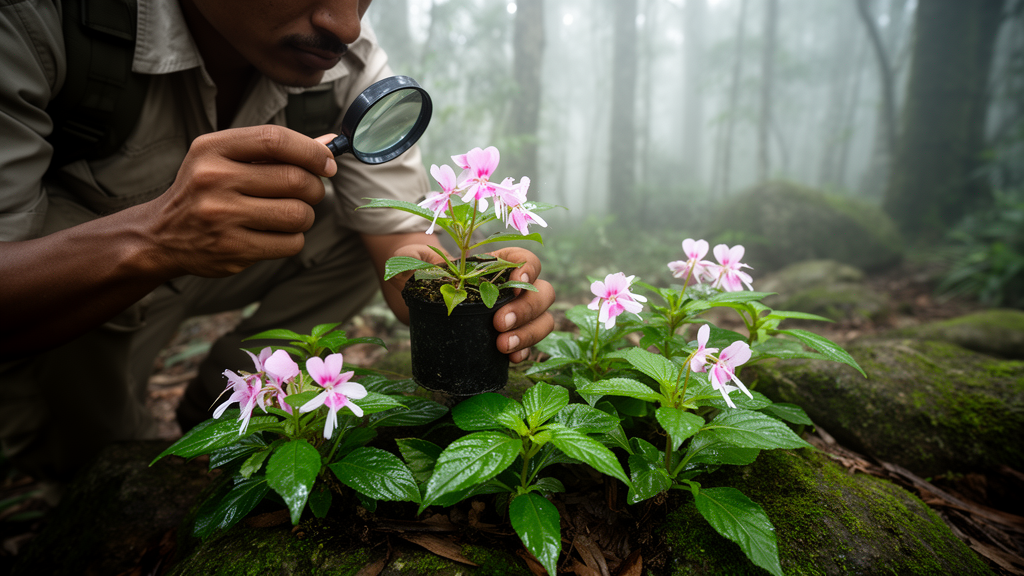
Researchers have formally described five new species of the balsam genus Impatiens from the southern Western Ghats of Kerala, India, adding to the region’s reputation as a global hotspot for plant diversity. The new taxa, named Impatiens flavispicata, I. filcyii, I. ninanii, I. xanthopetala, and I. berchmansiensis, were identified through extensive field surveys and detailed morphological analysis. These discoveries highlight the continued potential for finding previously unknown plant life in well-studied but ecologically complex mountainous regions. The study, published in the journal PhytoKeys, provides comprehensive descriptions, including scanning electron microscopy (SEM) analysis of pollen, to distinguish these species from their close relatives.
The Impatiens genus is a large and diverse group of annual and perennial herbs found across tropical and subtropical regions of the Old World. It is particularly rich in species in five distinct hotspots: tropical Africa, Madagascar, southern India and Sri Lanka, the eastern Himalayas, and Southeast Asia. In India alone, previous studies have recorded 210 species, with a high degree of endemism in the Western Ghats and Himalayas. The Western Ghats specifically host 106 species of Impatiens, many of which are adapted to highly specific microhabitats, leading to frequent reports of new species from this area.
The field exploration that led to these discoveries was conducted between July 2023 and March 2026 in the southern Western Ghats. The research team collected specimens from various localities in the Ernakulam and Idukki districts of Kerala. These specimens were then compared with existing herbarium collections at institutions including CMS, RHK, E, MH, and TBGT. The critical evaluation of these samples, combined with a thorough review of the literature, confirmed that the collected plants were distinct from all known species of Impatiens.
Impatiens flavispicata is an annual erect herb standing 18 to 20 cm high, characterized by white flowers with a yellow spot on the throat. It is distinguished from similar species like I. courtallensis and I. herbicola by its ovoid fruit containing only one or two seeds, in contrast to the multi-seeded fusiform fruits of its relatives. The species is known only from the type locality at Mamalakkandam, where it grows in open areas along rocky, steep landscapes at elevations between 600 and 1,200 meters. Its pollen is three-colpate and ovoid, measuring 8 to 10 micrometers in length.
Impatiens filcyii is another annual erect herb, reaching heights of 18 to 22 cm, with pink-purple flowers. It differs from the similar I. periyarensis by the absence of extrafloral nectaries and the presence of falcate, glabrous lateral sepals. The species is found along temporary streams and water-filled rock crevices in Mamalakkandam. Its pollen is two-colpate and rod-shaped, measuring approximately 27.3 to 28.1 micrometers in length, with a highly reticulate surface pattern. The specific epithet honors Prof. Filcy T. Baby, a former head of the Botany Department at CMS College Kottayam.
Impatiens ninanii is a terrestrial erect herb ranging from 14 to 28 cm in height, with purple flowers clustered at the apex. It is allied to I. cheruthoniensis but is distinguished by its entire leaf margins and a specific inflorescence structure with four to five flowers. The species grows along muddy slopes of rocky terrain in Mankulam, Idukki district. Its pollen is three-colpate and cylindrical, measuring 13.6 to 14.1 micrometers in length. The name I. ninanii honors Prof. C.A. Ninan, a former head of the Botany Department and Dean of the Faculty of Science at the University of Kerala.
Impatiens xanthopetala is an annual erect to straggling herb, often prostrate with many lateral branches, reaching 8 to 10 cm in height. It is easily recognized by its striking deep yellow flowers with a dark brown blotch on the throat. The species is found along shallow muddy areas associated with seasonal streams in Pambanar, Idukki district. Its pollen is four-colpate and roughly rectangular, measuring 5.6 by 7.7 micrometers. The specific epithet xanthopetala refers to the prominent yellow color of the petals, which aids in field recognition.
Impatiens berchmansiensis is an annual erect to suberect herb, 14 to 16 cm tall, with yellow flowers. It is most similar to I. herbicola but differs in flower color, stem shape, and pollen characteristics. The species is found along muddy slopes in the Vagamon area of Idukki district. Its pollen is four-colpate and ovoid, measuring 19.2 to 19.7 micrometers in length, with a reticulate surface pattern. The name I. berchmansiensis honors St. Berchmans College, Changanassery, in recognition of its contributions to education and research.
All five new species are currently categorized as Data Deficient (DD) according to IUCN Red List criteria. This classification is due to their limited known distributions and the potential threats posed by anthropogenic activities, such as tourism and land use changes. Further studies are recommended to assess their population sizes and conservation needs more accurately. The discovery of these species underscores the importance of continued botanical exploration in the Western Ghats, a region that continues to reveal new biodiversity despite extensive prior study.
The detailed morphological and micromorphological analyses provided in the study offer valuable insights into the evolutionary relationships within the Impatiens genus. The use of scanning electron microscopy to examine pollen characteristics has proven particularly useful in distinguishing between closely related species. These findings contribute to the broader understanding of plant diversity in the Western Ghats and highlight the need for conservation efforts to protect these unique and often threatened species. The study serves as a reminder of the rich, yet fragile, biodiversity that exists in this region, calling for increased attention and protection from both scientific and governmental bodies.
Subject of Research: Taxonomic description of five new Impatiens species from the southern Western Ghats
Article Title: Five new species of Impatiens ( Balsaminaceae ) from southern Western Ghats, Kerala
Article References: Arya, S., Salvy, T., Manuel, T., & Rogimon, T. P. (2026). Five new species of Impatiens (Balsaminaceae) from southern Western Ghats, Kerala. PhytoKeys, 276, 275-295. https://doi.org/10.3897/phytokeys.276.200226
Image Credits: AI Generated
DOI: 10.3897/phytokeys.276.200226
Keywords: Impatiens, Balsaminaceae, Western Ghats, Kerala, Plant Taxonomy, Biodiversity, PhytoKeys, Conservation, Micromorphology, New Species, Five, species
Cite Scienmag News
Margaret Porter. (October 18, 2026). Five New Impatiens Species Discovered in Kerala. Scienmag. https://scienmag.com/five-new-impatiens-species-discovered-in-kerala/
Margaret Porter. "Five New Impatiens Species Discovered in Kerala." Scienmag, 18 October 2026, https://scienmag.com/five-new-impatiens-species-discovered-in-kerala/. Accessed 18 October 2026.
Margaret Porter. "Five New Impatiens Species Discovered in Kerala." Scienmag. October 18, 2026. https://scienmag.com/five-new-impatiens-species-discovered-in-kerala/


