


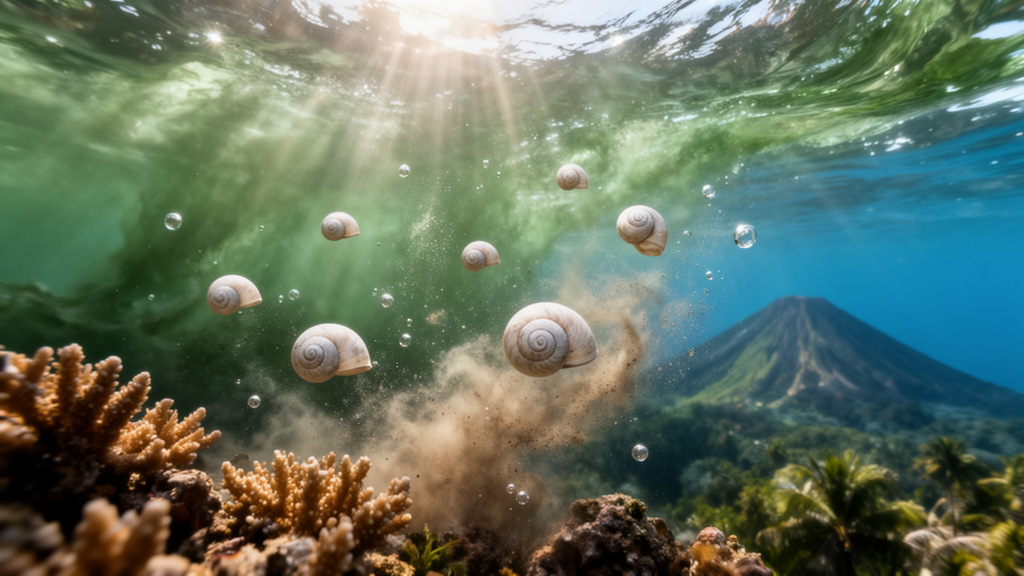
Some of the most dramatic events in Atlantic geology may have quietly solved one of biogeography’s stubborn puzzles. When volcanic island flanks collapsed into the sea during glacial periods, the resulting megatsunamis did more than reshape coastlines: they scooped up seafloor sediments teeming with marine life and hurled them high onto island slopes, preserving fossil assemblages from a time when sea level stood roughly 80 metres below today’s. A new study of two such deposits in the Macaronesian archipelagos now shows that cold-water and temperate molluscs expanded their ranges towards the tropics during ice ages, reversing the usual textbook narrative of interglacial-only dispersal.
The research, published in Frontiers of Biogeography, focuses on two fossiliferous conglomerates: one at Tarrafal on Santiago Island in Cabo Verde, emplaced by a megatsunami triggered by the flank collapse of neighbouring Fogo volcano around 68,000 years ago during Marine Isotope Stage 4 (MIS 4), and another at Teno Bajo on Tenerife in the Canary Islands, deposited by a tsunami generated by the collapse of the Las Cañadas edifice around 170,000 years ago during MIS 6. Both events occurred when coeval sea level was about 80 metres lower than present, yet the waves stranded their sediments tens of metres above modern Holocene sea level, safely out of reach of the erosive action of subsequent interglacial highstands.
This preservation is the study’s methodological breakthrough. Glacial-age marine fossil deposits are rarely accessible worldwide because rising seas during the following interglacial erode them from the record. Previous work on long-distance dispersal of shallow-water molluscs in the Macaronesian islands tracked tropical species moving poleward during glacial terminations or early interglacials, but full glacial episodes remained a blind spot. Megatsunami deposits, by contrast, represent a geological process that lifts glacial seafloor sediments onshore and locks them in place, offering a unique window into the biogeography of cold periods.
The Tarrafal deposit yielded a remarkable haul. From seven one-kilogram bulk samples, the team recovered 2,260 specimens representing 209 specific taxa of molluscs: 39 bivalves, 169 gastropods and one polyplacophoran. Of the 150 taxa identifiable to species level, 134 are shallow-water species restricted to depths shallower than 50 metres, 14 inhabit deeper waters, and two are pelagic. The assemblage mixes hard-ground dwellers, coarse-sand and gravel species, epifaunal grazers, carnivorous gastropods and suspension-feeding bivalves, along with fish otoliths, barnacle plates, echinoderm spines, bryozoans, foraminifers, coral fragments and rhodoliths. Three endemic Cabo Verdean bivalves and 34 endemic gastropods are reported for the archipelago’s fossil record, most for the first time.
Crucially, 32 taxa from the MIS 4 tsunami sediments do not presently inhabit the warm waters of Cabo Verde, and for 14 of these the Canary Islands constitute their present-day southernmost location. The team detected successful equatorward latitudinal range expansion to Cabo Verde of 12 bivalves and 14 gastropods, plus longitudinal range expansion from West African shores of seven bivalves and nine gastropods. At Teno, of 101 taxa (28 bivalves and 73 gastropods), eight species are absent from the Canaries today. Equatorward expansion to the Canaries was detected for three bivalves, including the familiar Glycymeris glycymeris, Pecten maximus and Ostrea edulis, and three gastropods, including the common periwinkle Littorina littorea, with longitudinal expansion from Moroccan shores for four bivalves. None of these species was present in the archipelagos during the Last Interglacial, so their glacial presence conclusively supports long-distance dispersal and the establishment of viable populations during cold periods.
The dispersal mechanisms most probably involved planktotrophic larvae carried by sea-surface currents and trade winds, or rafting on natural floating devices such as wooden logs and algae for non-planktotrophic species, with attached eggs, juveniles or adults. The authors speculate that such equatorward dispersal was only possible if the Canary Current, today an oceanographic barrier between the Canaries and Cabo Verde, shifted its position southward or weakened during glacial episodes, allowing mid-latitude species to reach lower latitudes. Some cooling of sea-surface temperatures at Cabo Verde latitudes would have enabled settlement of temperate species. Longitudinal dispersal from Senegal and Mauritania towards Cabo Verde, meanwhile, is expected if the West African upwelling intensified, boosting marine productivity along the continental margin.
Mid-latitude North Atlantic records support this oceanographic picture. Sea-surface temperatures fell during both MIS 4 and MIS 6, driven by a weakening of the Atlantic Meridional Overturning Circulation. The AMOC reduction favoured a southward displacement of the Intertropical Convergence Zone, triggering very dry conditions over northwestern Africa and intensified northeast trade winds, which supplied huge amounts of dust to the adjacent ocean and intensified upwelling in the region. These coupled atmospheric and oceanic changes would have opened dispersal corridors for cold-water species moving equatorward, both between archipelagos and from continental shores to oceanic islands.
Beyond the biogeographic findings, the study reveals an unexpected sedimentological signature. When the team compared diversity indices from the Tarrafal samples with 24 one-kilogram samples from Last Interglacial (MIS 5e) raised beach deposits on Santa Maria Island in the Azores, the glacial megatsunami samples showed dramatically higher values across all Hill numbers used: species richness (q = 0), the exponential of Shannon’s entropy index (q = 1) and the inverse of Simpson’s concentration index (q = 2). The differences were statistically significant in an asymmetrical ANOVA, with p = 0.0000 for all three indices. The seven Tarrafal samples yielded 209 taxa but only about 2,257 specimens, whereas the 24 Azorean samples produced 136 taxa and 25,090 specimens, a pattern of high species richness with comparatively low individual counts that also characterised the Teno deposit.
The explanation lies in the genesis of the deposits. Raised beach sediments accumulate gradually over hundreds or thousands of years, producing time-averaged death assemblages biased towards the most abundant and taphonomically durable species. Megatsunami deposits, by contrast, are instantaneous events at geological timescales: a few mega-waves en-masse transport and deposit sediments with minimal sorting or destruction, sampling a varied biological community from different depths and habitats in a single event. The result is a highly biodiverse, mixed-zonation assemblage characterised by the absence of dominant species, with well-preserved micromolluscs and even pelagic species included. The authors propose that this extremely high palaeobiodiversity and evenness constitutes a new criterion for distinguishing megatsunami deposits from normal highstand deposits, adding to established traits such as chaotic textures, extremely poor sorting, distribution at variable elevations and fossils never found in life position.
The study also carries a broader message for island biogeography theory. A collaborative horizon-scanning exercise identified the 50 most fundamental questions for the field, but only one palaeoecology question survived the final cut, reflecting the usual lack of geological and palaeontological expertise among biologists. This work demonstrates that integrating biology, palaeontology and geology through multidisciplinary teams is a superior approach. In times of accelerated global change, knowing how species distributions shifted during Pleistocene glacial and interglacial periods is crucial for understanding biogeography, ecology and evolution over the past million years in fragile marine ecosystems such as archipelagic settings. The cold-water travellers of the ice ages, preserved by catastrophe, now write a new chapter in the story of how life moves across the ocean.
Subject of Research: Megatsunami deposits reveal glacial equatorward range expansion of temperate marine molluscs in Macaronesia
Article Title: Megatsunami deposits and range expansion of cold-temperate marine species towards the tropics in glacial times
Article References: Ávila, S. P., Paris, R., Ramalho, R. S., Melo, C. S., Martín-González, E., Rolán, E., Madeira, P., Ávila, G. C., Porteiro, J. M., Medeiros, A. M., Naughton, F., Abrantes, F., Martins, G. M., Johnson, M. E., & Madeira, J. (2025). Megatsunami deposits and range expansion of cold-temperate marine species towards the tropics in glacial times. Frontiers of Biogeography, 18, Article e138319. https://doi.org/10.21425/fob.18.138319
Image Credits: AI Generated
Keywords: biogeography, megatsunami, Macaronesia, Cabo Verde, Canary Islands, molluscs, glacial periods, MIS 4, MIS 6, paleontology, deposits, range
Cite Scienmag News
Violet Maxwell. (October 18, 2026). Giant waves from volcanic collapses carried cold-water molluscs to the tropics during ice ages. Scienmag. https://scienmag.com/giant-waves-from-volcanic-collapses-carried-cold-water-molluscs-to-the-tropics-during-ice-ages/
Violet Maxwell. "Giant waves from volcanic collapses carried cold-water molluscs to the tropics during ice ages." Scienmag, 18 October 2026, https://scienmag.com/giant-waves-from-volcanic-collapses-carried-cold-water-molluscs-to-the-tropics-during-ice-ages/. Accessed 18 October 2026.
Violet Maxwell. "Giant waves from volcanic collapses carried cold-water molluscs to the tropics during ice ages." Scienmag. October 18, 2026. https://scienmag.com/giant-waves-from-volcanic-collapses-carried-cold-water-molluscs-to-the-tropics-during-ice-ages/


