


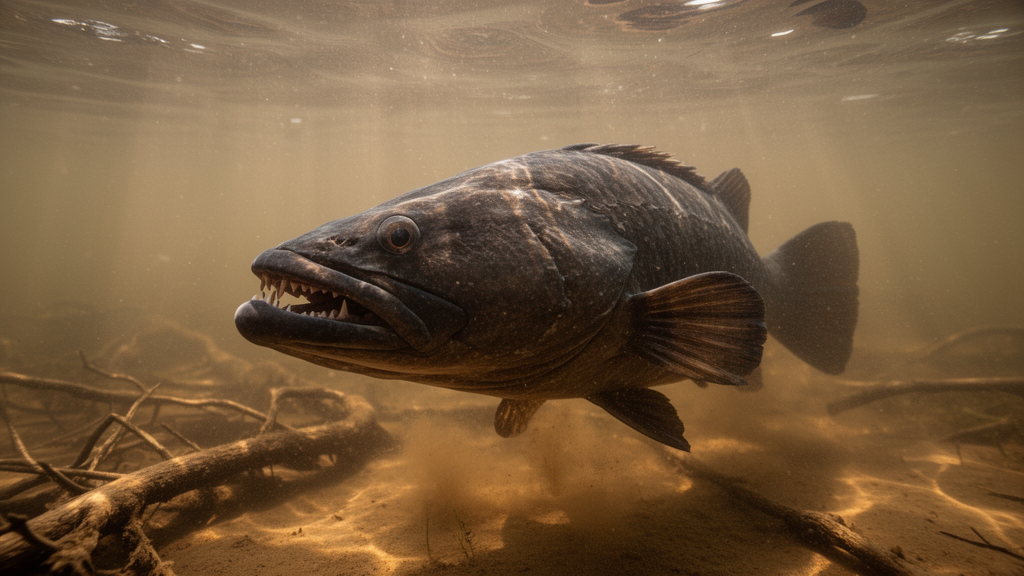
Deep in the Munim River basin of Maranhão state, northeastern Brazil, a predatory fish has been hiding in plain sight. Ichthyologists surveying the region’s waters have described a new species of trahira, the wolf-like characiform fishes of the genus Hoplias, and named it after a mythical creature from local folklore. The new species, Hoplias cazumba, belongs to one of the most notoriously difficult species complexes in Neotropical ichthyology, the Hoplias malabaricus group, and its discovery adds fresh evidence that the freshwater fish fauna of Maranhão remains far richer than scientists once believed.
The description, published in the journal Evolutionary Systematics, is the product of a concerted research effort to decipher the fish diversity of the Maranhão Hydrological Unit, a region where the number of known species has exploded from just 83 to 287 in recent years. The new species was identified from specimens collected near the village of Cedro, about 15 kilometers from the town of Chapadinha, on the banks of the Munim River. The holotype, a specimen measuring 193.43 millimeters in standard length, is deposited at the Museum of Zoology of the University of São Paulo, with paratypes held at the Pontifícia Universidade Católica do Rio Grande do Sul and additional non-type specimens at the Federal University of Maranhão fish collection.
Hoplias cazumba belongs to the family Erythrinidae, a group of Characiformes widely distributed across the Neotropics that comprises 17 valid living species in three genera: Erythrinus, Hoplerythrinus and Hoplias. Hoplias is the most species-rich genus of the family, with 13 valid species allocated into three groups. The H. lacerdae group is defined by the absence of teeth on the basihyal and basibranchial bones and by dentary margins that form a U shape in ventral view. The H. aimara group lacks an accessory ectopterygoid and bears a dark spot on the opercular membrane. The H. malabaricus group, to which the new species belongs, retains tooth plates on the basihyal and basibranchials and shows dentary margins converging toward the symphysis in a V shape.
The H. malabaricus species complex has been a source of frustration and fascination for ichthyologists since the 1970s. Its members share extremely conservative morphological characters, making them nearly impossible to distinguish by traditional anatomy alone. Decades of morphological, molecular and chromosomal studies have revealed cryptic lineages, karyotypic overlaps between disjunct populations and molecular differences between sympatric populations that look almost identical. Only since 2015 have new species within the group been formally described, using a combination of morphological and molecular characters, and the new study adds Hoplias cazumba to that growing roster alongside H. mbigua, H. misionera, H. argentinensis and H. auri.
What finally allowed the researchers to separate Hoplias cazumba from its congeners was a combination of meristic counts rather than any single dramatic feature. The new species has 11 to 13 dorsal-fin rays, always exactly 15 branched caudal-fin rays, 39 to 41 lateral-line scales with a mode of 40, and 19 to 22 scales around the caudal peduncle. By contrast, H. malabaricus has 14 dorsal-fin rays, 14 to 15 caudal-fin rays, 38 to 39 lateral-line scales and 18 scales around the caudal peduncle. The new species also differs from H. teres in pre-dorsal scale counts, vertebral numbers and snout proportions, and from H. microlepis in lateral-line scale counts, vertebral counts and caudal peduncle length. Vertebrae, counted from radiographs and including the four anterior vertebrae of the Weberian apparatus, number 39 to 41 in the new species.
The anatomical detail in the description is striking. Hoplias cazumba has a cylindrical body with an angular to slightly rounded anterior head profile, and its medial dentary margins converge to form a V or Y-shaped angle in ventral view. The dentition follows the elaborate pattern typical of the group: the premaxillary tooth row is divided into two sections, beginning with a large canine followed by decreasing teeth, then a gap, then three increasing teeth followed by two decreasing ones. The dentary carries two rows of teeth, the first with five small lingual teeth, then the two largest teeth of the lower jaw, one of which fits into the premaxillary gap and penetrates the bone to reach a foramen, then five small teeth, then eight alternating in size. The second row is an aligned sequence of 22 small teeth of equal size. Conical and caniniform teeth in both jaws are covered by fleshy lips, and the buccal faces of the accessory ectopterygoid and ectopterygoid bear aligned conical teeth and patches of villiform teeth.
In alcohol-preserved specimens, the ground coloration of the head and body is dark to light brown, darker dorsally and paler ventrally, with approximately five to six irregularly spaced chevron-shaped lateral blotches whose spacing decreases toward the caudal peduncle. Some individuals have a completely dark head, and a patch of dark brown pigmentation covers the mid-ventral surface of the opercular bone. The dorsal, anal and caudal fins are lighter than the body, with dark spots on the rays and interradial membranes forming irregular dark stripes, while the pectoral and pelvic fins carry dark spots or a dark brown roundish spot covering almost the entire fin.
The specific name cazumba honors a mythical creature from the bumba-meu-boi, the celebrated folklore theatrical tradition of Maranhão. The Cazumba is depicted as a strange-headed being that protects nature, and the word traces back to cazumbi from the Kimbundu linguistic group of Angola, meaning little spirit. It is a fittingly evocative name for a fish from a species complex whose members are defined as much by what separates them in fine-scale counts as by what they share in outward appearance.
The discovery carries broader biogeographic significance. Recent phylogenomic work based on 2,519 ultraconserved element loci confirmed the monophyly of Erythrinidae genera and suggested that diversification within the H. malabaricus complex intensified over the last 10 million years, coinciding with biogeographic events that drove freshwater fish diversification in Maranhão’s basins. Other studies have shown that fish populations in the region, including Schizodon dissimilis and Prochilodus lacustris, diversified relatively recently, around 0.6 million years ago. The researchers suggest that H. malabaricus populations in Maranhão may have undergone similar recent diversification, and that the conservative morphology of the group has hindered the recognition of new taxa until now.
The Munim River basin itself has been poorly sampled, with only two prior studies including specimens from the basin, in very limited numbers of two and six individuals respectively. Despite this, the material proved sufficient to demonstrate the presence of a distinct, previously unrecognized species. The research team also identified H. malabaricus sensu stricto and putative new species from the Itapecuru and Mearim basins, which are being described in an ongoing study by another research group. The Maranhão Hydrological Unit, located in the Eastern Amazon region, has been identified as a potential endemic area for freshwater fishes, and the ichthyofauna of the region is likely still underestimated. With Hoplias cazumba now formally on the books, the Munim River has claimed its place on the map of Neotropical fish endemism, and the cazumba, the little spirit that protects nature, finally has a scientific name of its own.
Subject of Research: A new species of Hoplias malabaricus species complex (Characiformes, Erythrinidae) from Northeastern Brazil
Article Title: A new species of Hoplias malabaricus species complex ( Characiformes , Erythrinidae ) from Northeastern Brazil
Article References: Abreu, J. M. S., Silva Pedroza, W., Oyakawa, O. T., de Araújo Melo, S., Tchaicka, L., & Piorski, N. M. (2025). A new species of Hoplias malabaricus species complex (Characiformes, Erythrinidae) from Northeastern Brazil. Evolutionary Systematics, 9(1), 135-143. https://doi.org/10.3897/evolsyst.9.153695
Image Credits: AI Generated
DOI: 10.3897/evolsyst.9.153695
Keywords: species, Hoplias, malabaricus, complex, Characiformes, Erythrinidae, Northeastern, Brazil, scientific research
Cite Scienmag News
Drew Townsend. (October 18, 2026). New wolf fish species with mythical head name found in Brazil’s Munim River. Scienmag. https://scienmag.com/new-wolf-fish-species-with-mythical-head-name-found-in-brazils-munim-river/
Drew Townsend. "New wolf fish species with mythical head name found in Brazil’s Munim River." Scienmag, 18 October 2026, https://scienmag.com/new-wolf-fish-species-with-mythical-head-name-found-in-brazils-munim-river/. Accessed 18 October 2026.
Drew Townsend. "New wolf fish species with mythical head name found in Brazil’s Munim River." Scienmag. October 18, 2026. https://scienmag.com/new-wolf-fish-species-with-mythical-head-name-found-in-brazils-munim-river/


