


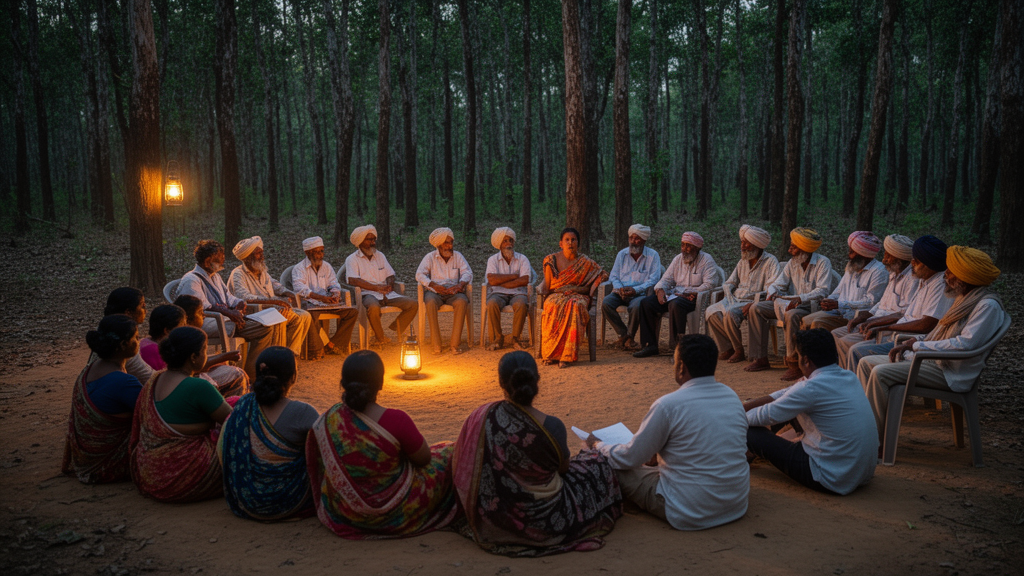
Joint Forest Management (JFM) initiatives in India were designed to bridge the gap between ecological conservation and community welfare by integrating local populations into the governance of forest resources. The program promotes participatory forest governance, aiming to create a shared responsibility between the state and rural communities. However, a new study published in SN Social Sciences reveals that deep-rooted social hierarchies, particularly those based on caste, class, and gender, continue to shape participation in these programs. The research, conducted in the Kharagpur Forest Division of West Bengal in Eastern India, highlights how these structural inequalities often marginalize women and disadvantaged groups, undermining the inclusive goals of the JFM framework.
The study focuses on two specific blocks within the division: Keshiary and Nayagram. By examining the lived experiences of forest fringe communities, the researchers utilized semi-structured interviews, focus group discussions, and statistical analysis to identify the socio-cultural, economic, and institutional barriers to equitable engagement. The findings indicate that despite the theoretical achievements of JFM, practical implementation is heavily skewed by existing power dynamics. These dynamics prevent many community members, especially women, from fully participating in decision-making processes or accessing the benefits of forest resources.
A significant disparity in livelihood strategies was observed between the two study areas. In Nayagram, forest dependency is notably higher, with 78.89% of women engaged in the collection of non-timber forest products (NTFPs) for their livelihoods. This heavy reliance on forest resources makes equitable access to NTFPs a critical issue for gender equality in the region. In contrast, Keshiary shows a more diversified economic landscape, where 68.47% of the population engages in rice cultivation. This agricultural diversification reduces the immediate reliance on forest resources, thereby altering the dynamics of participation and dependency in JFM activities.
Participation in JFM and Executive Committee meetings remains low in both Keshiary and Nayagram. The researchers identified several factors contributing to this disengagement, including a general lack of interest, the long distances required to travel to meeting sites, and the dispersed nature of settlements in these areas. These logistical and social barriers create a significant hurdle for inclusive governance. When community members cannot easily or willingly participate in formal meetings, the decision-making process becomes less representative of the broader population, further entrenching the influence of those who are already present and active.
Mistrust toward the Forest Department (FD) is a pervasive issue, particularly in Nayagram, where 63.87% of respondents expressed significant distrust. This sentiment reflects unequal power dynamics and limited transparency in the operations of the forest bureaucracy. The FD is often perceived as an external authority that imposes rules without adequate consultation, leading to a defensive posture among local communities. This lack of trust hampers the collaborative spirit that JFM is supposed to foster, making it difficult to build the necessary social capital for effective joint management.
Knowledge gaps regarding JFM processes are widespread, further complicating efforts to achieve inclusive governance. In Nayagram, 82.89% of respondents reported a lack of awareness about how JFM processes function. This ignorance is not merely a result of poor communication but is often a consequence of systemic exclusion from information networks. Without a basic understanding of their rights and the mechanisms of JFM, community members, especially women, are unable to advocate for their interests or hold the Forest Department accountable for its actions.
Representation in Village Forest Committees (VFCs) is dominated by upper-caste women, with over 60% of the seats held by this group. This dominance marginalizes women from Scheduled Castes (SC) and Scheduled Tribes (ST), who are often the most dependent on forest resources. The intersection of caste and gender creates a double disadvantage for these women, who face both gender-based discrimination and caste-based exclusion. This skewed representation ensures that the priorities of the most vulnerable groups are often overlooked in favor of those with greater social capital and influence.
Gender inequality remains pronounced in both study areas, with 79.38% of women in Nayagram and 68.23% in Keshiary reporting minimal interaction with the Forest Department. These women are constrained by domestic responsibilities, which can consume up to 98.59% of their time, and restrictive social norms that limit their mobility and public participation. The burden of unpaid care work, including childcare, elder care, and household management, leaves women with little time or energy to engage in the often time-consuming and distant JFM meetings. This time poverty is a critical barrier to gender equality in forest governance.
Although Self-Help Groups (SHGs) have fostered limited empowerment for some women, systemic exclusion endures. SHGs provide a platform for financial inclusion and social networking, but they do not necessarily translate into political power or decision-making authority within the JFM framework. The empowerment gained through SHGs is often confined to the economic sphere, leaving the structural barriers to political participation largely intact. To realize the participatory goals of JFM, policy and institutional reforms must promote inclusive, gender-sensitive, and locally tailored strategies that address these deep-seated inequalities.
Enhancing education, ensuring equitable representation, and strengthening community capacity are essential for achieving sustainable and just forest governance in West Bengal’s forest-dependent regions. These efforts must be aligned with the goals of Viksit Bharat 2047 and the Sustainable Development Goals (SDGs), which emphasize inclusive growth and gender equality. By addressing the socio-cultural, economic, and institutional barriers identified in this study, policymakers can create a more equitable and effective JFM system that benefits all community members, regardless of their gender, caste, or class.
Subject of Research: Gender inequalities and social hierarchies in Joint Forest Management in Eastern India
Article Title: Exploring emic perspectives and gender inequalities in joint forest management: evidence from the Kharagpur Forest Division, Eastern India
Article References: Shit, P. K. (2026). Exploring emic perspectives and gender inequalities in joint forest management: evidence from the Kharagpur Forest Division, Eastern India. SN Social Sciences, 6(10), Article 550. https://doi.org/10.1007/s43545-026-01849-z
Image Credits: AI Generated
DOI: 10.1007/s43545-026-01849-z
Keywords: Joint Forest Management, Gender Inequality, Forest Governance, West Bengal, Social Hierarchy, Community Participation, Non-Timber Forest Products, Village Forest Committees, Feminist Political Ecology, Rural Livelihoods, Exploring, emic
Cite Scienmag News
Courtney Benton. (October 18, 2026). Gender Inequalities Persist in India’s Joint Forest Management. Scienmag. https://scienmag.com/gender-inequalities-persist-in-indias-joint-forest-management/
Courtney Benton. "Gender Inequalities Persist in India’s Joint Forest Management." Scienmag, 18 October 2026, https://scienmag.com/gender-inequalities-persist-in-indias-joint-forest-management/. Accessed 18 October 2026.
Courtney Benton. "Gender Inequalities Persist in India’s Joint Forest Management." Scienmag. October 18, 2026. https://scienmag.com/gender-inequalities-persist-in-indias-joint-forest-management/


