


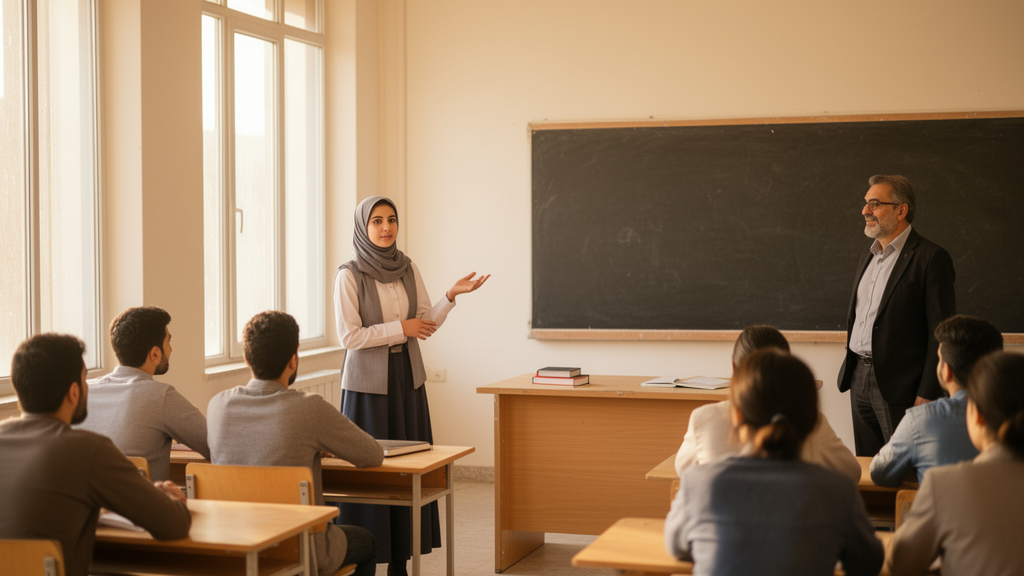
In a bustling teacher education center in Tehran, an experiment is quietly unfolding that could reshape how the world thinks about preparing teachers. A new qualitative case study published in Discover Education by Mohammad Hossein Arefian of Imam Khomeini International University examines an Islamic-Iranian model of the effective teacher educator, exploring whether a framework rooted in spiritual cultivation and moral exemplification can develop pre-service teachers’ personal, professional, and social skills in ways that conventional competency-based training does not. The findings, drawn from six months of immersive fieldwork with five teacher educators and ten pre-service teachers, offer a vivid portrait of a system where lesson planning becomes an act of worship and classroom management becomes a lesson in patience.
The study is grounded in a theoretical framework that merges Vygotsky’s Sociocultural Theory with the Islamic concept of Tarbiyah, which frames education as holistic upbringing rather than mere knowledge transmission. In this model, the teacher educator takes on the role of a Murabbi, an educator-cultivator whose responsibility extends beyond academic guidance to the fostering of the learner’s entire being. Effectiveness is not judged only by the educator’s ability to develop teaching competence but also by their success in modeling faith-based conduct and inspiring moral integrity. The educator’s personal adherence to Islamic principles and Iranian cultural values becomes a central indicator of professional excellence, a perspective that derives from Islamic-Iranian educational philosophy rather than from empirical measurement.
What makes this model technically distinctive is its emphasis on what participants described as epistemic integration, the weaving together of Qur’anic wisdom, Persian literary heritage, and modern pedagogy into a cohesive instructional approach. Rather than treating religious and scientific knowledge as competing domains, educators modeled what participants called tawhidi pedagogy, a unitive epistemology reflecting the Islamic principle of tawhid. This incorporation was observed when educators connected modern theories to Qur’anic and Persian intellectual heritage. For instance, one educator juxtaposed Piaget’s cognitive stages with the Islamic concept of Nafs, encouraging students to reflect on the moral development of the self alongside cognitive development. In a lesson on motivation, another educator started with Maslow’s hierarchy but engaged it through the concept of Rida and a poem by Rumi about seeking the divine.
The research employed a qualitative case study design at the Center for Teacher Education and Professional Development in Tehran, using semi-structured interviews, focus group discussions, non-participant observation, and document analysis. Data collection spanned a six-month period from September 2022 to February 2023, covering a single cohort of pre-service teachers in their final-year practicum under the ETE framework. The researcher completed forty-two hours of observation across fourteen separate sessions, capturing approximately eighty-five percent of all formal program activities. Document analysis included the Fundamental Transformation of Education Document, the pilot program curriculum, and reflective journals written by the five participating teacher educators. Data were analyzed using inductive thematic analysis, with coding conducted manually and later organized in NVivo software to ensure systematic data management and traceability.
The analysis generated five overarching themes. The first describes how participants characterized the effective teacher educator as an integrated moral and pedagogical exemplar who embodies the values, attitudes, and instructional competencies central to Islamic-Iranian education. Pre-service teachers repeatedly highlighted that witnessing ethical behavior in their educators was perceived as more formative than formal instruction. Acts such as staying after class to assist struggling students, indicating patience throughout heated debates, or treating every student with equal respect were mentioned as transformative examples of akhlaq in action. Participants suggested that this perceived authenticity contributed to what they termed a moral atmosphere in the classroom, a form of hidden curriculum that deeply influenced learning.
The second theme presents participants’ accounts of how the training program was associated with three domains of development. Pre-service teachers consistently reported substantial personal transformation, describing how viewing teaching as ibadah transformed their outlook on professional challenges. Failures were reframed as opportunities for self-purification and trust in God. One participant explained that before the program, faith and profession seemed separate, but now teaching is seen as worship, giving inner unity when lessons fail. In the professional domain, pre-service teachers reported developing a distinctive form of reasoning grounded in ethical intentionality, designing lessons to develop virtues and moral awareness rather than focusing solely on instructional techniques. In the social domain, participants reported that the program awakened a strong sense of social mission, with engagement in community instructional projects framed as jihad-e-ilmi, a sacred struggle for knowledge distribution and social equity.
The third theme addresses the structural and organizational enablers that participants identified as supporting the model’s implementation. Teacher educators perceived national policy documents like the Fundamental Transformation of Education Document as valuable guiding frameworks that articulated moral direction instead of fixed procedures. A cornerstone of the program’s professional culture was the Shura-e-Amuzeshi, a structured collaborative reflection practice among teacher educators characterized by open conversation, collective problem-solving, and the application of Islamic sources for moral reflection. The practicum was reconsidered as a comprehensive apprenticeship incorporating technical performance with moral formation, where mentors assessed not only instructional proficiency but also interpersonal conduct, humility, and value incorporation.
A cross-cutting theme that emerged across interviews and observations was participants’ narrative of spiritual reorientation, a perceived transformation of both teacher educators and pre-service teachers attributed to reflective engagement with the model. Participants spoke of rediscovering their purpose, redefining success, and re-evaluating what it means to educate within an Islamic-Iranian framework. One teacher educator described alignment between the heart and the hand, whereby professional acts including lesson design, mentoring, or assessment were described as spiritually significant expressions of faith. Pre-service teachers likewise described a deep sense of awakening, where learning became inseparable from self-transformation.
However, the study also captures real-world complexities and tensions in enacting the model. Teacher educators often tried to incorporate global pedagogical trends including critical thinking, learner-centered instruction, and assessment literacy with the spiritual and moral orientations of Islamic pedagogy, with many specifying feeling stretched between two epistemologies. Several participants emphasized structural and logistical barriers including restricted access to culturally aligned pedagogical materials, time pressures within the curriculum, and a lack of understanding among some administrators concerning the depth of the vision. The strong moral and spiritual expectations placed on teacher educators generated occasional feelings of inadequacy or internal conflict, though many viewed these struggles as part of the process of tazkiyah, or self-purification, rather than as failure.
The study’s findings are constrained by the single-case design, reliance on self-reported data, lack of longitudinal follow-up, and the potential for researcher and participant positivity bias. The findings are not claimed to be statistically generalizable but rather analytically generalizable to theory on value-based teacher education, with transferability supported by thick description. For Iran, the model offers one potential pathway for realizing the goals of the Fundamental Transformation of Education Document. For the wider international community, it presents an alternative perspective to predominantly Western paradigms of teacher education, suggesting that frameworks integrating spiritual, ethical, and professional dimensions warrant further scholarly attention. Future research should employ comparative designs across multiple institutions, incorporate independent measures of skill development, and examine whether reported changes persist over time.
Subject of Research: Strengthening pre-service teachers personal professional and social skills through the Islamic Iranian model of effective teacher educator training
Article Title: Strengthening pre-service teachers personal professional and social skills through the Islamic Iranian model of effective teacher educator training
Article References: Arefian, M. H. (2026). Strengthening pre-service teachers personal professional and social skills through the Islamic Iranian model of effective teacher educator training. Discover Education, 5(1), Article 852. https://doi.org/10.1007/s44217-026-02115-3
Image Credits: AI Generated
DOI: 10.1007/s44217-026-02115-3
Keywords: Strengthening, pre-service, teachers, personal, professional, social, skills, Islamic, Iranian, model, effective, teacher
Cite Scienmag News
Courtney Benton. (October 18, 2026). Strengthening pre-service teachers personal professional and social skills through the Islamic Iranian model of effective teacher educator training. Scienmag. https://scienmag.com/strengthening-pre-service-teachers-personal-professional-and-social-skills-through-the-islamic-iranian-model-of-effective-teacher-educator-training/
Courtney Benton. "Strengthening pre-service teachers personal professional and social skills through the Islamic Iranian model of effective teacher educator training." Scienmag, 18 October 2026, https://scienmag.com/strengthening-pre-service-teachers-personal-professional-and-social-skills-through-the-islamic-iranian-model-of-effective-teacher-educator-training/. Accessed 18 October 2026.
Courtney Benton. "Strengthening pre-service teachers personal professional and social skills through the Islamic Iranian model of effective teacher educator training." Scienmag. October 18, 2026. https://scienmag.com/strengthening-pre-service-teachers-personal-professional-and-social-skills-through-the-islamic-iranian-model-of-effective-teacher-educator-training/


