


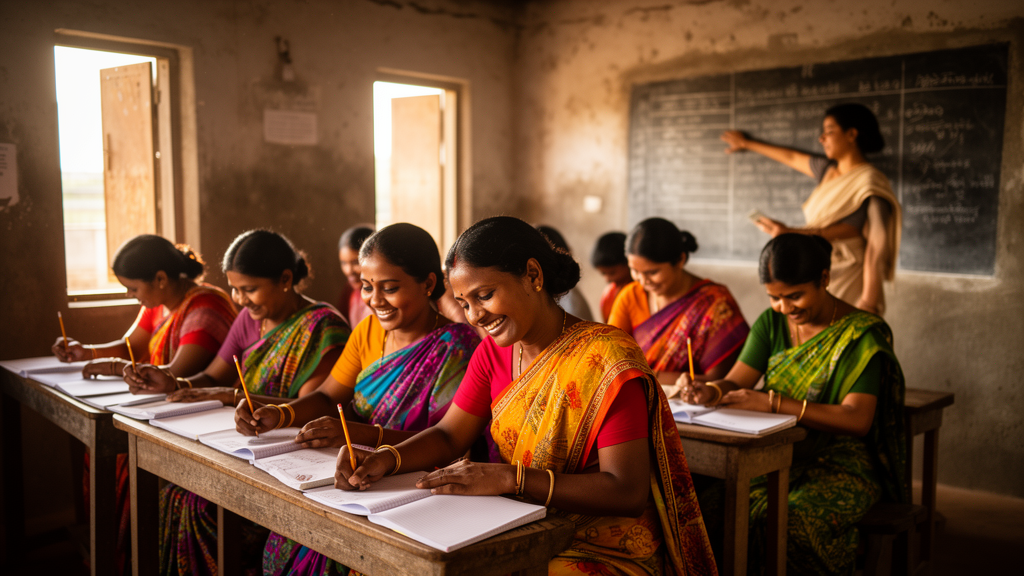
A new study from Bangalore Rural district offers one of the most detailed portraits yet of what happens when women who have never held a book are taught to read one. Published in Discover Education, the research by Stanzin Nouskit of the Institute for Social and Economic Change tracked 200 women across four slum communities, comparing the literacy and numeracy skills of 120 women who had completed adult literacy classes with 80 who had not. The results are striking: women who attended the programme outperformed non-participants in nearly every measurable skill, from reading comprehension, where 92.5 per cent of participants demonstrated competence against just 22.5 per cent of non-participants, to writing, where the gap widened to 90 per cent versus 17.5 per cent. Yet the study also reveals the stubborn limits of literacy alone in transforming lives shaped by poverty, labour and patriarchal norms.
The research is grounded in two influential theoretical traditions. Paulo Freire’s concept of critical consciousness holds that literacy is not merely decoding text but awakening an awareness of one’s social and economic conditions, enabling learners to question and respond to the realities of their lives. Amartya Sen’s capability approach, meanwhile, frames development not as rising income but as expanding the freedoms people have to lead lives they value. Together, these frameworks explain why the study measured not just reading scores but also confidence, decision-making, health awareness and community participation. Literacy, in this view, is a gateway capability: once acquired, it unlocks access to information, economic activity and civic voice that were previously out of reach.
The achievement tests, developed in alignment with National Literacy Mission norms and translated into Kannada, probed a range of skills from letter recognition to arithmetic operations. Both groups performed similarly on the simplest tasks, such as identifying single digits, where participants scored 76.8 per cent and non-participants 76.3 per cent. But the divergence widened sharply as tasks grew more complex. Participants identified double digits at 52.6 per cent versus 20 per cent, executed multiplication at 90.1 per cent versus 37.5 per cent, and recognised alphabets at 58.4 per cent against 13.7 per cent. These findings suggest that well-designed programmes do more than teach rote recognition; they build the higher-order cognitive skills of reasoning, comprehension and problem-solving that functional literacy demands.
Beyond the test scores, the qualitative interviews revealed transformations in how women saw themselves. Nearly 99.2 per cent of participants reported increased awareness of legal and constitutional rights, and 96.7 per cent became aware of their right to parental property. Vaishnavi, a 34-year-old participant, described the shift: before joining, she was unaware of legal rights; now she understood that the law exists to protect her and that injustice need not be tolerated. Varalakshmi, a 45-year-old daily wage worker, said learning about her rights gave her the confidence to stand up for herself. These accounts echo Freire’s insight that literacy awakens a sense of agency that extends far beyond the classroom.
The programme also reshaped family dynamics in measurable ways. Approximately 83.3 per cent of participants said it motivated them to prioritise their children’s schooling, and every single participant opposed early marriage for their daughters, recognising education as a pathway to better futures. Rajamma, a 28-year-old who became the first literate person in her family, said she now ensures her children do not face the hardships she endured. Health awareness also improved, with 80.9 per cent reporting increased knowledge of government welfare schemes and healthcare services. At the community level, 95.8 per cent of participants reported increased participation in local meetings and activities, suggesting that literacy ripples outward from the individual to the collective sphere.
Yet the study is unsparing about what literacy cannot fix. Nearly 60 per cent of participants felt that literacy alone did not fully empower them, citing financial insecurity, limited livelihood opportunities and inadequate institutional support. Only 20.7 per cent reported improvement in their standard of living, and while 58.3 per cent felt the programme boosted their career prospects through confidence, the majority said it did not help them secure employment. Palavi, a 27-year-old, wished the programme had included specific job skills training. Meghana, 40, could now read her electricity bill but still depended on others to manage household finances. These findings align with Sen’s framework: literacy expands a capability, but converting that capability into real freedom requires complementary resources, from vocational training to financial access.
The barriers to participation were equally revealing. Among the 80 non-participants, 60 per cent were aware the programme existed but could not join, with 87.5 per cent citing feasibility issues such as time constraints and personal responsibilities. Amrin, 32, leaves for work before sunrise and returns late in the evening, leaving no room for classes. Pavitra, 26, runs a tea stall she cannot close even for a few hours. Najamma, 25, said her husband and in-laws expect her to take care of everything at home. Another 40 per cent were wholly unaware of the programme, with 87.5 per cent stating they had never received any information about it. Muniyamma, 45, said no one from the government or community leaders had ever told her about it. These gaps point to serious failures in outreach and communication.
Participants who did attend faced their own obstacles. Fixed class timings clashed with dinner preparation and household chores, as Lakshmi, 38, described: classes started just when she needed to cook, and by the time she finished, the class was over. The six-month duration felt insufficient for women with no prior formal education; Kamalamma, 34, said she had just started understanding letters and numbers when the programme ended, returning her to where she began. Volunteers collected learning materials after the programme concluded, leaving women without books or resources to continue practising. Teacher punctuality was another concern; Rani, 26, rushed through her chores only to wait an hour at a closed centre. Cultural norms compounded these difficulties, with husbands and mothers-in-law dismissing education as a waste of time for women of their age.
Nouskit proposes a set of policy recommendations grounded in these findings. Curricula should be enriched with practical writing tasks such as form-filling and letter-writing, while foundational numeracy gaps could be addressed through small-group or personalised instruction. Flexible scheduling, hybrid learning formats and targeted support for marginalised communities could boost participation. Outreach campaigns led by community leaders and delivered in local languages could close the awareness gap, while integrating modules on parenting, financial literacy and vocational skills would enhance relevance. Consistent instruction through trained volunteers, digital tools and backup systems would sustain learning momentum, and family support, particularly in overcoming household resistance to women’s education, remains crucial.
The study contributes to a body of literature that has long recognised adult literacy as a vehicle for empowerment but has rarely examined its effects in slum settings with this level of granularity. The findings resonate with global evidence from the UNESCO Global Education Monitoring Report, which notes that literacy enables individuals to exercise their rights, access better job opportunities and advocate for themselves and their families. They also align with Mezirow’s transformative learning theory, in which education produces a fundamental shift in perspective that enables learners to challenge societal norms. For the women of Bangalore’s slums, literacy is more than a skill; it is a gateway to self-determination, economic resilience and civic participation. But as this research makes clear, that gateway opens only when programmes are designed with cultural relevance, community engagement and a focus on empowerment, and when the structural barriers of poverty, labour and gender norms are addressed alongside the letters and numbers on the page.
Subject of Research: Impact of adult literacy programmes on the lives of women in slum of Bangalore
Article Title: Impact of adult literacy programmes on the lives of women in slum of Bangalore
Article References: Nouskit, S. (2026). Impact of adult literacy programmes on the lives of women in slum of Bangalore. Discover Education, 5(1), Article 862. https://doi.org/10.1007/s44217-026-02132-2
Image Credits: AI Generated
DOI: 10.1007/s44217-026-02132-2
Keywords: Impact, adult, literacy, programmes, lives, women, slum, Bangalore, scientific research
Cite Scienmag News
Courtney Benton. (October 18, 2026). Literacy classes reshape lives of women in Bangalore slums, study finds. Scienmag. https://scienmag.com/literacy-classes-reshape-lives-of-women-in-bangalore-slums-study-finds/
Courtney Benton. "Literacy classes reshape lives of women in Bangalore slums, study finds." Scienmag, 18 October 2026, https://scienmag.com/literacy-classes-reshape-lives-of-women-in-bangalore-slums-study-finds/. Accessed 18 October 2026.
Courtney Benton. "Literacy classes reshape lives of women in Bangalore slums, study finds." Scienmag. October 18, 2026. https://scienmag.com/literacy-classes-reshape-lives-of-women-in-bangalore-slums-study-finds/


