


Environmental DNA has promised a revolution in how we monitor rivers and streams: instead of scraping larvae from stones and squinting at mouthparts under a microscope, scientists can in principle simply filter a bottle of water and read out the community living there. A new study published in Metabarcoding and Metagenomics puts that promise to a rigorous field test in German streams, and its verdict is nuanced. Briefly incubating collected animals in a bucket of stream water before filtering dramatically sharpens the local biodiversity signal, but the fashionable idea of reading environmental RNA directly from the water does not live up to expectations for stream invertebrates.
The core problem the researchers confronted is one of geography. When you filter stream water, the DNA you capture does not necessarily come from organisms standing in front of you. Molecules drift downstream from upstream sources, linger in sediments, get resuspended by currents, and distribute themselves according to a stream’s hydromorphology. That regional haze is fine if you want a holistic picture of a catchment, but it is a liability when your goal is a site-specific bioassessment comparable to the traditional kicknet surveys that underpin legislation like the European Water Framework Directive and the US Clean Water Act. Benthic macroinvertebrates, the mayflies, stoneflies and caddisflies that serve as biological quality elements, are collected physically at a site in routine monitoring, and water-based eDNA metabarcoding has consistently failed to capture the local invertebrate community as comprehensively as tissue-based metabarcoding of the collected specimens.
Two remedies had recently been proposed. The first targets environmental RNA, or eRNA, which is produced and turned over at higher rates than DNA, so most captured eRNA should have been recently released by living animals present at the site. The second is an incubation strategy: capture the animals locally, hold them briefly in a container of stream water, and then filter that enriched water, allowing the animals to be released alive afterwards. Building on these options, the team derived and tested three distinct strategies for obtaining a more localized signal: eRNA metabarcoding of a direct stream water sample; eDNA and eRNA metabarcoding of water in which animals collected by kicknet multi-habitat sampling were briefly incubated; and eDNA and eRNA metabarcoding of water in which natural substrate exposures, pre-compiled substrates left in the stream for four weeks to be actively colonised by invertebrates, were briefly incubated. For comparison, they used eDNA directly isolated from stream water as the more regional signal, and the bulk sample of animals that had been incubated as the local point-based reference.
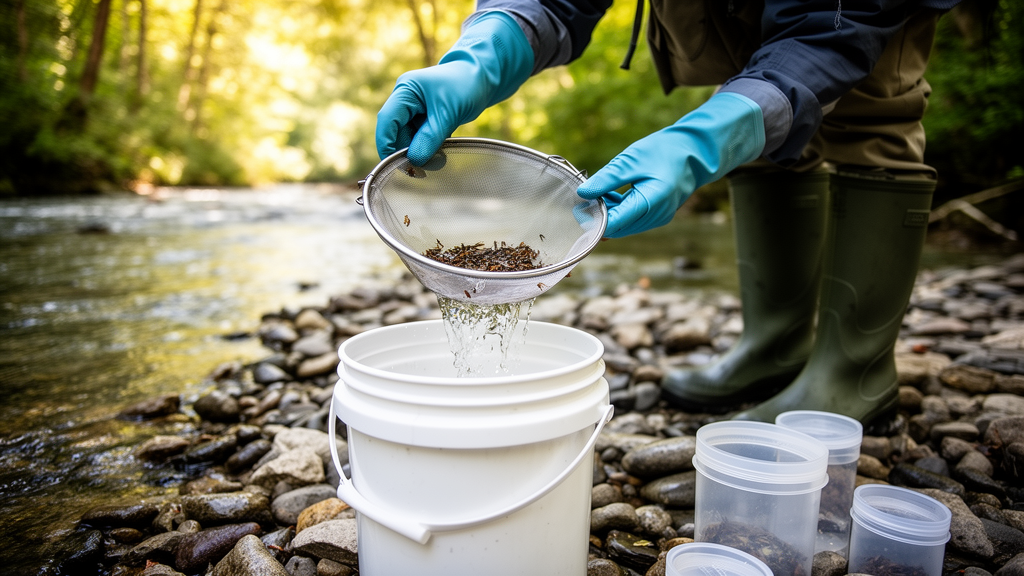
The field campaign spanned four streams in North-Rhine Westphalia, Germany, each sampled at two spots. The researchers prepared two types of natural substrate exposures, a wood-leaf mix and gravel, using materials collected at each site to preserve natural conditions and prevent cross-contamination between streams. Thirty-two NSEs in total, each a 30 by 30 centimetre nylon net, were anchored to the riverbed in April 2023, with one of each substrate type placed in a low-flow pool and the other in a high-flow riffle to capture a diverse range of species. After four weeks of colonisation, the team took direct 500 millilitre water samples downstream of the NSEs, carefully recovered the NSEs and transferred them to 20 litre buckets filled with 10 litres of stream water, and performed kicknet multi-habitat sampling along a transect, with the whole sample likewise transferred to an identical bucket. After 20 minutes of incubation, with stirring to mix the water and DNA, 500 millilitre aliquots were filtered in the field. The animals were preserved in ethanol for bulk metabarcoding, and in the laboratory the team co-extracted DNA and RNA from the filters, digested the RNA samples with DNase, reverse-transcribed the RNA to cDNA, and amplified a freshwater invertebrate primer pair targeting the mitochondrial COI gene region in a two-step PCR before sequencing on an Illumina NovaSeq 6000.
The sequencing effort was enormous: more than 334 million reads clustering into over 23,000 operational taxonomic units before quality filtering. After retaining only OTUs assigned to at least family level, filtering for macroinvertebrates and removing terrestrial taxa, the final dataset comprised 1,498 OTUs and 682 unique species. Statistical comparisons relied on ANOVA for species and OTU counts, non-metric multidimensional scaling based on Jaccard’s distance to visualise community composition, and ANOSIM tests to formally compare the three sampling approaches.
The first headline result concerns eRNA. Contrary to the hypothesis that eRNA metabarcoding of stream water would overlap better with the locally collected bulk samples than eDNA does, the opposite occurred: species lists from eDNA stream water shared a 13.65 percent higher proportion of species with the bulk samples than eRNA stream water did. eRNA metabarcoding simply detected fewer species overall, independent of whether the molecules originated locally or regionally. The authors point out that recent studies have reported similar decay rates for eDNA and eRNA in water, and that binding of molecules to organic matrices like biofilm, or their presence within shed cells, can stabilise them for up to 21 days, blurring the assumed temporal advantage of RNA. Field handling may also have contributed, since although samples were filtered immediately and kept on ice, the sampling process took several hours before the filters reached a laboratory freezer at minus 80 degrees Celsius.
The second headline result is far more encouraging for practitioners. Both incubation strategies significantly increased the proportion of species identified by both metabarcoding of the enriched water and the locally collected bulk sample, by roughly 17 percent for eDNA and 20 percent for eRNA compared with direct stream water sampling. After merging species lists across sampling spots at a site, the overlap between bulk samples and incubated eDNA water samples reached 67 percent, while the overlap between bulk samples and direct stream water samples reached only 53 percent. Multidimensional scaling showed that eDNA and bulk samples clustered closely together after incubation, regardless of which stream was sampled, whereas direct stream water samples were more dissimilar both among themselves and to the bulk samples. Notably, eRNA metabarcoding of incubated water did not outperform eDNA of incubated water either, detecting about 10 percent fewer shared species, which led the authors to conclude that the effect of incubation outweighs the effect of the molecule analysed.
The third headline result was a genuine surprise. The researchers had predicted that kicknet multi-habitat sampling, covering a broader habitat range and roughly half again more streambed area than the NSE approach, would detect more species. Instead, the NSEs revealed 20 percent more species with both eDNA and bulk DNA metabarcoding, and 94 percent of the species detected by kicknet sampling were also detected by the NSEs. The authors attribute this to the artificial substrates offering a richer, more spatially condensed array of food resources, including foliage, wood and biofilm, which likely attracted macroinvertebrates, while the nets and their anchoring provided protection and a stable habitat resistant to strong currents. Only the order Odonata was exclusively detected in the NSE samples, all four dragonfly and damselfly species having aggregated at the low-flow pool placements, while the groundwater amphipod Niphargus aquilex appeared only in the kicknet samples, which agitate the streambed and can capture animals living just below the surface.
Each strategy carries distinct practical trade-offs. eRNA metabarcoding demands rapid, sterile handling, immediate filtration, ice storage and costly stabilisation reagents, plus the added expense of DNase digestion and reverse transcription, and its future value may lie less in species detection than in assessing the physiological status and stress responses of organisms, potentially functioning as a predictive molecular early-warning tool. Kicknet sampling requires less preparatory work and no prior deployment, but it is destructive to the streambed and stressful for organisms, and the animals are typically killed for bulk analysis. NSEs, by contrast, allow gentle removal of animals with minimal harm, reported mortality below 1 percent and survival rates around 97 percent for sensitive mayfly, stonefly and caddisfly taxa, and the animals can be released back to the stream after incubation. However, NSEs demand substantial preparatory effort, from collecting and drying substrates to anchoring and recovery, and they are difficult to deploy in larger, faster streams, which is why the Emscher itself was too large and deep to sample and its smaller tributaries were used instead. Sandy-bottomed streams like the Boye also pose challenges, since animals can bury themselves beyond the reach of the substrates.
The study’s conclusion is that the most effective strategy for enhancing detection of the local stream community via water samples involves briefly incubating collected organisms in water and analysing the enriched eDNA, with natural substrate exposures representing the most promising, animal-friendly avenue for local and standardised eDNA metabarcoding assessments. The authors caution that further verification is needed in other stream types before NSE-based incubation could be taken up into standardised biomonitoring programmes, and they suggest testing whether shorter incubation times might suffice, since a preceding study showed a high degree of overlap immediately after transfer of animals to the incubation medium. If confirmed, the approach could allow monitoring campaigns to cover more sites per day while releasing every captured animal alive, aligning modern genetic bioassessment with the growing demand to minimise the impact of monitoring on the very habitats it is meant to protect.
Subject of Research: Comparison of eDNA and eRNA metabarcoding strategies for local stream bioassessment of macroinvertebrates
Article Title: Comparison of three strategies for local bioassessments in streams using environmental DNA and RNA metabarcoding of macroinvertebrates
Article References: Sander, M., Beermann, A. J., Brömmling, D., Buchner, D., Weiss, M., & Leese, F. (2025). Comparison of three strategies for local bioassessments in streams using environmental DNA and RNA metabarcoding of macroinvertebrates. Metabarcoding and Metagenomics, 9, Article e148923. https://doi.org/10.3897/mbmg.9.148923
Image Credits: AI Generated
Keywords: environmental DNA, environmental RNA, metabarcoding, macroinvertebrates, stream bioassessment, biomonitoring, natural substrate exposures, Water Framework Directive, freshwater ecology, biodiversity monitoring, Comparison, three
Cite Scienmag News
Margaret Porter. (October 18, 2026). Incubating stream creatures in buckets sharpens eDNA biodiversity checks. Scienmag. https://scienmag.com/incubating-stream-creatures-in-buckets-sharpens-edna-biodiversity-checks/
Margaret Porter. "Incubating stream creatures in buckets sharpens eDNA biodiversity checks." Scienmag, 18 October 2026, https://scienmag.com/incubating-stream-creatures-in-buckets-sharpens-edna-biodiversity-checks/. Accessed 18 October 2026.
Margaret Porter. "Incubating stream creatures in buckets sharpens eDNA biodiversity checks." Scienmag. October 18, 2026. https://scienmag.com/incubating-stream-creatures-in-buckets-sharpens-edna-biodiversity-checks/


