


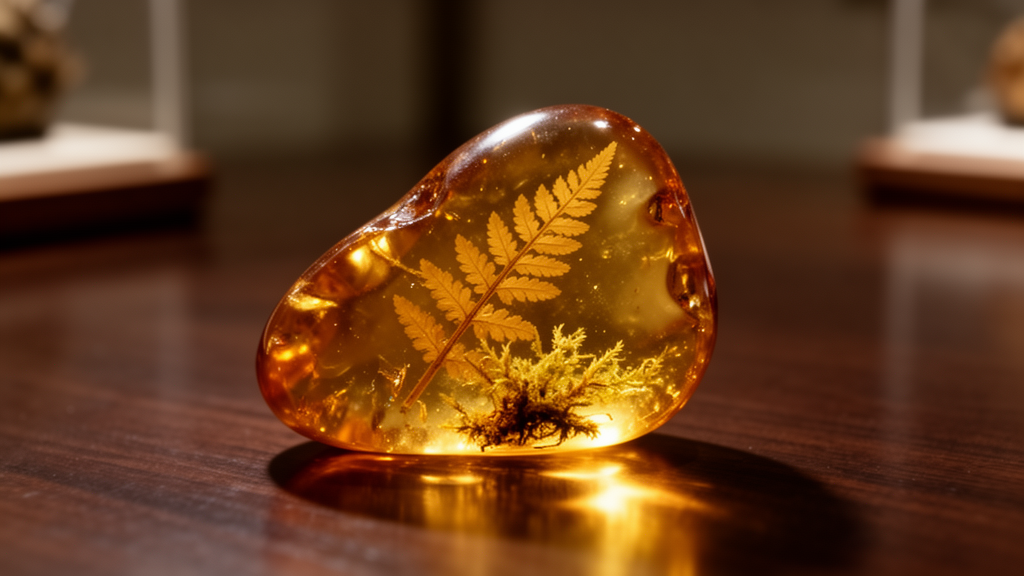
Deep inside golden chunks of amber mined in the Dominican Republic and the Mexican state of Chiapas, scientists have found nine specimens of tiny plants and fungi that once clung to the branches of Miocene rainforest trees. The fossils, described in the journal Fossil Record, include two new species of leafy liverworts and several lichens of the genus Parmotrema, and they carry a striking message: the communities of mosses, liverworts, and lichens that decorate tropical tree trunks and canopies today were already assembled in essentially their modern form 15 to 23 million years ago.
Amber is an unusual and precious medium for fossilization. Unlike rock fossils, which are often flattened, distorted, or fragmentary, amber inclusions are preserved in three dimensions with astonishing fidelity, sometimes down to the level of individual cell walls. That makes them uniquely valuable for comparing extinct organisms with living ones. Both Dominican amber, dated to roughly 15 to 20 million years old, and Mexican amber, dated to 15 to 23 million years old, were produced by trees of the genus Hymenaea, a member of the bean family that still grows in Mexico, Central America, and the Caribbean. The resin trapped not only insects but also the delicate epiphytes, organisms that grow on other plants without parasitizing them, that covered the bark and leaves of the ancient forest.
Leafy liverworts of the subclass Jungermanniidae are among the earliest diverging lineages of land plants, yet their fossil record is otherwise scarce because their soft tissues decay quickly. In amber, however, they are remarkably frequent. The order Porellales, in particular, contains many epiphytes and epiphylls, plants that grow on living leaves, and its members show morphological adaptations to life in the canopy. Species-rich families such as Lejeuneaceae, with more than 1,000 extant species, and Frullaniaceae, with more than 675 accepted taxa, are common amber inclusions from the mid-Cretaceous onward. Dominican amber has preserved the best-studied and most diverse Neogene liverwort flora known, and Mexican amber is emerging as a second, still understudied source of well-preserved material.
The first new species, named Frullania chiapasensis after the Chiapas amber deposit, is a small liverwort preserved as two gametophyte fragments, the largest an intact shoot about 2.64 millimeters long. Its leaves are conduplicate-trilobed, folded into three lobes, with a saccate ventral lobule of the classic Frullania type and a sickle-shaped mouth opening along the abaxial side of the lobe. The underleaves are triangular to obovate and armed with short teeth in their upper third. It is only the fourth representative of this hyperdiverse genus, which contains 675 currently accepted taxa and more than 2,000 published names, to be described from New World amber deposits. To establish that the fossil truly represents a distinct species, the team built a morphology matrix comparing it with 144 extant and extinct species across 16 critical characters, including lobule orientation, underleaf shape, and the structure of the lobule mouth.
The closest living relative by these criteria is Frullania simmondsii, which matches the fossil in all 11 additional characters scored. Yet the two can still be separated: the fossil has leaf lobes longer than wide, a foliaceous stylus longer than wide, and underleaves mostly longer than wide with concave lower margins, whereas F. simmondsii shows the opposite states in each case. Eight more extant species differ from the fossil in exactly one character, most often the arrangement of the lobules, which in F. chiapasensis run largely parallel to the stem rather than spreading obliquely. The remaining 135 species in the comparison differ by two to seven characters. The subgeneric assignment of the new species remains problematic because its most similar relatives are currently placed in different subgenera, a reflection of the extensive morphological homoplasy that complicates the taxonomy of this genus even for specialists working with fresh material.
The second new species, Thysananthus patrickmuelleri, named for the amber collector Patrick Müller who provided all known specimens, is a member of the Lejeuneaceae subfamily Ptychanthoideae. Its shoots reach up to 5.04 millimeters in length with leaves, and the species is diagnosed by a ventral merophyte at least five cells wide, flagelliform branches on the lower parts of the shoots, elongate median lobe cells with distinctly cordate trigones, and underleaves with recurved apices and revolute margins. The genus Thysananthus is already rather diverse in Dominican amber, where it includes one extant species and two extinct ones, but this is its first record from Mexican amber. Among living species, the fossil most closely resembles the neotropical T. plicatiflorus of northern South American rainforests, sharing elongate ovate-oblong leaves with rounded apices and auriculate underleaves, but it differs markedly in the squarrose orientation and recurved apex of its underleaves.
A third liverwort specimen, too fragmentary and sterile for species-level description, was assigned to the genus Lejeunea, a cosmopolitan group of about 200 extant species that grows on bark and living leaves in tropical and warm-temperate regions. The fossil shows the obliquely spreading leaf lobes, large flask-shaped lobules with a short straight tooth, and thin-walled leaf cells characteristic of Lejeunea, though its unusually small size, possibly because it represents a branch rather than a main shoot, distinguishes it from most extant members of the genus. Four fossil species of Lejeunea have previously been described from Dominican amber; the Mexican specimen differs from all of them but cannot be ruled out as an extant species given its incomplete preservation.
The lichen fossils are equally significant. Only four lichen species had previously been described from Dominican amber and none at all from Mexican amber, even though lichen-like associations existed as early as 600 million years ago in the Precambrian and stratified thalli are known from 415-million-year-old Devonian strata. The new material includes three specimens from Dominican amber and one from Mexican amber, all belonging to the extant genus Parmotrema, a group of roughly 300 foliose lichens concentrated in tropical and subtropical regions. The fossils show the long, thick, tapered marginal cilia and dark lower surfaces typical of the genus. One Dominican specimen with effigurate maculae on its upper surface resembles the former genus Canomaculina, now synonymized with Parmotrema, while another shows abundant finger-shaped isidia. Because species-level identification of parmelioid lichens relies largely on chemistry invisible in fossils, the specimens were compared at the level of infrageneric groups such as Parmotrema s. str., which contains more than 250 extant species.
These fossils carry real phylogenetic weight. Molecular analyses calibrated with fossils had constrained the age of the parmelioid crown group to around 60 million years and the genus Parmotrema to around 23 million years, but the only fossil calibration previously available within the parmelioid group consisted of two ambiguous specimens tentatively placed in Parmelia that lacked the marginal cilia characteristic of Parmotrema. The newly described Parmotrema fossils, some of which can be assigned to infrageneric clades, now provide a minimum age of 15 to 23 million years for the genus, a substantially firmer calibration point for future dating studies of lichenized fungi.
Taken together, the nine specimens substantiate a hypothesis of generic stasis in neotropical epiphyte communities. Every bryophyte, fern, and lichen genus known from Dominican amber is extant, and Mexican amber appears to have captured a liverwort flora of similar composition, dominated by Porellales and especially Lejeuneaceae. Yet the two deposits also reveal floristic differences: Frullania is represented by three well-delimited species in Mexican amber but only one fragment from Dominican amber, while Spruceanthus extinctus, known only from Mexican amber, belongs to a genus today centered in Asia and Australasia, suggesting that its Miocene distribution was once far wider. Comparable understudied deposits, including early Miocene Shewa amber from Ethiopia, which was also produced by Hymenaea, and mid-Miocene Zhangpu amber from China, promise to further illuminate how these cryptogamic communities evolved as angiosperm-dominated megathermal forests rose to prominence during the Cenozoic.
Subject of Research: Paleontology
Article Title: Extending the fossil record of Miocene neotropical epiphyte communities
Article References: Feldberg, K., Kaasalainen, U., Mamontov, Y. S., Gradstein, S. R., Schäfer-Verwimp, A., Divakar, P. K., & Schmidt, A. R. (2025). Extending the fossil record of Miocene neotropical epiphyte communities. Fossil Record, 28(1), 79-102. https://doi.org/10.3897/fr.28.137758
Image Credits: AI Generated
DOI: 10.3897/fr.28.137758
Keywords: Extending, fossil, record, Miocene, neotropical, epiphyte, communities, scientific research
Cite Scienmag News
Gavin Prescott. (October 18, 2026). Amber fossils reveal Miocene rainforest epiphytes little changed for 20 million years. Scienmag. https://scienmag.com/amber-fossils-reveal-miocene-rainforest-epiphytes-little-changed-for-20-million-years/
Gavin Prescott. "Amber fossils reveal Miocene rainforest epiphytes little changed for 20 million years." Scienmag, 18 October 2026, https://scienmag.com/amber-fossils-reveal-miocene-rainforest-epiphytes-little-changed-for-20-million-years/. Accessed 18 October 2026.
Gavin Prescott. "Amber fossils reveal Miocene rainforest epiphytes little changed for 20 million years." Scienmag. October 18, 2026. https://scienmag.com/amber-fossils-reveal-miocene-rainforest-epiphytes-little-changed-for-20-million-years/

