


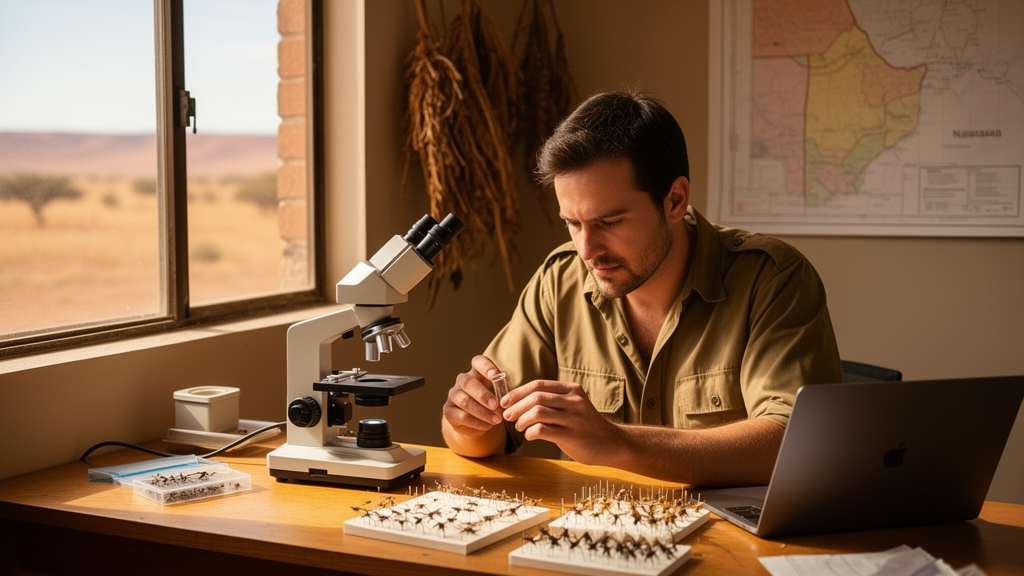
On a warm December morning in central Namibia, a team of entomologists swept fine mesh nets over the tufa formations of the Mountain Zebra National Park and the ephemeral streams around Windhoek. What they brought back was not large game or dramatic landscapes, but hundreds of tiny midges, each barely a few millimeters long. Those unassuming insects, preserved in ethanol and later sequenced and mounted on slides, have now become the basis of the first comprehensive inventory of Namibia’s chironomid fauna, published in the journal African Invertebrates.
Chironomids, commonly known as non-biting midges, are among the most species-rich families of flies, with thousands of described species worldwide. Their larvae thrive in virtually every aquatic habitat, from mountain streams to desert pools, and the adults, although harmless to humans, form a crucial link in aquatic food webs. Yet in Namibia, the fauna has remained almost entirely undocumented. The new study, led by Baranov and colleagues, is the first to combine DNA barcoding with classical morphological analysis to reveal the true diversity of the family in the country.
The team sampled four localities in central Namibia during December 2018: the tufa formations of the Mountain Zebra National Park in the Khomas region, and three sites around Windhoek, including the Goreangab Dam and ephemeral streams in the Windhoek area. Using sweep nets and light traps, they collected adult midges and, in some cases, larvae. Back in the laboratory, they extracted DNA from a subset of specimens, amplified the standard barcode region of the mitochondrial COI gene, and sequenced it. The remaining vouchers were mounted on slides and identified morphologically, following the established taxonomic framework for the Afrotropical region.
The results were striking. From a relatively modest sampling effort, the team recorded 21 species of chironomids across 14 genera, including several genera never before documented in Namibia. Among the most notable finds was a new species of the genus Paraphaenocladius, which the team described as Paraphaenocladius namibiensis sp. nov. The new species was distinguished from its relatives by a combination of morphological features of the male hypopygium, the genital structure used in chironomid taxonomy, and by its distinct barcode sequence.
The new species belongs to the Paraphaenocladius crassicaudatus species group, a lineage previously known only from the Palaearctic region. Its discovery in Namibia extends the known range of the group deep into the Afrotropics and raises questions about how these midges, whose larvae are associated with semi-terrestrial habitats, came to colonize the semi-arid landscapes of central Namibia. The team suggests that the semi-terrestrial larvae of Paraphaenocladius, which develop in moist soil and semi-terrestrial habitats, may be preadapted to survive in the ephemeral aquatic habitats that characterize the Namibian landscape.
But the new species was only one part of the story. The team also documented several genera for the first time in Namibia, including Limnophyes, Paratanytarsus, and Rheocricotopus. The genus Limnophyes, previously known in the Afrotropical region only from South Africa, was represented in the Namibian samples by a single specimen whose barcode sequence did not match any existing record, suggesting that it may represent another undescribed species. Similarly, the genus Rheocricotopus, previously undocumented in Namibia, was represented by specimens whose morphology and barcodes suggest a close relationship with species from South Africa.
The team also recorded several species that were previously known from the Afrotropical region but never documented in Namibia, including Paratanytarsus laetitarsus and Rheocricotopus capensis. These records extend the known distributions of these species northward and suggest that the chironomid fauna of Namibia is more closely related to that of South Africa than to that of tropical Africa.
Perhaps the most intriguing result of the study was the discovery of several specimens whose barcodes did not match any existing record in the Barcode of Life Data System, the international reference database for DNA barcodes. These specimens, which the team assigned to genera such as Limnophyes and Rheocricotopus, may represent additional undescribed species. The team suggests that the true diversity of Namibia’s chironomid fauna is likely much higher than the current inventory suggests, and that further sampling, particularly in the more remote regions of the country, is likely to reveal many more new species.
The study also highlights the value of DNA barcoding for chironomid taxonomy. Chironomids are notoriously difficult to identify morphologically, and many species can only be distinguished by subtle features of the male genitalia. DNA barcodes provide an independent means of species delimitation, and the team found that barcode sequences were generally consistent with morphological species boundaries. In several cases, however, barcodes revealed cryptic diversity within morphologically similar specimens, suggesting that some species may actually represent complexes of closely related species.
The team’s inventory also provides a baseline for future ecological studies. Chironomid larvae are important indicators of aquatic ecosystem health, and their community composition is widely used in biomonitoring programs. The new inventory provides the taxonomic foundation needed to identify Namibian chironomid larvae and to assess the health of the country’s aquatic ecosystems. The team suggests that the ephemeral streams and dams of central Namibia, which are subject to dramatic seasonal fluctuations, may harbor a distinctive chironomid fauna adapted to these extreme conditions.
The study also underscores the importance of basic taxonomic research in the face of ongoing biodiversity loss. Chironomids are among the most ecologically important families of flies, yet their fauna remains poorly documented in many parts of the world. The new inventory, although focused on a relatively small region of Namibia, provides a model for how DNA barcoding and classical morphology can be combined to rapidly document the diversity of poorly known groups. The team suggests that similar approaches could be applied to other regions of the Afrotropics, where the chironomid fauna remains largely undocumented.
For the team, the discovery of a new species in the semi-arid landscapes of central Namibia is a reminder that even the most familiar landscapes can harbor unknown diversity. The semi-terrestrial larvae of Paraphaenocladius, which develop in moist soil, are a testament to the remarkable adaptations of chironomids to life in extreme environments. As the team continues to sample the ephemeral streams and dams of Namibia, they are likely to uncover many more surprises, each one a testament to the remarkable diversity of life in one of the world’s most challenging environments.
Subject of Research: Biodiversity
Article Title: Uncovering the hidden diversity of non-biting midges ( Diptera , Chironomidae ) from central Namibia, using morphology and DNA barcodes
Article References: Baranov, V., Lin, X., Hübner, J., & Chimeno, C. (2024). Uncovering the hidden diversity of non-biting midges (Diptera, Chironomidae) from central Namibia, using morphology and DNA barcodes. African Invertebrates, 65(1), 15-36. https://doi.org/10.3897/afrinvertebr.65.111920
Image Credits: AI Generated
DOI: 10.3897/afrinvertebr.65.111920
Keywords: Chironomidae, DNA barcoding, Namibia, new species, taxonomy, Uncovering, hidden, diversity, non-biting, midges, Diptera, central
Cite Scienmag News
Gavin Prescott. (October 18, 2026). Hidden Wings: DNA Barcodes and Morphology Reveal Namibia’s Unknown Chironomid Diversity. Scienmag. https://scienmag.com/hidden-wings-dna-barcodes-and-morphology-reveal-namibias-unknown-chironomid-diversity/
Gavin Prescott. "Hidden Wings: DNA Barcodes and Morphology Reveal Namibia’s Unknown Chironomid Diversity." Scienmag, 18 October 2026, https://scienmag.com/hidden-wings-dna-barcodes-and-morphology-reveal-namibias-unknown-chironomid-diversity/. Accessed 18 October 2026.
Gavin Prescott. "Hidden Wings: DNA Barcodes and Morphology Reveal Namibia’s Unknown Chironomid Diversity." Scienmag. October 18, 2026. https://scienmag.com/hidden-wings-dna-barcodes-and-morphology-reveal-namibias-unknown-chironomid-diversity/


