


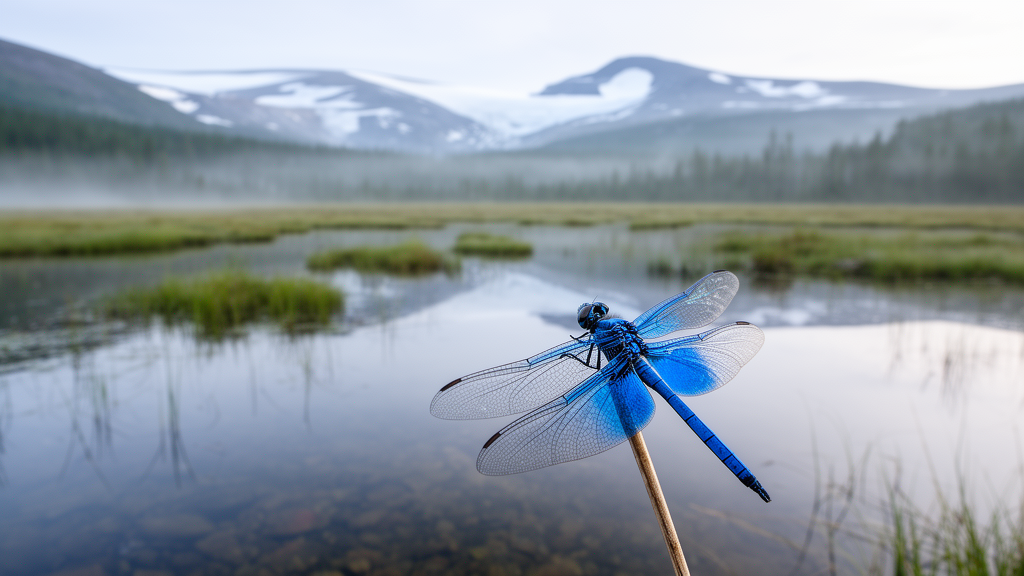
Across Europe, the map of dragonfly and damselfly diversity looks deceptively simple at first glance: a broad band of high richness stretching through France, Germany and the Alps, fading both towards the frozen north and the drier south. But a new study argues that this mid-latitude peak is the product of two very different forces working at different timescales — the climate of the present day and the climate of the last ice age, 21,000 years ago — with freshwater habitat availability playing a supporting, and sometimes counterintuitive, role. The research, published in Frontiers of Biogeography, analysed 124 species of Odonata, the insect order that contains dragonflies and damselflies, and found that the ghost of Pleistocene glaciation still leaves a measurable imprint on where these insects thrive today.
The study set out to test three complementary hypotheses about what drives species richness gradients. The first is the water-energy hypothesis, a long-standing idea in biogeography which holds that the limiting factor for diversity changes with latitude. In cold, high-latitude regions, energy — essentially heat — is the scarcest resource, so species richness should track temperature. In warmer, lower-latitude regions, energy is abundant and water becomes the constraint, so richness should track precipitation. The second hypothesis concerns history: Pleistocene glacial cycles may have stripped northern Europe of its fauna, leaving a non-equilibrium signature that species have not fully erased through recolonisation. The third hypothesis is ecological: because odonates are aquatic insects that depend on freshwater habitats for breeding and larval development, the sheer amount of habitat available might support more species.
To disentangle these forces, the researchers compiled species distributions from a monograph, a field guide, a conservation atlas and occurrence records from the Global Biodiversity Information Facility, overlaying them on a 50-kilometre grid across continental Europe. They excluded Russia, all European islands except Great Britain and Ireland, and adjacent regions such as North Africa and Anatolia, to avoid noise from isolation effects and digitisation inconsistencies. Crucially, they subdivided the species not by suborder — dragonflies versus damselflies — but by breeding habitat type: lentic species, which depend on standing water such as ponds, lakes and marshes, and lotic species, which depend on running water such as rivers and streams. Lentic species turned out to dominate the European fauna, accounting for 87 of the 124 species, or 70 percent of the total, meaning their patterns largely shape those of the order as a whole.
The team divided the continent into northern and southern Europe along the 0 °C isotherm of the Last Glacial Maximum, the line beyond which ice-age conditions were most extreme. They then modelled species richness against current temperature and precipitation, climate variability since the glacial maximum — calculated as the difference between present-day and ice-age values from the ECHAM3 paleoclimatic model — and habitat availability derived from Corine Land Cover and hydrological GIS maps. Generalised linear models with Poisson error distributions captured the count-based richness data, while spatial filters from Principal Coordinates of Neighbourhood Matrices removed spatial autocorrelation, ensuring the observed relationships were not artefacts of geographic clustering.
The results paint a vivid picture of a continent caught between two climatic eras. Species richness is highest in Central Europe, particularly in France, Germany and the Alps, with the richest grid cell containing 74 species. From this peak, richness declines both northwards and southwards, but the drivers of the two declines differ sharply. In the north, temperature is the dominant current-climate predictor, with a standardised coefficient of 0.215 for all odonates, confirming that energy limits diversity in cold regions. In the south, precipitation takes over, with a coefficient of 0.151, confirming that water availability constrains diversity in warmer regions. This north-south shift in limiting factors is exactly what the water-energy hypothesis predicts, and it holds for both lentic and lotic species regardless of habitat type.
Past climate, however, tells a more dramatic story. North of the 0 °C ice-age isotherm, temperature variation since the Last Glacial Maximum shows a strong negative relationship with richness — a coefficient of -0.190 for all odonates and -0.226 for northern lotic species — indicating a drastic reduction in species numbers in areas that experienced the most extreme glacial conditions. Deviance partitioning, a statistical technique that splits explained variation among predictors, revealed that in northern Europe past climate explains slightly more of the richness pattern than current climate, even though the two are highly correlated and their effects overlap substantially. In southern Europe, by contrast, current climate alone dominates, particularly for lentic species. The south, which escaped the worst of the glaciation and acted as a climatic refugium, appears to be in equilibrium with present-day conditions, while the north still carries the scar tissue of an impoverished post-glacial fauna.
The split between lentic and lotic species adds a crucial evolutionary dimension. Lotic species, which are poorer dispersers, show a much steeper decline towards the north than lentic species, with their regional pool dropping from 37 species in the south to just 19 in the north. Their richness peaks in southern France and northern Spain, mainly in the Massif Central and the Pyrenees, and their northward expansion appears constrained by an inability to cross intermediate areas without suitable stepping stones of running water. Lentic species, by contrast, are better dispersers — an adaptation thought to arise from the spatiotemporal unpredictability of standing-water habitats, which forces species to be mobile and less dependent on permanent waters. This mobility allowed lentic species to recolonise previously glaciated northern Europe after the ice retreated, which is why their patterns, and therefore those of all odonates as a whole, show higher median local richness in the north than the south.
Habitat availability, the third force, proved to be a subtler player. Lotic species richness shows a positive and significant relationship with the availability of running-water habitats, both in northern and southern Europe, supporting the idea that more rivers and streams provide more resources, niches and opportunities for species establishment. But the relationship for lentic species is the opposite: their richness correlates negatively with the availability of standing-water habitats, a counterintuitive result the researchers attribute to their high dispersal capacity and broad distributions, which make them less dependent on local habitat amount. This asymmetry mirrors findings from terrestrial taxa such as butterflies, birds and ground beetles, where habitat specialists depend strongly on habitat availability while generalists do not. The study concludes, in line with earlier work on freshwater diversity, that habitat availability alone is a poor predictor of odonate richness — past and current climate are simply more powerful.
The broader significance of this work lies in what it reveals about the interplay between equilibrium and non-equilibrium processes in shaping biodiversity. Southern European assemblages, buffered by climatic stability and east-west mountain ranges that may have prevented species movement during glacial oscillations, reflect present-day conditions and have had opportunities for habitat specialisation. Northern European assemblages, assembled from species with high dispersal ability that could recolonise glaciated terrain, still bear the legacy of Pleistocene cold. The study also highlights why ecological traits matter when interpreting diversity gradients: the same climatic forces produce different richness patterns in species with different dispersal capacities and habitat dependencies. For conservation, the findings suggest that protecting running-water habitats is particularly important for lotic specialists, whose limited dispersal makes them vulnerable to fragmentation, while lentic species may be more resilient but still depend on the broader climatic envelope. Future research, the authors argue, should explore how habitat fragmentation influences the evolution of dispersal traits, how dispersal differs between natural and human-altered habitats, and how species interactions such as competition and predation vary between standing and running waters — questions that will be essential as climate change reshapes the freshwater landscapes these insects depend on.
Subject of Research: Ice age, current climate, habitat availability, and the diversity of European dragonflies and damselflies
Article Title: Ice age, current climate, habitat availability, and the diversity of European dragonflies and damselflies
Article References: Gómez-Vadillo, M., Calatayud, J., Alves-Martins, F., Ronquillo, C., & Hortal, J. (2025). Ice age, current climate, habitat availability, and the diversity of European dragonflies and damselflies. Frontiers of Biogeography, 18, Article e136933. https://doi.org/10.21425/fob.18.136933
Image Credits: AI Generated
Keywords: current, climate, habitat, availability, diversity, European, dragonflies, damselflies, scientific research
Cite Scienmag News
Violet Maxwell. (October 18, 2026). Ice age legacy still shapes where European dragonflies and damselflies live. Scienmag. https://scienmag.com/ice-age-legacy-still-shapes-where-european-dragonflies-and-damselflies-live/
Violet Maxwell. "Ice age legacy still shapes where European dragonflies and damselflies live." Scienmag, 18 October 2026, https://scienmag.com/ice-age-legacy-still-shapes-where-european-dragonflies-and-damselflies-live/. Accessed 18 October 2026.
Violet Maxwell. "Ice age legacy still shapes where European dragonflies and damselflies live." Scienmag. October 18, 2026. https://scienmag.com/ice-age-legacy-still-shapes-where-european-dragonflies-and-damselflies-live/


