


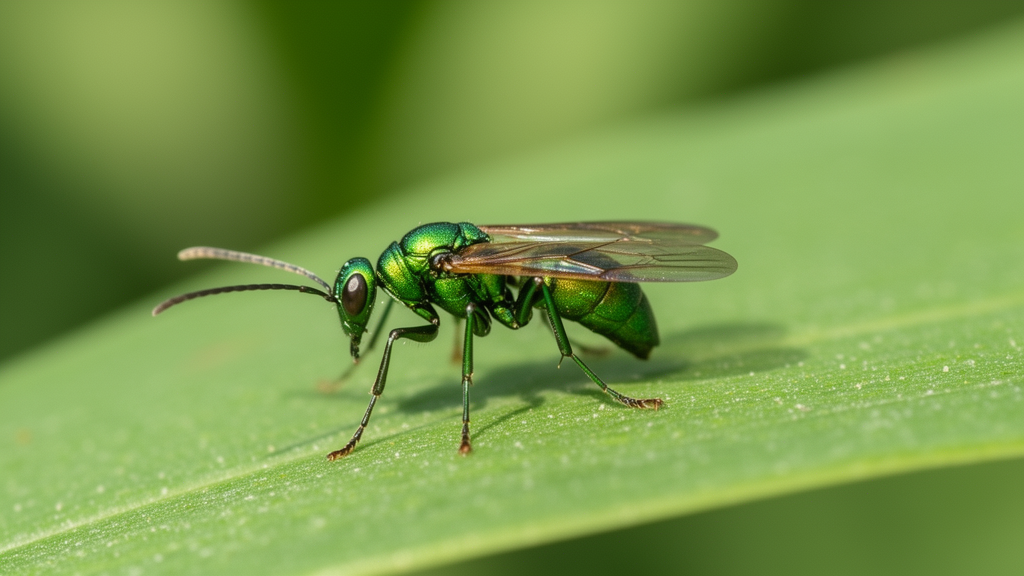
Deep in the genomes of two tiny parasitic wasps from China, scientists have uncovered molecular signatures that could reshape how biologists understand one of the most species-rich families of beneficial insects on Earth. In a study published in ZooKeys, researchers report the first two complete mitochondrial genomes for the genus Neotrichoporoides, a group of parasitic wasps belonging to the family Eulophidae within the superfamily Chalcidoidea. These wasps play an indispensable role in the biological control of agricultural and forest pests, quietly suppressing crop-damaging insects and helping maintain ecosystem balance. Before this study, only nine complete mitochondrial genomes of Eulophidae had been sequenced worldwide, including the two newly sequenced species, making the work a significant addition to a remarkably sparse genomic record.
The genus Neotrichoporoides was established based on its type species, Neotrichoporoides uniguttatus, described by Girault in 1913. Over nearly a century of taxonomic revisions, eight generic names have been synonymized under it, including Aprostoceroloides, Tetrastichomorpha, Trichaporoidella, Epiquadrastichus, Paraprostocetus, Burksia, Neogaleopsomyia and Dubiostalon. The circumscription of the genus was clarified by Graham in 1987 and Bouček in 1988, with subsequent minor additions by Narendran in 2007 and Burks in 2012. Currently, the genus is widely accepted within the subfamily Tetrastichinae of Eulophidae and comprises approximately 75 valid species. The family Eulophidae itself encompasses 328 genera and more than 6000 described species worldwide, with diverse life strategies including parasitoids and gall inducers.
To obtain the new genomes, the team collected specimens of Neotrichoporoides nyemitawus in August 2022 from the Tianjin Academy of Agricultural Sciences in Xiqing District, Tianjin City, China, and specimens of Neotrichoporoides viridimaculatus in June 2025 from Machang Village in Siyang County, Suqian City, Jiangsu Province, China. Freshly collected specimens were immediately immersed in 99 percent ethanol for initial preservation and subsequently stored in a minus 20 degree Celsius freezer at the Insect Herbarium of Tianjin Agricultural University. After morphological identification, total DNA was extracted from each specimen, excluding the abdomen, using the DNeasy Blood and Tissue Kit following the manufacturer’s instructions. The purity and concentration of the extracted DNA were assessed by agarose gel electrophoresis and optical density measurements before sequencing on the Illumina NovaSeq 6000 platform with a 350 bp insert size and a paired-end 150 bp sequencing strategy.
The resulting mitochondrial genomes are small circular molecules of 15,164 bp for N. nyemitawus and 15,297 bp for N. viridimaculatus. Each contains 13 protein-coding genes, 22 transfer RNAs, two ribosomal RNAs, and one control region located between trnM and trnI. Both genomes exhibit a strong AT bias, with AT contents of 85.5 percent and 85.0 percent respectively. On the majority strand, both species encode three protein-coding genes, ND2, ND6 and CYTB, and five tRNA genes, while the minority strand carries the remaining ten protein-coding genes, 16 tRNA genes, and the two rRNA genes. Interestingly, the coding strand of trnR differs between the two species: it is encoded on the sense strand in N. nyemitawus but on the antisense strand in N. viridimaculatus, one of the few visible differences between these closely related genomes.
Skew analysis revealed that the mitogenome of N. nyemitawus had a positive AT-skew of 0.032 and a negative GC-skew of minus 0.103, while N. viridimaculatus showed a positive AT-skew of 0.033 and a negative GC-skew of minus 0.099. The protein-coding genes account for roughly 73 percent of the full genome in both species, and their AT content varies considerably among individual genes, from a low of 76.7 percent in the COI gene of N. viridimaculatus to a high of 93.8 percent in the ATP8 gene of N. nyemitawus. Relative synonymous codon usage analysis showed that both species significantly preferred codons ending with A or U. In N. nyemitawus, codons with RSCU values greater than 2 included UUA, GUA and CGA, whereas in N. viridimaculatus they included UUA, GUA, GAA and CCU, all exhibiting extremely high usage frequencies. This overwhelming preference for A and U at the third codon position is one of the major reasons for the observed AT bias in these mitogenomes.
All protein-coding genes in both genomes use ATN start codons, drawn from ATA, ATG, ATT and ATC, while stop codons include TAA, TAG and truncated stop codons, with TAA being the most frequently used. Truncated stop codons are widespread in metazoan mitochondrial genomes and are thought to be completed via post-transcriptional polyadenylation. Among the 22 tRNA genes in each genome, trnL and trnS each possess two copies, whereas the remaining 20 tRNAs occur as single copies. The majority of tRNAs adopt the canonical cloverleaf folding, but trnS1 and trnR represent structurally degenerate forms, as both lack the DHU arm and fold into a simple loop configuration. This simplification in trnS1 is a recurrent architectural motif in insect mitochondrial genomes rather than an incidental feature. Mismatched base pairs were also detected in the tRNA arm structures, including non-canonical G-U wobble pairings and a U-U mismatch in trnV of N. nyemitawus.
One of the most striking findings emerged from comparative analysis of gene arrangements across 17 species from three chalcidoid families: Encyrtidae, Eulophidae and Pteromalidae, using the gene arrangement of Drosophila yakuba as the putative ancestral pattern. The results showed that rearrangements occurred mainly on tRNA genes, whereas the 13 protein-coding genes exhibited few rearrangements and their order remained largely conserved. In all eight eulophid species analyzed, trnA underwent inverse transposition and trnV underwent transposition, a finding reported for the first time within this family. The two Neotrichoporoides species differ only in the arrangement of several tRNAs: in N. nyemitawus, trnR is encoded on the J-strand and the remaining three tRNA genes are arranged as trnY-trnI-trnC, whereas in N. viridimaculatus, trnR is encoded on the N-strand and the remaining three tRNA genes are arranged as trnC-trnY-trnI. Meanwhile, the gene cluster COI-trnL2-COII-trnK-trnD-ATP8-ATP6-COIII-trnG-ND3 underwent a specific rearrangement, becoming ND3-trnG-COIII-ATP6-ATP8-trnD-trnK-COII-trnL2-COI.
Comparative analysis of the 13 protein-coding genes across nine eulophid mitochondrial genomes revealed differences in molecular evolutionary rates among genes, with ATP8, ND2 and ND4 evolving faster than the others. The evolutionary rate ranking was ATP8, followed by ND2, ND4, ND4L, ND5, ND6, ND3, ND1, ATP6, COII, COIII, CYTB and COI. Notably, the Ka/Ks ratios of ATP8, ND2 and ND4 all exceeded 1, which may be suggestive of positive selection. The Ka/Ks ratio of ND4L was 0.98, close to the neutral expectation of 1, suggesting that this gene may not be under strong selective pressure. Among the remaining genes, ND5 and ND6 had ratios of 0.90 and 0.88 respectively, slightly below 1, suggesting only weak purifying selection, whereas the other genes had ratios far below 1, indicating strong purifying selection. The rapid evolution of most genes may be associated with differences in ecology, host range and reproductive strategies among eulophid species, potentially reflecting adaptation to diverse environments, although further functional or population-level studies are needed to confirm selective pressures.
For phylogenetic reconstruction, the team aligned each protein-coding gene individually using the L-INS-i strategy of MAFFT, refined the alignments with MACSE, trimmed them using GBlocks, and concatenated the trimmed sequences into a protein-coding gene dataset. Phylogenetic trees were reconstructed using both maximum likelihood with 1000 bootstrap replicates and Bayesian inference running for 2 million generations, with Exoristobia philippinensis from Encyrtidae as the outgroup. The two methods produced congruent results. The resulting phylogenetic tree shows that congeneric species form well-supported monophyletic clades: N. nyemitawus and N. viridimaculatus cluster together, as do Tetrastichus sp. and Tetrastichus howardi, which is consistent with the morphological classification. At the subfamily level, species from Eulophinae and Tetrastichinae together form a monophyletic group, with the two subfamilies forming distinct clades whose divergence node is positioned near the base of the tree and receives strong support values.
This study contributes to resolving phylogenetic relationships within Eulophidae and further deepens understanding of this ecologically vital family. Because the concatenated dataset includes all three codon positions of protein-coding genes, it provides richer information on molecular variation, which may be useful for phylogenetic studies of Eulophidae, particularly for species with problematic or unusual taxonomic placements. The authors acknowledge limitations, including limited sample size and insufficient molecular evidence, and recommend that future research increase species sampling, expand mitochondrial genome datasets, and integrate multiple types of data to conduct robust phylogenetic analyses that comprehensively evaluate the internal classification of Eulophidae. For now, the first two complete mitochondrial genomes of Neotrichoporoides stand as a molecular foundation for understanding a genus of wasps that safeguards crops and forests worldwide.
Subject of Research: Genomics
Article Title: The first two complete mitochondrial genomes for the genus Neotrichoporoides ( Hymenoptera , Eulophidae ) and their phylogenetic analysis
Article References: Wen, J.-S., Jin, X.-X., Li, W.-J., Chen, Z.-P., & Zu, G.-H. (2026). The first two complete mitochondrial genomes for the genus Neotrichoporoides (Hymenoptera, Eulophidae) and their phylogenetic analysis. ZooKeys, 1291, 137-154. https://doi.org/10.3897/zookeys.1291.206033
Image Credits: AI Generated
DOI: 10.3897/zookeys.1291.206033
Keywords: mitochondrial genomes, parasitic wasps, Eulophidae, phylogenetics, gene rearrangement, biological control, Neotrichoporoides, ZooKeys, first, complete, mitochondrial, genomes
Cite Scienmag News
Gavin Prescott. (October 18, 2026). First Complete Mitochondrial Genomes Reveal Hidden Evolution of Parasitic Wasp Genus Neotrichoporoides. Scienmag. https://scienmag.com/first-complete-mitochondrial-genomes-reveal-hidden-evolution-of-parasitic-wasp-genus-neotrichoporoides/
Gavin Prescott. "First Complete Mitochondrial Genomes Reveal Hidden Evolution of Parasitic Wasp Genus Neotrichoporoides." Scienmag, 18 October 2026, https://scienmag.com/first-complete-mitochondrial-genomes-reveal-hidden-evolution-of-parasitic-wasp-genus-neotrichoporoides/. Accessed 18 October 2026.
Gavin Prescott. "First Complete Mitochondrial Genomes Reveal Hidden Evolution of Parasitic Wasp Genus Neotrichoporoides." Scienmag. October 18, 2026. https://scienmag.com/first-complete-mitochondrial-genomes-reveal-hidden-evolution-of-parasitic-wasp-genus-neotrichoporoides/


