


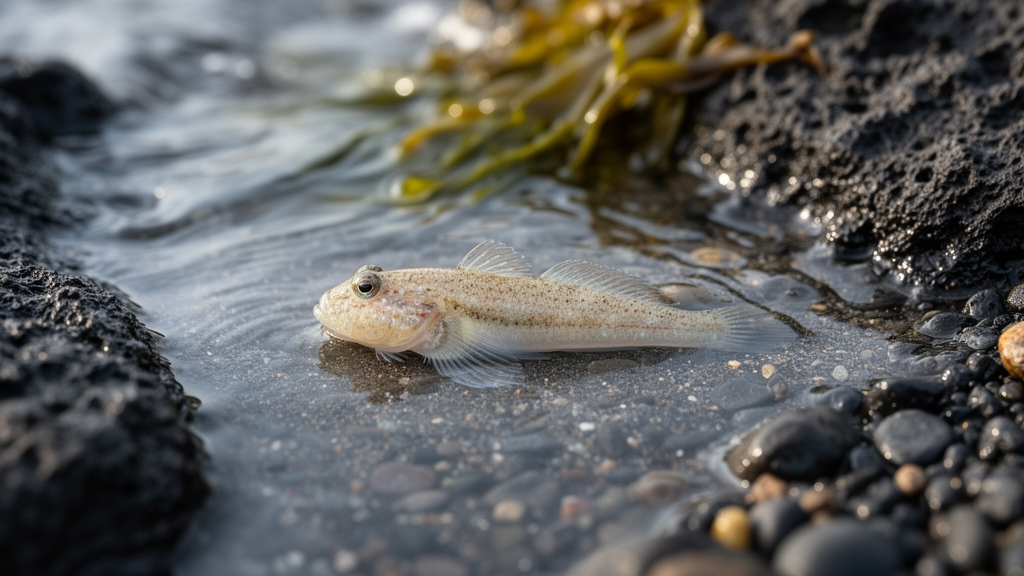
A tiny fish with yellow-striped flanks has turned up far from where scientists expected to find it. Two specimens of the Indo-Pacific tropical sand goby, Favonigobius reichei, were collected from the intertidal zone of Jeju-do Island, South Korea, in October 2024, marking the first confirmed record of the species in Korean waters. The discovery, published in the journal Acta Ichthyologica et Piscatoria, means Korea is now home to a second species of the goby genus Favonigobius, a group previously represented in the country by a single species, F. gymnauchen.
The two fish, a male and a female measuring 32.7 and 41.9 millimeters in standard length, were scooped up with a hand net at Wimi Port in Namwon-eup, Seogwipo-si, on the southern coast of Jeju Island. The collection happened at low tide, when the water over the sandy and muddy bottom was only 30 to 40 centimeters deep. Such shallow estuarine habitats are exactly where small sand gobies thrive, but they are also easy to overlook, which may partly explain why this species escaped detection in Korea for so long.
Identifying the specimens required a careful comparison of fin rays, scales, and sensory pores. The Jeju fish show six flexible rays followed by one spine in the first dorsal fin and eight soft rays in the second dorsal fin, a formula written as VI–I, 8. The anal fin carries a single spine and eight rays, and the area ahead of the dorsal fin bears at most a single scale, with counts of zero to one predorsal scales. Each of these characters separates F. reichei from F. gymnauchen, which has nine soft rays in both the second dorsal and anal fins and zero to seven predorsal scales.
Coloration provided additional confirmation. The Jeju specimens carry five black blotches along each side of the body, with the last blotch sitting at the base of the tail fin. Crucially, that caudal spot is undivided and rounded, whereas in F. gymnauchen the corresponding spot splits into two branches toward the rear. The male also shows a black spot near the center of the first dorsal fin, positioned away from the fin base, with a yellow band immediately above it, and transverse yellow stripes across the abdomen. Those male-only features are considered diagnostic of F. reichei and inspired the newly proposed Korean common name, Hwang-jul-nal-gae-mang-duk, which references the yellow stripes on the male’s flanks and fins.
The researchers also mapped the cephalic sensory canal pores, a system of tiny openings on the head that goby taxonomists use much like fingerprints. The anterior oculoscapular canal of the Jeju fish contains pores B′, C, D, E, F, G, and H′, with C and D each present as single pores, while the posterior oculoscapular canal carries K′ and L′ and the preopercular canal carries M′, N, and O′. Meristic counts such as 16 pectoral-fin rays, 29 to 30 longitudinal scale rows, and seven to nine transverse scale rows all fall within the ranges reported for F. reichei in Japan and Iran, reinforcing the identification.
What makes the record scientifically striking is the species’ known distribution. Favonigobius reichei is a euryhaline goby, tolerant of a wide range of salinities, and its range stretches across the tropical and subtropical Indo-Pacific: from east and southern Africa, the Red Sea, Madagascar, the Seychelles, and Mauritius, through India, Thailand, Vietnam, Malaysia, Singapore, Indonesia, the Philippines, Palau, and Hong Kong, to northern Australia, New Guinea, New Caledonia, the Marshall Islands, Vanuatu, and the Ryukyu Islands of southern Japan. Jeju-do Island, sitting at roughly 33 degrees north latitude, lies at the northern edge of the East China Sea, well beyond the previously documented northern limit of the species.
Jeju Island has a reputation for producing range extensions of this kind. The island sits where warm currents of the Kuroshio system brush the continental shelf, and its intertidal flats and estuaries can harbor tropical and subtropical species that ride the currents northward as larvae or juveniles. Climate-driven warming of regional seas has been linked to poleward shifts in the distributions of many coastal fishes, and each new record from Jeju adds a data point to the growing picture of Indo-Pacific faunas edging into temperate waters. Whether F. reichei has established a resident breeding population on Jeju or represents occasional arrivals remains unknown, and the authors note that further surveys will be needed to resolve the question.
The specimens, fixed in 10 percent formalin and preserved in 70 percent ethanol, are deposited in the Ichthyology Laboratory at Kunsan National University under voucher numbers AREIS-0009 and AREIS-0010. Counting and measurement methods followed standard ichthyological protocols, with morphometric characters expressed as percentages of standard length. Head length measured 27.2 to 27.5 percent of standard length, the eye diameter 6.7 to 7.3 percent, and the caudal peduncle length 23.9 to 24.3 percent, values consistent with published descriptions of the species from Japanese and Iranian material.
The genus Favonigobius itself carries some taxonomic baggage. Established by Whitley in 1930 with Gobius lateralis as the type species, the genus lacked a proper description at the time of its creation. Gill and Miller later redescribed the genus and, based on osteological and morphological differences, erected the genus Papillogobius, into which several former Favonigobius species were reclassified. Subsequent researchers have disagreed over whether the two genera should be recognized separately, with some phylogenetic analyses criticized for leaning heavily on cephalic sensory characters that may introduce bias. The authors of the present study tentatively adopted Favonigobius, the usage common in Korea, to avoid confusion, while acknowledging that a future review of the genus is necessary.
With nine valid species worldwide, Favonigobius is a modest genus by goby standards, but its members are ecologically interesting as small benthic residents of sandy and muddy shallows, where they feed on tiny invertebrates and serve as prey for larger fish and wading birds. The recognition of F. reichei in Korea brings the country’s gobiid fauna one species richer and highlights how much remains to be learned about fish diversity in intertidal habitats, even in well-studied coastal regions. For now, the yellow-striped sand goby of Jeju stands as a reminder that a careful sweep of a hand net across a shallow estuary can still rewrite the map of where life is found.
Subject of Research: First Korean record of the Indo-Pacific tropical sand goby Favonigobius reichei from Jeju-do Island
Article Title: New distributional record of the Indo-Pacific tropical sand goby, Favonigobius reichei ( Actinopterygii , Gobiiformes , Gobiidae ), from Jeju-do Island, Korea
Article References: Kim, M.-S., Shin, Y.-S., & Kim, J.-G. (2025). New distributional record of the Indo-Pacific tropical sand goby, Favonigobius reichei (Actinopterygii, Gobiiformes, Gobiidae), from Jeju-do Island, Korea. Acta Ichthyologica et Piscatoria, 55, 363-367. https://doi.org/10.3897/aiep.55.150774
Image Credits: AI Generated
Keywords: Favonigobius reichei, goby, Jeju Island, Korea, new record, biogeography, ichthyology, marine biodiversity, Gobiidae, range extension, distributional, record
Cite Scienmag News
Addison Whitmore. (October 18, 2026). Tropical sand goby makes a surprise appearance on Jeju Island, stretching its range north. Scienmag. https://scienmag.com/tropical-sand-goby-makes-a-surprise-appearance-on-jeju-island-stretching-its-range-north/
Addison Whitmore. "Tropical sand goby makes a surprise appearance on Jeju Island, stretching its range north." Scienmag, 18 October 2026, https://scienmag.com/tropical-sand-goby-makes-a-surprise-appearance-on-jeju-island-stretching-its-range-north/. Accessed 18 October 2026.
Addison Whitmore. "Tropical sand goby makes a surprise appearance on Jeju Island, stretching its range north." Scienmag. October 18, 2026. https://scienmag.com/tropical-sand-goby-makes-a-surprise-appearance-on-jeju-island-stretching-its-range-north/


