


In the rapidly growing cities of the developing world, the middle class often falls between the cracks of housing policy: too well-off to qualify for subsidized low-income schemes, yet frequently unable to afford formal housing built to adequate standards. A new study from Bangladesh, published in SN Social Sciences, offers one of the most detailed statistical portraits to date of how this squeezed group actually experiences its homes, and it identifies a short list of concrete factors that separate fair housing from good housing in an urbanizing South Asian context.
The research, conducted by Samia Islam Sara, Mohammad Lutfur Rahman and Jannatul Ferdous Momo of the Department of Urban and Regional Planning at Jahangirnagar University in Savar, Dhaka, set out to evaluate the housing quality of middle-income households in an urban area of Bangladesh. The team adopted a quantitative research approach, collecting data through a structured questionnaire administered to households in the study area. After screening, a total of 300 valid responses were included in the analysis, a sample size the authors justify with reference to established recommendations for survey research in the social sciences.
What makes the study methodologically interesting is the way it treats housing quality. Rather than measuring quality solely through objective indicators such as floor area or building age, the researchers captured residents’ own perceptions of their dwellings on an ordered scale. Because the outcome variable was ordinal, meaning households rated their housing quality in ranked categories rather than on a continuous scale, the team turned to ordinal logistic regression, a statistical technique designed for exactly this kind of ordered categorical outcome. The method, grounded in the framework developed by statistician Alan Agresti, models the probability that a household falls into a higher rather than a lower quality category as a function of multiple explanatory variables simultaneously.
Those explanatory variables were deliberately broad. The researchers drew on decades of housing literature to assemble nine domains of potential influence: dwelling unit characteristics, user comfort, neighborhood features, building services, structural quality, economic factors, maintenance, sustainability, and social support. This multidimensional framing reflects a shift in housing scholarship since the 1990s, when researchers such as Roderick Lawrence argued that housing quality cannot be reduced to physical structure alone but must encompass the environment, services, and social context in which a dwelling is embedded. Earlier work on residential environment quality and neighborhood attachment, as well as studies linking housing conditions to health outcomes, reinforced the case for treating housing as a system rather than a single object.
The headline finding is one of cautious adequacy. Most middle-income households in the study perceived their housing as fair to good, a result that suggests the group is neither thriving in high-quality formal housing nor trapped in the worst conditions of informal settlements. That middle position, however, is precisely why the authors argue the group deserves policy attention. International bodies, including the OECD in its analysis of the squeezed middle class, have documented how middle-income households in rapidly urbanizing economies face mounting pressure on housing affordability, often spending large shares of income on accommodation that may still fall short of comfort and service standards.
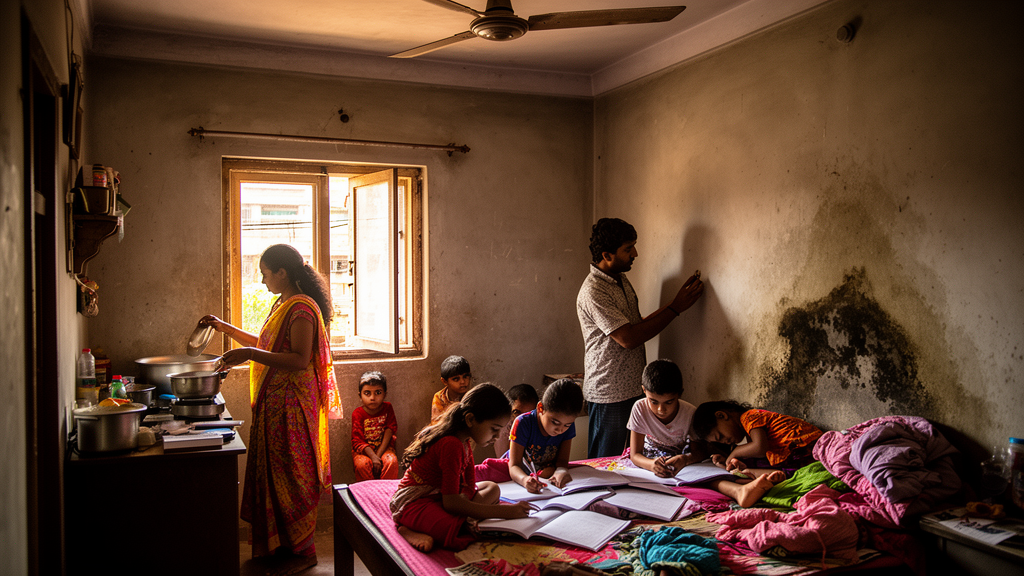
Within the regression results, a consistent set of predictors emerged as statistically significant. Crowding, meaning the number of occupants relative to the space available, was a key determinant, echoing a long line of environmental psychology research showing that household and community crowding degrade satisfaction and well-being. Ventilation also mattered, a finding with particular resonance in Dhaka’s hot, humid climate, where airflow shapes both thermal comfort and health. Access to essential services, the use of quality construction materials, affordability, and the presence of a supportive neighborhood each added explanatory power. In other words, the physical fabric of the dwelling, the economics of occupying it, and the social fabric around it all contributed independently to how residents judged their housing.
The significance of neighborhood effects deserves emphasis. The finding that supportive neighborhoods predict perceived housing quality aligns with a substantial body of evidence, including studies of socially contrasting neighborhoods in the United Kingdom and research on low-cost housing in Malaysia, showing that satisfaction with place depends heavily on social and environmental conditions beyond the front door. For urban planners in developing countries, this suggests that investments in street-level infrastructure, safety, and community facilities may yield returns in perceived housing quality that are comparable to improvements in the dwellings themselves.
The study’s policy implications are framed explicitly for decision-makers. The authors state that the research provides evidence for policymakers and urban planners seeking to enhance housing standards, especially for middle-income groups in rapidly growing cities, particularly in developing countries. Because the significant predictors are actionable, reducing crowding through floor-area and occupancy standards, enforcing ventilation requirements in building codes, expanding access to essential services such as water and sanitation, promoting quality materials, and addressing affordability, the findings translate relatively directly into regulatory and programmatic levers. The work also situates itself within the United Nations Sustainable Development Goals framework, which calls for adequate, safe and affordable housing for all, and within UN-Habitat’s recent emphasis on placing housing at the centre of urban futures.
The research team is careful to acknowledge the limits of a single-city, single-income-group survey. Perceptions of housing quality are shaped by cultural expectations, as theorized in the work of Amos Rapoport on culture, architecture and design, and by the specific housing market conditions of Dhaka, one of the world’s most densely populated cities. The authors therefore propose that future research could conduct a comparative analysis across different income groups in rapidly urbanizing cities, which would reveal whether the drivers of housing quality identified here hold for lower-income households facing more acute deprivation, or for higher-income households with greater choice, and whether they generalize across other developing-country contexts.
For a field often dominated by case studies of slums on one side and gated developments on the other, the study fills a genuine gap by quantifying the experience of the urban middle. Its message is ultimately an optimistic one: the factors that most strongly shape how middle-income residents judge their homes are measurable, comparable and, in principle, fixable. As cities across South Asia, Africa and Latin America absorb hundreds of millions of new residents in the coming decades, evidence of this kind, grounded in the stated perceptions of the households themselves, will be essential for steering urban growth toward housing that is not merely sheltered but genuinely adequate.
Subject of Research: Statistical assessment of perceived housing quality among middle-income urban households in Bangladesh
Article Title: Housing quality assessment in an urban area: perspectives from the context of a developing country
Article References: Sara, S. I., Rahman, M. L., & Momo, J. F. (2026). Housing quality assessment in an urban area: perspectives from the context of a developing country. SN Social Sciences, 6(11), Article 555. https://doi.org/10.1007/s43545-026-01870-2
Image Credits: AI Generated
DOI: 10.1007/s43545-026-01870-2
Keywords: housing quality, middle-income households, Bangladesh, Dhaka, ordinal logistic regression, urban planning, housing affordability, crowding, ventilation, neighborhood effects, developing countries, sustainable development
Cite Scienmag News
Courtney Benton. (October 18, 2026). Crowding, Ventilation and Affordability Drive Housing Quality for Middle-Income Bangladeshis. Scienmag. https://scienmag.com/crowding-ventilation-and-affordability-drive-housing-quality-for-middle-income-bangladeshis/
Courtney Benton. "Crowding, Ventilation and Affordability Drive Housing Quality for Middle-Income Bangladeshis." Scienmag, 18 October 2026, https://scienmag.com/crowding-ventilation-and-affordability-drive-housing-quality-for-middle-income-bangladeshis/. Accessed 18 October 2026.
Courtney Benton. "Crowding, Ventilation and Affordability Drive Housing Quality for Middle-Income Bangladeshis." Scienmag. October 18, 2026. https://scienmag.com/crowding-ventilation-and-affordability-drive-housing-quality-for-middle-income-bangladeshis/


