


Spirulina, the commercial name for the helically-coiled cyanobacteria Arthrospira, Spirulina, and Limnospira, has been one of the most widely consumed microalgae in large-scale production since the 1970s. Its biomass contains 60 to 70 percent protein on a dry weight basis, with all essential amino acids, and is rich in vitamins, dietary minerals, essential fatty acids, and bioactive pigments such as C-phycocyanin. The organism thrives naturally in alkaline waters rich in minerals at temperatures between 35 and 40 degrees Celsius, which historically confined its cultivation to tropical open ponds. Its extremophilic characteristics, allowing fast growth under high pH values of 9 to 11 that minimize biological contamination by protozoa, bacteria, fungi, and other microalgae, have made it commercially successful compared to other microalgae. However, concerns about safety of cultures exposed to weather variations and contamination, especially in the absence of appropriate controls and certifications, have driven the expansion of cultivation into subtropical and temperate zones using greenhouses that prevent external contamination, rain intrusion, and mitigate temperature excursions.
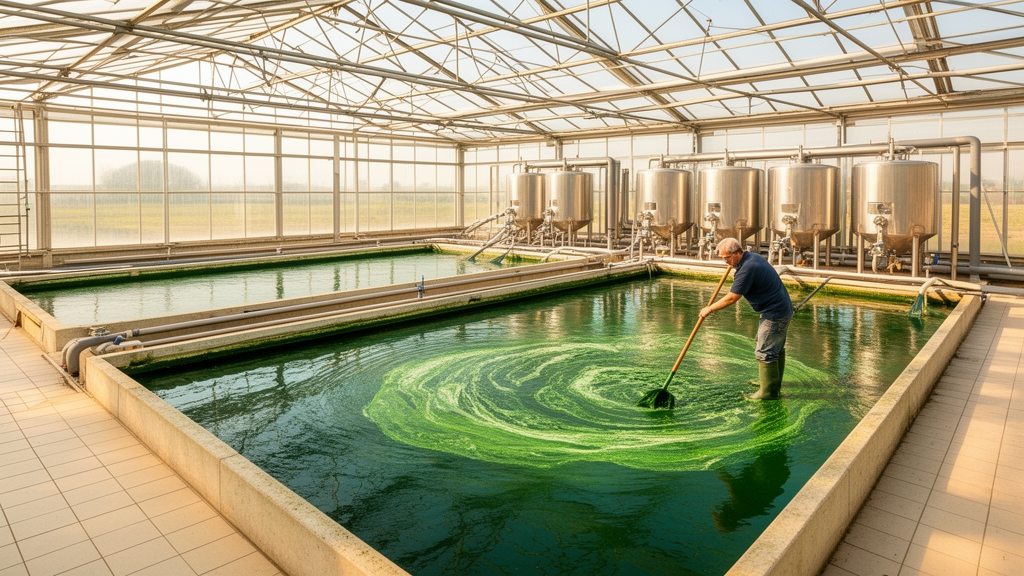
A new study published in Italian Botanist has now provided detailed evidence from a real industrial production plant in northeastern Italy that recycling the culture medium after each harvesting step can be sustained for months without compromising biomass quality. The research, conducted at the Micoperi Blue Growth company in Ravenna, followed four of the seven largest raceway ponds, each with a volume of 11,000 liters, over a three-month semi-continuous cultivation period from May to August 2023. This period included the highest biomass productivity of the year. The plant operates inside a greenhouse containing 11 raceways with a total pond area of 458 square meters, where cultures are exposed to natural sunlight with shading systems activated according to season, and the only temperature regulation consists of ventilation openings in the roof to lower summer temperatures. Twice a year, each pond is filled with a modified Zarrouk Medium kept at pH values between 9.7 and 10.3 and inoculated with Arthrospira platensis culture of Moroccan origin, identified by 16S gene sequencing.
The cultivation system operates according to a semi-continuous regime in which variable volumes of culture are harvested based on the biomass concentration measured in each pond. Harvesting is performed using a pumping system connected to a vibro-sifter that separates the algal biomass from the liquid medium, and the biomass is dehydrated by freeze-drying before commercialization. The filtered medium is reintroduced into the pond and then reinstated with the main nutrients, nitrogen and phosphorus, according to the amount of harvested biomass and the nitrogen and phosphorus content of the cells, around 10 and 0.8 percent respectively. At the end of the six-month cultivation period, the entire biomass is harvested, the culture medium is completely eliminated, and the empty ponds are washed and sanitized before production resumes. This recycling practice, applied ever since the big Earthrise farm was established in California, can have deleterious effects on biomass quality, as organic matter remaining in the filtered medium may stimulate the growth of opportunistic mixotrophic algae, bacteria, and fungi, and can also have autoinhibitory effects on algal growth.
Previous studies addressing water and nutrient recycling have been performed mainly with small culture volumes and in one case in a large pond, highlighting a consistent reduction in growth rate and protein production, an increase in extracellular polysaccharides, and culture contamination. However, when growth trials are performed in a real productive environment, the recycling of water and nutrients is strictly necessary. It was calculated that by re-adding the nitrogen and phosphorus consumed based on their content in the harvested biomass, a 15-fold savings of money compared to the use of fresh medium was obtained. Suggested solutions such as ferric chloride flocculation plus carbon adsorption or ultrafiltration steps, although promising, were tested only with cultures of 2,000 or 600 milliliters and did not appear applicable to thousands of liters of medium. The new study therefore focused on an in-depth monitoring of nitrate and phosphate levels in the medium over three months of semi-continuous cultivation, where medium recycling was performed concurrently with monitoring of cell biomass composition.
The results showed that during the study period, three temporal phases were observed in terms of temperature variation and its increasing values. The first sub-period, from day 0 to the first biomass harvest on day 20, was characterized by the lowest recorded temperature values of 23 to 24.5 degrees Celsius and by steady growth with biomass concentration increasing from 0.190 to 0.400 grams per liter. In the second period, from day 20 to day 40, temperature slightly increased with average values never exceeding 26 degrees Celsius, still resulting in slow growth so that harvesting was performed weekly, collecting culture volumes equal to one-sixth of the total pond volumes, after which constant biomass values of 0.395 grams per liter were reached. In the third period, from day 42 to day 84, concomitant with the temperature increase to between 27 and 29 degrees Celsius, a further increase in biomass concentration was observed, reaching 0.461 grams per liter and allowing the harvest of higher culture volumes, one-quarter of the total pond volume, either weekly or biweekly.
Biomass productivity during the first 20 days was 0.011 grams per liter per day, and in the second and third temporal phases it increased by two to three-fold, reaching 0.029 and 0.038 grams per liter per day respectively, showing a significant positive correlation with temperature. The maximum volumetric productivity value of 0.038 grams per liter per day corresponded to an areal productivity of 7.6 grams per square meter per day, in line with results reported for productive plants in Mongolia, higher than the value observed in the Canary Islands in ponds of 8,000 liters, and lower than those obtained in southern Spain and Italy in very large ponds during summer. This production variability indicates that besides geographical location, the size of the culture system and its operativity highly influence plant performance, and that industrial production in temperate zones is feasible with year-long operativity even without a heating system. The company’s historical data attest that the highest productivity values span from June to October, while they decrease by 25 percent from February to May and reach the lowest values in December and January, corresponding to a 65 percent decrease, although cells still appear healthy and growth resumes shortly as soon as photoperiod and temperature increase.
Nutrient monitoring revealed that nitrate concentrations decreased during the initial period of biomass growth with an uptake rate of 0.219 millimoles per gram of biomass per day, then remained at values very similar to those initially added for four weeks during the semi-continuous operativity of the ponds, with a small but not statistically significant increase from the initial value of 860.51 to the final one of 937.74 milligrams per liter. Phosphate concentrations showed a decreasing trend until day 20 with an uptake rate of 0.010 millimoles per gram per day, then displayed an opposite trend compared to nitrates with a significant decrease from the initial value of 79.21 to the final one of 55.90 milligrams per liter, possibly due to salt precipitation with the progression of biomass growth. As a consequence, the nitrogen to phosphorus molar ratio in the medium remained constant near the Redfield value of 16 until the end of June, then increased up to a maximum of 25.8 at the end of the study period. The slow nutrient uptake observed, together with the slow consumption of added carbonate, clearly indicates that recycling of the residual medium from harvested biomass is an important issue both from an economic point of view and for avoiding the release of nitrogenous compounds in the environment.
The biochemical composition of the biomass remained remarkably constant throughout the entire study period, which is the most striking finding of the research. Total proteins displayed no significant differences among ponds and harvesting days, remaining constant over time with an average value of 61.6 percent, similar to the average value measured for one year by the company and consistent with the protein content reported for most commercialized spirulina products. C-phycocyanin content also showed no significant changes during the study period, with an average contribution of 12.24 percent, consistent with values found in spirulina grown under fed-batch conditions. Cellular carbon, nitrogen, and phosphorus contents were assessed in all harvested biomass lots, showing constancy of the three elements throughout the study period with average cell contents of 46.10, 10.30, and 0.85 percent respectively, leading to stable trends over time of both carbon to nitrogen and nitrogen to phosphorus molar ratios. The only significant variation was observed in intracellular polysaccharides, which decreased over time from a maximum of 26.44 to a minimum of 18.25 percent, possibly linked to the presence of nitrates as the only nitrogen source for the cultures, in the absence of ammonium, where the highest consumption of reducing equivalents was observed and stored polysaccharides might be involved and utilized.
Extracellular polysaccharides released from the cells can provide important information on culture health and can severely affect harvesting efficiency by reducing medium filterability. The values in the monitored ponds were by far lower than those reported for fresh medium in previous studies, remaining within a constant range of 5 to 7 milligrams per liter for the entire period. Several factors can influence the release of polysaccharides as a means to protect the cyanobacteria, including high and low temperatures, nutrient deficiency, high salinity, and particularly high light intensity, while when growth conditions are favorable, extracellular polysaccharide production is low. The low values observed throughout the analyzed period were consistent with the observation that the ponds were regularly free of foam and cells retained their healthy shape with normal length and spiral form. This finding suggests that the number of stressors triggering extracellular polysaccharide release in small volumes is higher than in large ponds where spirulina grows in a more favorable environment, similar to that in which spirulina blooms under natural conditions.
To assess food-grade quality of the cultivated biomass, each fresh batch harvested was analyzed for the presence of bacteria, molds, and yeasts, and their abundances were very low, with bacteria ranging from 1.2 to 8.0 thousand colony-forming units per gram of fresh weight biomass, molds below 150 colony-forming units per gram, and yeasts below 25 colony-forming units per gram. Opportunistic microalgae or zooplankton were rarely found in the biomass during the study. Given the lack of a directive for algal biomass, documentary research on similar food products and analysis of the company’s historical data allowed fine-tuning of a microbiological values guide for monitoring the quality of the harvested product. For the administrative region of Emilia-Romagna, the limit for ready-to-eat vegetables is 1.0 million colony-forming units for total mesophilic bacteria and 100 colony-forming units per gram for molds and yeasts, which are an order of magnitude higher than those reported for the spirulina biomass in this study.
The study concludes that weekly monitoring of the medium and biomass collected from four ponds in the productive industrial plant proved it is possible to recycle the medium for several months without affecting the quality of the microalga, as attested by the good biochemical composition of the biomass and the low presence of organic substances and contaminants in the medium. This can be attributed to appropriate management of the system, considering both operation mode and operational conditions, including moderate mixing of the ponds, stringent monitoring of environmental parameters, and a gentle harvesting procedure. The good practices adopted are also testified by the fact that the four ponds showed similar values for each measured parameter, and it is noteworthy that this occurred in a temperate zone with high climate variability. The results allow the conclusion that better operativity in terms of nutrient recycling could be adopted to decrease the level of nutrients in the medium and facilitate its disposal as waste at the end of the six-month cultivation period, envisaging a solution consisting of gradually decreasing the re-addition of nutrients during the last harvesting steps. Further studies performed at an industrial plant could test whether a decrease in nutrient replenishment could be performed without affecting biomass quality, leading to economic savings and an improvement in the environmental footprint of the cultivation, thus achieving a more sustainable process.
Subject of Research: Cyanobacteria cultivation
Article Title: Good practices for the industrial cultivation of the cyanobacterium Arthrospira platensis under a greenhouse in a temperate zone (northern Italy)
Article References: Pistocchi, R., Guerrini, F., Vanucci, S., Montalbetti, L., Simonazzi, M., Mazzotti, M., Abbondanzi, F., Emiliani, G., & Pezzolesi, L. (2024). Good practices for the industrial cultivation of the cyanobacterium Arthrospira platensis under a greenhouse in a temperate zone (northern Italy). Italian Botanist, 18, 193-214. https://doi.org/10.3897/italianbotanist.18.143333
Image Credits: AI Generated
DOI: 10.3897/italianbotanist.18.143333
Keywords: spirulina, Arthrospira platensis, cyanobacteria, medium recycling, greenhouse cultivation, temperate zone, biomass productivity, food-grade quality, Good, practices, industrial, cultivation
Cite Scienmag News
Drew Townsend. (October 18, 2026). Spirulina Farming in Northern Italy Shows Medium Recycling Keeps Quality High. Scienmag. https://scienmag.com/spirulina-farming-in-northern-italy-shows-medium-recycling-keeps-quality-high/
Drew Townsend. "Spirulina Farming in Northern Italy Shows Medium Recycling Keeps Quality High." Scienmag, 18 October 2026, https://scienmag.com/spirulina-farming-in-northern-italy-shows-medium-recycling-keeps-quality-high/. Accessed 18 October 2026.
Drew Townsend. "Spirulina Farming in Northern Italy Shows Medium Recycling Keeps Quality High." Scienmag. October 18, 2026. https://scienmag.com/spirulina-farming-in-northern-italy-shows-medium-recycling-keeps-quality-high/


