


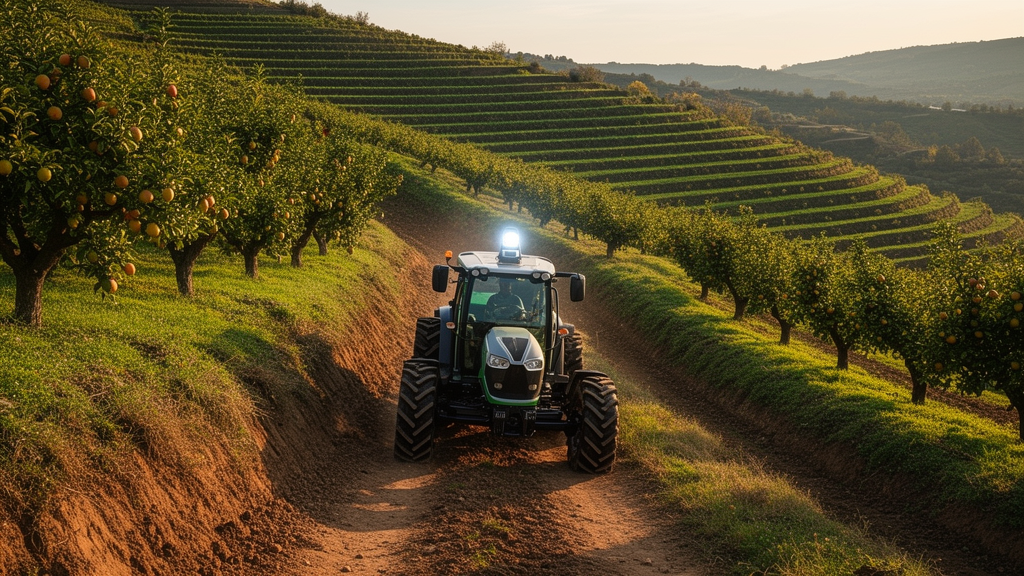
On the steep, winding lanes of mountain orchards, agricultural machines face some of the harshest driving conditions in farming. They crawl uphill under heavy load, brake downhill with fruit-laden trailers, and contend with rolling resistance that changes from one moment to the next as the slope and surface shift beneath their tracks. For hybrid powertrains, which must juggle a diesel engine, electric machines, and a battery pack, this constantly shifting demand makes the question of when to use the engine and when to use electricity remarkably difficult. A new study published in PLOS One by Zuojin Li, Hao Huang, Linlu Dong, Xianfeng Zhang, Rui Zhou, Bo Li, and Bao Yu proposes a fresh answer: a predictive-feedforward energy management strategy that gives hybrid agricultural machines a form of short-range foresight without the punishing computational cost of full predictive control.
The research team set out to solve a problem that has long frustrated engineers working on off-road hybrid vehicles. In mountainous orchards, a machine’s power demand is nonstationary, meaning it does not follow stable statistical patterns and can change abruptly as the vehicle crests a ridge or turns onto a steeper grade. Traditional rule-based energy management strategies, which dispatch power according to fixed thresholds and simple logic, offer essentially no preview of what the terrain ahead will demand. Instantaneous optimization strategies fare little better, because they minimize fuel use only for the present instant without regard to what comes next. Model predictive control, or MPC, does look ahead by solving an optimization problem over a rolling time horizon, and it can feed prediction errors directly into actuator commands. But that capability comes at a price: MPC imposes substantial online computation, which is a serious burden for the resource-constrained embedded controllers typical of agricultural machinery.
The researchers’ solution begins with a forward model of a power-split hybrid agricultural machine. The architecture comprises a combustion engine, two electric machines, a traction battery, and a planetary gear set, the latter allowing power from the engine and the electric machines to be split and recombined mechanically. This kind of power-split layout is attractive because it lets the engine operate near its sweet spot of efficiency while the electric machines absorb or supply the difference between what the engine produces and what the wheels demand. The team built a mathematical description of how power flows through this system, including two selectable transmission ratios and the physical constraints on every actuator, so that any control strategy could be tested against a faithful representation of the machine.
At the heart of the new strategy is a concept the authors call a bounded load-risk indicator. The machine looks a short distance into the future, gathering predictions of upcoming vehicle speed and road gradient. These predictions are then normalized, weighted, and saturated, a mathematical process that caps the indicator at a fixed upper bound so that no single alarming prediction, or any burst of prediction noise, can dominate the control decision. The indicator essentially condenses the near future into a single number that expresses how demanding the road ahead is likely to be. Crucially, rather than feeding this number directly into low-level torque calculations, where a prediction error would propagate straight into the actuators, the designers use it to modulate higher-level decision boundaries.
This soft decoupling of prediction and execution is the strategy’s defining trick. The load-risk indicator modifies three things: the dynamic safety boundary of the battery’s state of charge, the selection of the power-source mode, and the switching threshold between the two transmission ratios. In other words, if the indicator senses a demanding climb ahead, it nudges the battery’s usable range, shifts the mode selection toward configurations better suited to heavy load, and adjusts when the transmission jumps between ratios. The actual torque allocation is then carried out by a computationally efficient online scheme that coordinates engine high-efficiency operation, the two transmission ratios, and actuator constraints. Because prediction errors only reshape decision boundaries instead of commanding torques directly, the machine retains the benefit of preview while limiting how far a bad prediction can propagate into the hardware.
To judge how well this approach performs, the team needed a gold standard. They turned to dynamic programming, or DP, an offline optimization technique that, given a complete driving cycle in advance, computes the theoretically best possible power split at every moment. DP cannot run in real time on a machine because it requires perfect foreknowledge of the entire route, but it establishes an unbeatable benchmark. Over three test cycles, labeled C1 through C3, the new predictive-feedforward strategy achieved between 93.29 and 95.59 percent of the DP performance. That is a striking result for a real-time method that knows nothing about the route beyond a short prediction horizon.
The comparison against other real-time strategies is equally telling. The new approach exceeded MPC by 1.41 to 3.19 percentage points in fuel-related performance, and it beat adaptive equivalent-consumption minimization, a well-known real-time strategy that adapts a fuel-equivalence factor for battery use, by 3.62 to 4.99 percentage points. Meanwhile, the computational advantage was dramatic. The mean execution time of the new strategy was between 0.128 and 0.191 milliseconds per control step, which is 93.54 percent lower than that of MPC. For an embedded controller with limited processing resources, that difference is the gap between a strategy that fits comfortably in real time and one that strains the hardware.
Battery health is another central concern for any hybrid machine, because deep or erratic battery cycling shortens component life and raises operating costs. In the tests, the terminal state of charge remained near 0.600, indicating that the machine finished its work with the battery in a healthy, sustainable condition rather than having drained it to compensate for poor engine coordination. More importantly, the strategy proved robust under stress. When the researchers injected prediction noise and abrupt disturbances in the equivalent rolling resistance, simulating the sudden changes a machine might encounter on uneven orchard lanes, no constraint was violated. The state of charge stayed within bounds, battery current stayed within limits, and the torque of the power sources never exceeded what the actuators could deliver.
The practical implications extend beyond the test bench. Hybrid agricultural machines operating in mountain orchards typically run at low speed under high load, a regime in which the engine’s efficiency map is unforgiving and every percentage point of fuel savings matters for both cost and emissions. A strategy that runs in a fraction of a millisecond per step can be deployed on the modest embedded controllers that agricultural manufacturers actually fit to their machines, without requiring automotive-grade computing hardware. The bounded feedforward design also offers a template for other off-road hybrid applications, from forestry machines to vineyard tractors, where terrain varies continuously and full MPC is too expensive to compute online.
The authors are careful to delineate the limits of their findings. The conclusions apply to maintained, firm orchard lanes with low track slip, the kind of well-kept paths found in managed orchards. Soft-soil operation, which involves high traction demands, severe sinkage of the wheels or tracks, or substantial slip, requires further validation before the strategy can be recommended for those conditions. Within its validated domain, however, the study demonstrates that a machine can enjoy the foresight of prediction without paying the computational price of predictive control. By saturating its view of the future and letting that view reshape decision boundaries rather than command torques, the predictive-feedforward approach retained short-horizon preview while limiting direct error propagation, providing a practical real-time path for hybrid agricultural machines working the hills.
Subject of Research: A predictive-feedforward energy management strategy for power-split hybrid agricultural machines in mountainous orchards
Article Title: Predictive-feedforward energy management for a hybrid agricultural machine operating in mountainous orchards
Article References: Li, Z., Huang, H., Dong, L., Zhang, X., Zhou, R., Li, B., & Yu, B. (2026). Predictive-feedforward energy management for a hybrid agricultural machine operating in mountainous orchards. PLOS One, 21(10), e0360955. https://doi.org/10.1371/journal.pone.0360955
Image Credits: AI Generated
DOI: 10.1371/journal.pone.0360955
Keywords: hybrid vehicles, agricultural machinery, energy management, predictive control, mountain orchards, battery state of charge, Predictive-feedforward, energy, management, hybrid, agricultural, machine
Cite Scienmag News
Alan Morgan. (October 18, 2026). Smart Energy Brain Helps Hybrid Farm Machines Conquer Steep Orchard Hills. Scienmag. https://scienmag.com/smart-energy-brain-helps-hybrid-farm-machines-conquer-steep-orchard-hills/
Alan Morgan. "Smart Energy Brain Helps Hybrid Farm Machines Conquer Steep Orchard Hills." Scienmag, 18 October 2026, https://scienmag.com/smart-energy-brain-helps-hybrid-farm-machines-conquer-steep-orchard-hills/. Accessed 18 October 2026.
Alan Morgan. "Smart Energy Brain Helps Hybrid Farm Machines Conquer Steep Orchard Hills." Scienmag. October 18, 2026. https://scienmag.com/smart-energy-brain-helps-hybrid-farm-machines-conquer-steep-orchard-hills/


