


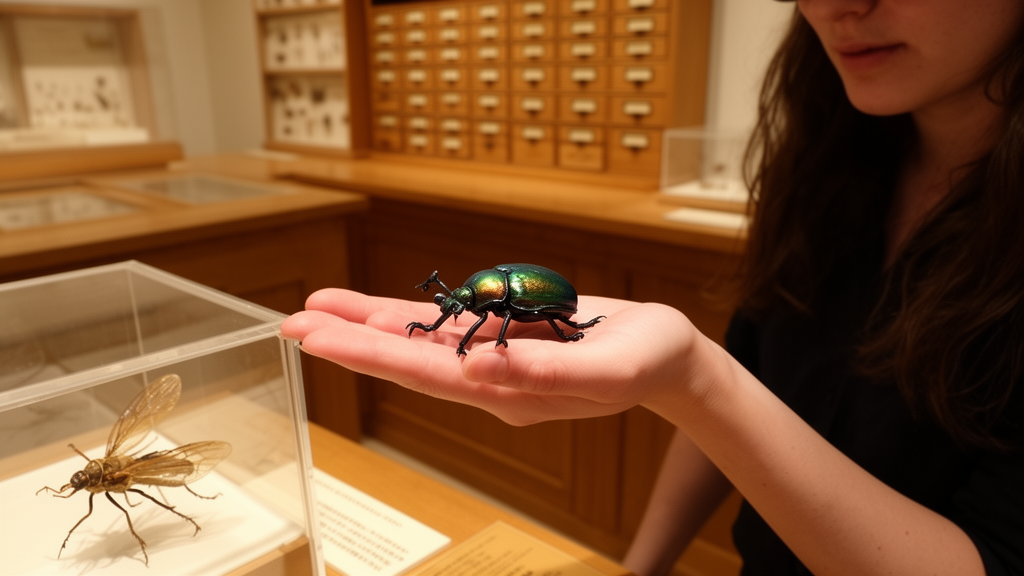
Insects are the most diverse group of animals on Earth, yet they remain among the least appreciated. Natural history museums hold vast entomological collections that could change public perceptions, but the glass-topped drawers in which pinned specimens are traditionally displayed impose a strict limit: visitors can look, but never touch. A team at the Spanish National Museum of Natural Sciences in Madrid has now shown how a workflow of 3D scanning and resin printing can break through that barrier, producing durable, enlarged replicas of real collection specimens that children and researchers alike can hold in their hands.
The project, described in the journal Natural History Collections and Museomics, combined an open-source photogrammetry platform called scAnt with stereolithography 3D printing to create replicas of nine insect species from the museum’s holdings, which include roughly five million insects and constitute the largest entomological collection in Spain. The researchers document the entire pipeline in practical detail, from image acquisition to finished model, with the explicit aim of making it reproducible at other museums and educational institutions.
The scanning stage relies on the scAnt device, a fully open-source system designed for automated 3D digitization of arthropods. Each specimen was photographed from many angles, yielding 3,780 raw images organized into 180 focus-stacked image stacks, with 20 exposures per stack. The complete image set for a single model amounts to roughly 90 gigabytes, and acquisition takes about three hours per specimen. The stacked images were then processed with the commercial photogrammetry software Agisoft Metashape Professional, which applies a Structure-from-Motion algorithm to reconstruct a textured three-dimensional model. The authors recommend a workstation with 16 to 32 gigabytes of RAM, a modern multi-core processor, a graphics card with at least 4 to 6 gigabytes of video memory, and half a terabyte of storage.
For printing, the team chose stereolithography over the more common fused deposition modelling technique, and the reasoning is instructive. SLA printers cure liquid resin with a laser, layer by layer, achieving far finer detail than filament-based machines. Insects present particular challenges for any printer: delicate legs, slender antennae, and intricate exoskeletal textures are exactly the features that filament printing tends to blur or break. SLA also produces smoother surfaces that look more organic without post-processing, offers resins with transparent, flexible, or biocompatible properties, and generates thinner support structures that are easier to remove without damaging fragile parts. Using an Elegoo Saturn printer with water-washable resin, the researchers scaled their models to at least 300 percent of original size, producing replicas of 5 to 8 centimeters that are easy to handle, particularly for children. Specimens were printed vertically to maximize the number per build plate, and a batch of 30 took only 3.5 hours.
The cost breakdown is strikingly modest for a museum-grade workflow. The scAnt photogrammetry rig comes in at roughly 2,700 US dollars, the software licence at 3,500 dollars, the printer at about 400 dollars, and the resin at around 34 dollars per litre, or roughly 40 cents per insect. The free Chitubox slicer handled print preparation. For institutions weighing the investment against their outreach budgets, these figures suggest that tactile entomology is within reach of far more than just the largest national museums.
Specimen selection mattered as much as technology. Only specimens with unique catalogue numbers, properly pinned rather than glued, in good condition, and representing a taxonomically broad range were digitized. The final set included beetles such as the striking weevil Eupholus bennigseni and the rosalia longhorn beetle Rosalia alpina, hawkmoth and sphinx moth lepidopterans including the hummingbird hawkmoth Macroglossum stellatarum, and orthopterans such as the migratory locust Locusta migratoria, alongside a velvet ant for the second activity. The researchers note that photogrammetry of insects still struggles with thin appendages, reflective metallic surfaces, and transparent wings, so choosing opaque, matte, roughly spherical specimens with short, thick limbs maximizes reconstruction success.
The first public test came at European Researchers’ Night, an annual science communication event held across 25 countries since 2005. On 27 September 2024, the museum’s entomology team staged a gamified insect identification activity titled The Naturalist’s Legacy: Pepa Mosca García, framed as a fictional donation from a historical female collector whose field notes helped players solve the puzzle. Two drawers sat side by side: one covered, holding 15 real mounted specimens from 12 species, and one open, displaying 16 resin replicas, two of each of eight species. Players matched numbered real specimens to lettered replicas using identification sheets, in a format reminiscent of the classic game Guess Who. Throughout the two-hour event, roughly ten children and family members stood at the table at any moment, each spending five to ten minutes handling the models while staff guided them through the anatomical features that distinguish beetles, moths, and grasshoppers.
The activity revealed both the promise and the fragility of the approach. Children were visibly eager to manipulate the replicas, so much so that many asked to take them home, and every replica used during the evening suffered some damage, typically the loss of legs or antennae. The team had brought spares for exactly this reason. Meanwhile, at the far end of the table, staff showed children uncased specimens from the museum’s educational collection, allowing close examination with a hand lens and conversations about pollinators, insect declines, and form and function. Preparation for the event took about two months from concept to opening, though the specimens had already been scanned in advance.
The second case study brought the replicas to an internal audience. At a biweekly journal club of the museum’s Department of Biogeography and Global Change in December 2024, 25 staff and students discussed a paper on how global warming favours light-coloured insects in Europe while painting their own 3D models with acrylics. The workshop aimed to deepen engagement with insect colouration research and, notably, to give participants a safe way to confront entomophobia through direct tactile contact with realistic models. A follow-up survey drew 19 responses, a 87 percent response rate, mostly from early-career natural scientists aged 20 to 52.
The survey results carry useful signals despite the small sample. Nearly 95 percent of respondents rated the workshop as satisfactory or very satisfactory. When asked which attributes of educational materials mattered most, half ranked touchability and manipulability first, ahead of authenticity, rarity, or visual impact. Among educational formats, real specimens and face-to-face conversation tied for top preference, but 3D-printed models ranked clearly above videos, images, or virtual 3D models viewed on screen, suggesting that physical presence, even in replica form, outperforms screen-based alternatives. Almost 90 percent judged the printed models highly or very highly relevant for education, and nearly three quarters saw strong potential for improving outreach to visually impaired visitors, for whom traditional glass-cased drawers offer essentially nothing. Views on research utility were more divided: 79 percent saw relevance for research, but a fifth saw none, and opinions on relevance to participants’ own fields split roughly into thirds. Two respondents captured the emerging consensus in open comments: the replicas are not meant to replace original specimens but to complement and enrich them, and to disseminate scientific knowledge more effectively.
The broader implications extend beyond Madrid. Because replicas can be shared between institutions, museums far from major collections could borrow or print tactile versions of specimens they will never hold. Because models can be produced from sensitive material, including type specimens or insects from locally extinct populations, curators can increase public exposure to their most precious holdings without risk. And because multisensory interaction is known to strengthen memory encoding, the approach aligns with what neuroscience and educational psychology suggest about how people learn. The authors are candid about limitations: modelling still takes about four hours per specimen, monochrome resin cannot reproduce true colours, and replicas remain fragile, creating a trade-off between print size and durability. Their preliminary survey is small and skewed toward young researchers, so firmer conclusions await larger studies. Still, the message is clear and timely, arriving amid worrying evidence of global insect declines: if people will only conserve what they love, and love only what they understand, then letting the public finally hold an insect in their hands may be one of the most effective conservation tools a museum can deploy.
Subject of Research: Use of 3D-scanned and 3D-printed insect specimen replicas for accessibility, education, and outreach in natural history museums
Article Title: Insect insights: case studies using 3D-printed specimen models as a tool for accessibility, education and outreach in a Natural History Museum
Article References: Sánchez Albert, A., González Cristóbal, M., Pertierra, L. R., González-López, C., París, M., Palancar, C. A., Sánchez Ruiz, M., Bastir, M., & Wilson, R. J. (2025). Insect insights: case studies using 3D-printed specimen models as a tool for accessibility, education and outreach in a Natural History Museum. Natural History Collections and Museomics, 2, 1-20. https://doi.org/10.3897/nhcm.2.154351
Image Credits: AI Generated
Keywords: 3D printing, photogrammetry, entomology, natural history museums, science outreach, accessibility, insect conservation, digitization, science education, SLA printing, Museomics, entomophobia
Cite Scienmag News
Gavin Prescott. (October 18, 2026). 3D-Printed Insects Bring Museum Collections Within Reach of Every Visitor. Scienmag. https://scienmag.com/3d-printed-insects-bring-museum-collections-within-reach-of-every-visitor/
Gavin Prescott. "3D-Printed Insects Bring Museum Collections Within Reach of Every Visitor." Scienmag, 18 October 2026, https://scienmag.com/3d-printed-insects-bring-museum-collections-within-reach-of-every-visitor/. Accessed 18 October 2026.
Gavin Prescott. "3D-Printed Insects Bring Museum Collections Within Reach of Every Visitor." Scienmag. October 18, 2026. https://scienmag.com/3d-printed-insects-bring-museum-collections-within-reach-of-every-visitor/


