


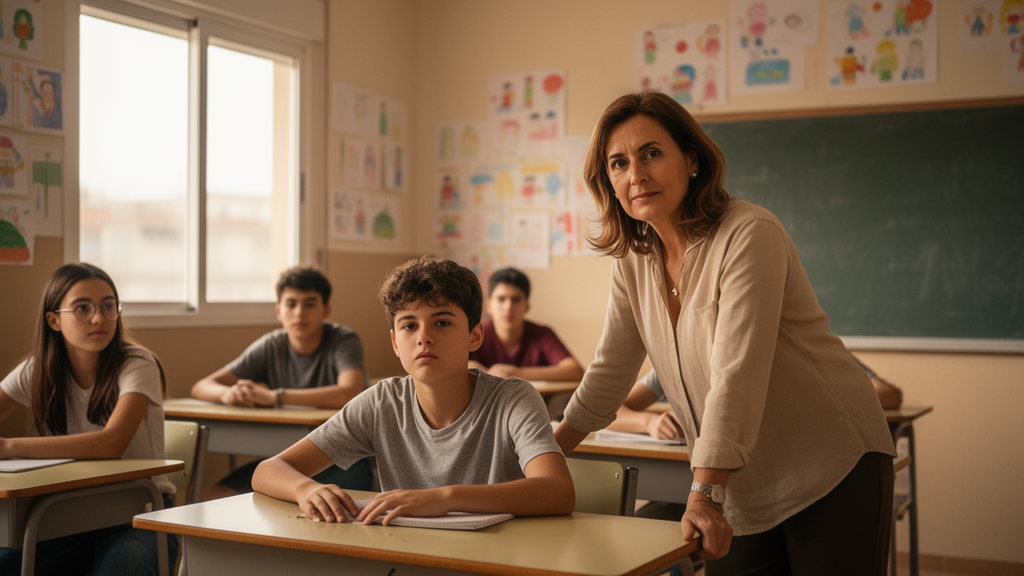
When a student is bullied, the way a teacher responds can shape everything that follows. A new study from Spain has now rigorously tested the main questionnaire researchers use to measure how adolescents perceive those adult responses, and the results are both promising and cautionary. Published in BMC Psychology, the psychometric validation of the Teachers’ Responses to Bullying Questionnaire among Spanish secondary-school adolescents offers one of the most detailed examinations of this instrument to date, involving 1,279 students aged 12 to 16 years.
The research team, led by Álvaro García-Prieto, Carmen Galán-Arroyo and Jorge Rojo-Ramos of the University of Extremadura, set out to resolve a persistent problem in bullying research. Although the TRBQ has been validated in several countries, previous studies have reported conflicting factorial solutions, leaving researchers uncertain about how many distinct dimensions of teacher response the instrument actually captures. This ambiguity matters because the questionnaire is intended to distinguish between very different adult behaviours, from active intervention to deliberate non-intervention, and from mediation to various forms of active response.
To address this, the team employed a cross-validation design that split the sample into two subsamples. In the first subsample of 639 students, they used exploratory factor analysis to uncover the underlying structure of the items. In the second subsample, initially 640 students and analytically 624 after data screening, they used confirmatory factor analysis to test competing models against the data. This two-step approach is considered a gold standard in psychometrics because it prevents researchers from fitting a model and testing it on the same data, which would inflate apparent fit.
The exploratory phase revealed a significant finding: the Non-intervention and Mediation dimensions showed substantial overlap, suggesting that students may not perceive a teacher who stays out of a bullying situation as clearly different from one who tries to mediate. One item, Item 3, was excluded because of inadequate psychometric performance, reducing the instrument to 14 items. Among the models tested, a correlated five-factor solution showed the best statistical fit, although the four-factor and second-order models also demonstrated acceptable fit, indicating that the factorial structure of the TRBQ remains a matter of interpretation rather than settled fact.
The preferred 14-item correlated five-factor model demonstrated excellent fit indices in the confirmatory subsample. The robust chi-square was 139.447 with 67 degrees of freedom, the robust comparative fit index reached 0.979, the robust Tucker-Lewis index was 0.972, the robust root mean square error of approximation was 0.052 with a 90 percent confidence interval of 0.040 to 0.065, and the standardized root mean square residual was just 0.032. These values fall well within accepted thresholds for good model fit, providing strong quantitative support for the five-factor interpretation among Spanish adolescents.
However, the validation also uncovered important limitations. Internal consistency was adequate for the four active-response dimensions, but the two-item Non-intervention factor showed only borderline reliability and narrower content coverage, meaning that this dimension may not reliably capture the full range of teacher inaction that students experience. Convergent validity was supported, but discriminant validity was limited for some factor pairs, indicating that certain dimensions of teacher response are statistically difficult to separate from one another. The substantial overlap among active-response dimensions warrants cautious interpretation of subscale scores.
The team also examined measurement invariance, testing whether the questionnaire functions equivalently across different groups. Strict invariance was supported across sex, meaning boys and girls interpret the items in the same way. Scalar invariance was supported across school grade, while strict grade invariance was borderline. Test-retest reliability over two weeks was moderate, with intraclass correlation coefficients ranging from 0.557 to 0.668, and greater uncertainty for the Non-intervention dimension. Longitudinal analyses provided preliminary evidence of approximate metric invariance, although exact scalar invariance over time was not fully supported.
These findings carry significant implications for bullying research and school psychology. The TRBQ emerges as a promising research measure of adolescents’ perceptions of teachers’ responses to bullying, but the authors are clear that the factorial solution should not be considered definitive. Before the instrument can be recommended for broader applications, further evidence of external and predictive validity, sensitivity to change, longitudinal invariance, and independent replication is needed. The study was approved by the Bioethics and Biosafety Committee of the University of Extremadura and conducted in accordance with the Declaration of Helsinki, with written informed consent from parents or legal guardians.
For schools and policymakers, the research underscores a fundamental point: how students perceive adult responses to bullying is a measurable construct, but measuring it well requires instruments that are statistically robust and culturally validated. The Spanish validation adds an important piece of evidence to the international psychometric literature on the TRBQ, while honestly documenting its limitations. As bullying prevention programmes increasingly rely on data about teacher behaviour, studies like this one ensure that the tools used to generate that data can be trusted, or at least understood, in all their complexity.
Subject of Research: Psychometric validation of the teachers’ responses to bullying questionnaire (TRBQ) among Spanish adolescents
Article Title: Psychometric validation of the teachers’ responses to bullying questionnaire (TRBQ) among Spanish adolescents
Article References: García-Prieto, Á., Galán-Arroyo, C., & Rojo-Ramos, J. (2026). Psychometric validation of the teachers’ responses to bullying questionnaire (TRBQ) among Spanish adolescents. BMC Psychology. https://doi.org/10.1186/s40359-026-05630-y
Image Credits: AI Generated
DOI: 10.1186/s40359-026-05630-y
Keywords: Psychometric, validation, teachers, responses, bullying, questionnaire, TRBQ, Spanish, adolescents, scientific research
Cite Scienmag News
Glenn Wilkins. (October 18, 2026). New Spanish study puts teacher bullying responses to the test. Scienmag. https://scienmag.com/new-spanish-study-puts-teacher-bullying-responses-to-the-test/
Glenn Wilkins. "New Spanish study puts teacher bullying responses to the test." Scienmag, 18 October 2026, https://scienmag.com/new-spanish-study-puts-teacher-bullying-responses-to-the-test/. Accessed 18 October 2026.
Glenn Wilkins. "New Spanish study puts teacher bullying responses to the test." Scienmag. October 18, 2026. https://scienmag.com/new-spanish-study-puts-teacher-bullying-responses-to-the-test/


