


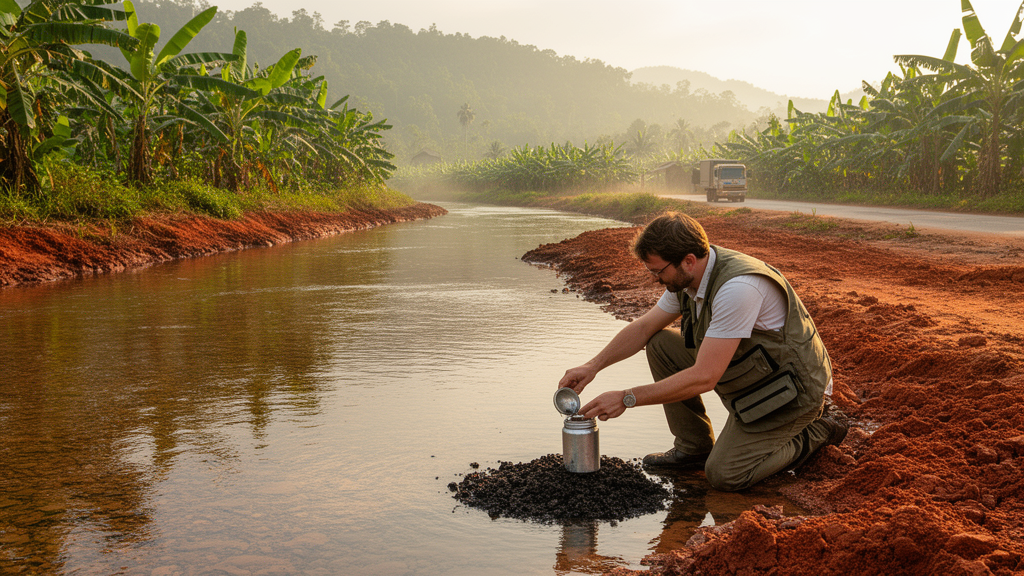
On China’s only tropical island province, the mud at the bottom of eight major rivers has quietly been keeping a record of everything flowing through the landscape above it. A new study of river sediments across western Hainan Island has now decoded that record, measuring six heavy metals in 67 surface sediment samples and using statistical source-tracing to work out where each one came from. The findings, published in Environmental Monitoring and Assessment, offer a detailed technical portrait of pollution in one of the country’s most ecologically distinctive regions.
The research team, led by Jiaqing Li of Hainan University’s School of Marine Sciences together with Shuwen Sun of Laoshan Laboratory, collected surface sediment samples from the eight major rivers that drain the island’s western half. They analyzed six heavy metals: chromium (Cr), cadmium (Cd), lead (Pb), zinc (Zn), copper (Cu), and nickel (Ni). The average concentrations followed a clear hierarchy: zinc at 41.05 milligrams per kilogram ranked highest, followed by lead at 30.93, chromium at 17.89, copper at 8.23, nickel at 5.45, and cadmium at just 0.08 milligrams per kilogram. Coefficients of variation ranged from 41.3 percent to 181.5 percent, a signal that metal levels varied substantially from site to site rather than being uniformly distributed.
To translate those raw numbers into meaning, the researchers deployed a battery of established geochemical assessment tools. The contamination factor (CF) compares measured concentrations against regional background values. The geo-accumulation index (Igeo) quantifies enrichment on a logarithmic scale. The potential ecological risk index (RI), originally formulated by Hakanson in 1980, weights each metal by its toxicity to living organisms. Together, these metrics revealed something reassuring: the study area presented an overall low ecological risk, with a mean RI value of 39.70, well below thresholds that would indicate moderate or considerable harm.
Not every metal came through clean, however. Lead and cadmium both exhibited moderate contamination, with mean contamination factors of 1.21 and 1.08 respectively, meaning their concentrations slightly exceeded regional background levels. Chromium, zinc, copper, and nickel showed no contamination, with contamination factors below 1. The pattern matters because cadmium and lead are among the most toxic heavy metals to aquatic ecosystems, capable of bioaccumulating in food webs and disrupting enzyme function even at low concentrations.
The most technically ambitious part of the study was its source apportionment using the APCS-MLR model, short for absolute principal component score-multiple linear regression. This statistical receptor-modeling technique works by decomposing the correlation structure of metal concentrations across sampling sites into underlying factors, then regressing each metal’s measured levels against those factors to estimate how much each source contributes. The results identified three distinct pollution sources with remarkably different footprints.
The dominant source, accounting for 64.0 percent of the total contribution, was a composite of natural, agricultural, and traffic influences. This source mainly controlled the enrichment of cadmium, lead, and zinc. The finding makes technical sense: agricultural fertilizers and pesticides can introduce cadmium and zinc into watersheds, while traffic emissions, including legacy leaded fuel and brake wear, contribute lead and zinc. Natural weathering of tropical soils, accelerated by Hainan’s extreme climate, adds a geological background component to all three metals.
A second source, contributing 13.3 percent, was identified as industrial, primarily affecting chromium, nickel, and copper. These three metals often travel together in industrial emissions and effluents, particularly from metal processing, electroplating, and mining operations. The third source, at 22.7 percent, was a mixed source representing multi-source superposition, meaning metals arriving from overlapping human and natural influences that could not be cleanly separated by the statistical model.
What makes the study particularly valuable is its regional specificity. Hainan Island’s western rivers drain a landscape shaped by extreme tropical weathering of basalts, a geological process documented in prior research that mobilizes and redistributes elements under the island’s hot, humid climate. The island also hosts the Shilu iron mine, whose tailings have been studied as a potential industrial source of metals. By clarifying which metals are enriched above background and which sources drive that enrichment, the study provides theoretical support for regional pollution management and watershed ecological restoration.
The low overall ecological risk should not invite complacency. Cadmium and lead contamination factors above 1 indicate that human activity has nudged these metals above natural levels, and the APCS-MLR results show that the dominant composite source is largely anthropogenic. As Hainan’s free trade port construction accelerates development across the island, traffic density, agricultural intensification, and industrial activity are all likely to grow, potentially shifting the balance of metal inputs in the years ahead.
The study also fits into a broader scientific effort to understand heavy metal dynamics across Hainan’s diverse environments. Prior work has examined metals in the island’s estuarine and coastal sediments, its groundwater, and its continental shelf, building a picture of how metals move from land to sea. This new river sediment dataset adds a critical inland link to that chain, clarifying the pollution characteristics and key sources of heavy metals in western Hainan Island’s river systems and offering a technical foundation for protecting the island’s unique tropical watersheds.
Subject of Research: Spatial distribution characteristics and source analysis of heavy metals in river sediments in Western Hainan Island, China
Article Title: Spatial distribution characteristics and source analysis of heavy metals in river sediments in Western Hainan Island, China
Article References: Li, J., Sun, S., Wang, Y., Wang, F., Wang, J., & Chen, X. (2026). Spatial distribution characteristics and source analysis of heavy metals in river sediments in Western Hainan Island, China. Environmental Monitoring and Assessment, 198(11), Article 1219. https://doi.org/10.1007/s10661-026-16058-7
Image Credits: AI Generated
DOI: 10.1007/s10661-026-16058-7
Keywords: Spatial, distribution, characteristics, source, analysis, heavy, metals, river, sediments, Western, Hainan, Island
Cite Scienmag News
Violet Maxwell. (October 18, 2026). Heavy Metals in Western Hainan Island River Sediments Trace a Mostly Natural-Agricultural-Traffic Story. Scienmag. https://scienmag.com/heavy-metals-in-western-hainan-island-river-sediments-trace-a-mostly-natural-agricultural-traffic-story/
Violet Maxwell. "Heavy Metals in Western Hainan Island River Sediments Trace a Mostly Natural-Agricultural-Traffic Story." Scienmag, 18 October 2026, https://scienmag.com/heavy-metals-in-western-hainan-island-river-sediments-trace-a-mostly-natural-agricultural-traffic-story/. Accessed 18 October 2026.
Violet Maxwell. "Heavy Metals in Western Hainan Island River Sediments Trace a Mostly Natural-Agricultural-Traffic Story." Scienmag. October 18, 2026. https://scienmag.com/heavy-metals-in-western-hainan-island-river-sediments-trace-a-mostly-natural-agricultural-traffic-story/


