


Six decades ago, an armada of research ships from thirteen nations descended on the least explored of Earth’s great ocean basins, and the specimens they hauled up from the Indian Ocean are still yielding scientific dividends. A new analysis published in Frontiers of Biogeography has quantified, for the first time, exactly how many new species the American component of the first International Indian Ocean Expedition produced, and the results offer a striking case study in how large-scale, coordinated science can accelerate the discovery of life on our planet. Between 1959 and 1965, the expedition’s U.S. Program in Biology collected specimens that led taxonomists to describe 399 species new to science, a tally that rivals the output of far more recent biodiversity initiatives.
The first International Indian Ocean Expedition, known today as IIOE-1, was conceived in 1959 by the Scientific Committee on Oceanic Research as one of its founding activities, with the Intergovernmental Oceanographic Commission later joining as co-sponsor. The expedition officially ran from 1 September 1959 to 31 December 1965 and remains one of the largest multinational, multidisciplinary oceanographic research efforts ever focused on a single basin. The Indian Ocean was chosen deliberately. Its oceanography was less known than that of any other major ocean, its circulation reverses annually with the monsoon winds, and planners believed its living resources could help feed the growing populations of developing nations ringing the basin. Australia, France, Germany, India, Indonesia, Japan, Pakistan, Portugal, South Africa, Thailand, the USSR, the United Kingdom, and the United States all contributed ships, with the U.S. National Science Foundation playing a particularly significant financing role.
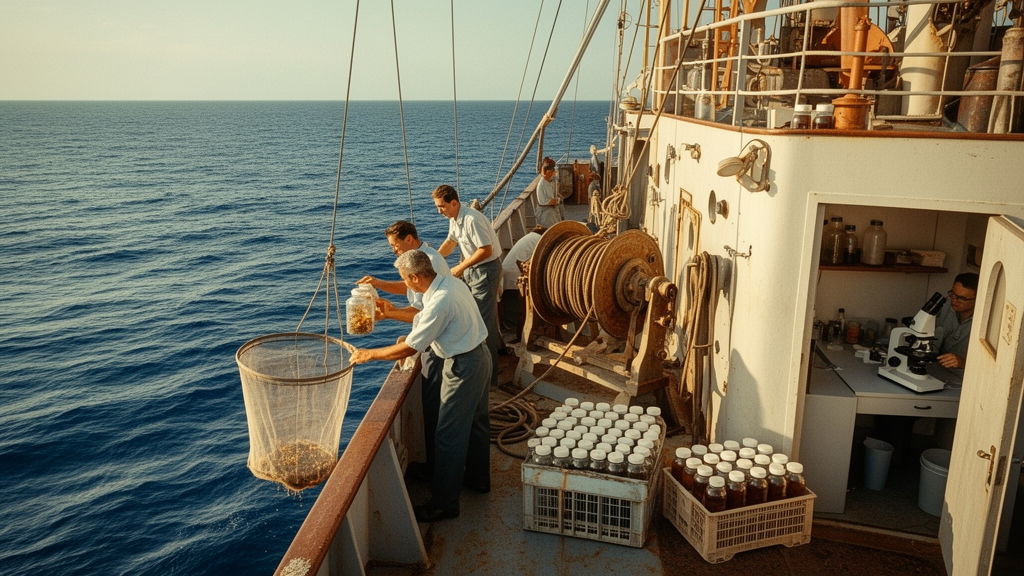
The American biological program was distinctive in its scale and organization. It combined sampling from several research vessels, most notably the R/V Anton Bruun and the graduate training ship Te Vega, with two land-based camps in India and Madagascar. Sampling devices were deployed throughout the water column down to the seafloor, capturing everything from surface plankton to deep-sea benthic invertebrates. Plankton samples were forwarded to the Indian Ocean Biological Centre in Ernakulam, India, which received and identified 2,068 samples, while larger specimens were dispatched to a newly created processing hub: the Smithsonian Oceanographic Sorting Center, established in December 1962 specifically to handle the expedition’s biological bounty. That center eventually received 3.6 million specimens from the IIOE-1 and distributed about 1.5 million of them to roughly 140 taxonomic experts in the United States and 17 other countries.
Compiling the list of 399 species was itself a formidable research undertaking. The author, Edward R. Urban Jr., searched the collections of the U.S. National Museum of Natural History using keywords tied to the expedition’s ships and camps, combed through reprints collated by the IOC, and cross-referenced the Ocean Biodiversity Information System against the World Register of Marine Species. The screening process began with 34,205 species and subspecies known from the Indian Ocean, narrowed to 8,963 described in 1960 or later, and then to 7,652 papers that could actually be located to verify holotype details. Species lacking verifiable collection years, or carrying taxonomic flags such as nomen dubium or nomen nudum, were excluded. The resulting metadatabase, freely available online, records where each holotype was collected, when, and in which museum it resides today.
The geography of discovery tells its own story. Of the 399 holotypes, 277 were collected south of the equator and 117 north of it, with a conspicuous line of collections along a transect at approximately 65 degrees east occupied by Cruise 6 of the Anton Bruun. Most holotypes are archived in museums in the United States, but at least 19 different museum locations hold specimens, including institutions in Paris, Amsterdam, London, Cape Town, and Cambridge, Massachusetts. Two-thirds of the species in the metadatabase have verified catalog numbers in the Smithsonian’s National Museum of Natural History, and thirteen other museums hold holotypes of some of the listed species, many of which now provide open access to their digital records.
Perhaps the most sobering finding concerns time. Collections by the Program in Biology occurred primarily in a pulse during 1963 and 1964, yet the descriptions of new species trickled out over decades. Half of the 376 descriptions for which a collection year could be determined were published within 10 years of collection, with the most common interval being 5 years. But some species waited far longer: one was not described until 54 years after its holotype was collected. The lesson, the analysis argues, is that it may be premature to judge the productivity of any expedition until 5 to 10 years after it ends, even though many modern expeditions release preliminary counts of putative new species in press releases rather than peer-reviewed publications.
The expedition’s productivity was far from uniform, and the differences are instructive. Research cruises of the Anton Bruun, Te Vega, Argo, Pioneer, and Horizon produced 254 holotypes, about 63.7 percent of the total, while land-based camps at Nosy Be in Madagascar and Mandapam in India yielded 114, and independent research accounted for 31 more. When productivity was normalized by cruise length, benthic-focused cruises dramatically outperformed those sampling the water column. Cruise 7 of the Anton Bruun, which sampled benthic invertebrates in the southwest Indian Ocean, produced 69 holotypes in 43 days, a rate of 1.60 holotypes per day, while Cruise 8 achieved 0.93 and Cruise 9, focused on reef and shore collecting, 1.35. By contrast, long-lining cruises for pelagic fish produced rates as low as 0.02 holotypes per day, and a hydrographic cruise produced none at all. A handful of stations off the northeast coast of Somalia, occupied on 16 and 17 December 1964, yielded up to seven holotypes each.
Taxonomically, the discoveries were dominated by one group: crustaceans, which made up roughly 75 percent of the 399 species, most of them copepods, the tiny often parasitic crustaceans that pervade marine plankton and infest fish and invertebrates. Chordates, mostly fish, accounted for about 15 percent, with the remainder spread among annelids, mollusks, cnidarians, echinoderms, and the obscure kinorhynchs. The dominance of copepods reflects the outsized influence of a handful of individual specialists. Ten authors described about 55 percent of the 399 species. Arthur G. Humes, a Boston University professor who directed the expedition’s Nosy Be laboratory in Madagascar, described 87 species from the program, often collaborating with Ju-Shey Ho, his doctoral student, who co-authored 65. Brian F. Kensley described 37 species of decapod and isopod crustaceans, Rosalie F. Maddocks described 35 ostracods, and Olga Hartman described 17 polychaete annelids. Seventy species were later moved to different genera, 60 percent of them copepods, many through the splitting of the genus Lichomolgus.
The analysis draws pointed comparisons with more recent initiatives. The Census of Marine Life, a 10-year global effort from 2000 to 2010, is credited with 1,109 new species worldwide, of which only 85 were from the Indian Ocean, fewer than the American program alone produced in the 1960s. Other recent expeditions, including a 2022 voyage to the Cocos Islands by Museums Victoria, the Maldives Deep Reef Survey, and the South Java Deep Sea Expedition, have reported counts of collected species that may prove new to science, but the actual numbers may shrink considerably once the necessary taxonomic work is done. The IIOE-1 experience suggests that focused effort on a relatively unexplored basin, combining cruises with land-based stations, and empowering individual specialists in understudied taxa, remains a remarkably productive formula for discovery.
The legacy of the expedition extends well beyond species counts. The IIOE-1 produced standardized plankton sampling gear adopted by all participating nations, atlases of phytoplankton and zooplankton distribution, and the founding of India’s National Institute of Oceanography in Goa, now the country’s premier oceanographic institution. Its 1960s data remain benchmarks for comparing with modern observations of a changing ocean. But the analysis also identifies persistent obstacles: many species descriptions sit behind paywalls, older publications often omit collection dates and locations, and most museums lack online catalogs of their holdings. The number of species attributable to the program would likely grow with additional library research, particularly in non-English journals, since the Smithsonian distributed specimens to specialists worldwide. For a scientific community now planning new deep-sea explorations with remotely operated vehicles and submersibles, the 1960s expedition offers a clear message: big science works, but only when the specimens, the specialists, and the museums that preserve them are funded for the long haul.
Subject of Research: Big Science
Article Title: The role of “Big Science” in the discovery of new marine species: Experience from the International Indian Ocean Expedition of the 1960s
Article References: Urban Jr., E. R. (2025). The role of “Big Science” in the discovery of new marine species: Experience from the International Indian Ocean Expedition of the 1960s. Frontiers of Biogeography, 18, Article e163345. https://doi.org/10.21425/fob.18.163345
Image Credits: AI Generated
Keywords: Big Science, International Indian Ocean Expedition, marine biodiversity, species discovery, Smithsonian, biogeography, role, Science, discovery, marine, species, Experience
Cite Scienmag News
Violet Maxwell. (October 18, 2026). The role of “Big Science” in the discovery of new marine species: Experience from the International Indian Ocean Expedition of the 1960s. Scienmag. https://scienmag.com/the-role-of-big-science-in-the-discovery-of-new-marine-species-experience-from-the-international-indian-ocean-expedition-of-the-1960s/
Violet Maxwell. "The role of “Big Science” in the discovery of new marine species: Experience from the International Indian Ocean Expedition of the 1960s." Scienmag, 18 October 2026, https://scienmag.com/the-role-of-big-science-in-the-discovery-of-new-marine-species-experience-from-the-international-indian-ocean-expedition-of-the-1960s/. Accessed 18 October 2026.
Violet Maxwell. "The role of “Big Science” in the discovery of new marine species: Experience from the International Indian Ocean Expedition of the 1960s." Scienmag. October 18, 2026. https://scienmag.com/the-role-of-big-science-in-the-discovery-of-new-marine-species-experience-from-the-international-indian-ocean-expedition-of-the-1960s/


