


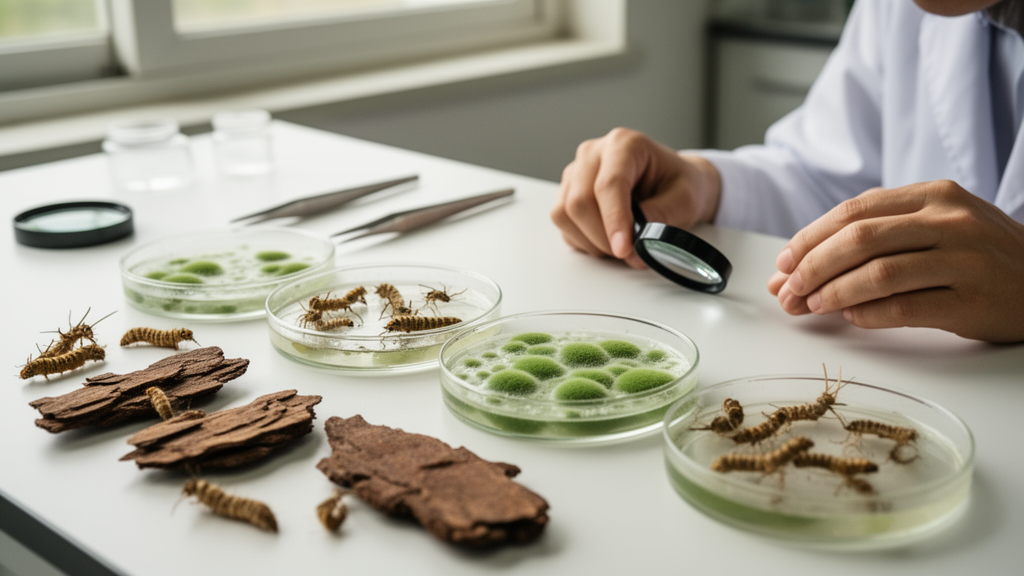
Deep in the mountains of southwestern China, where the prized caterpillar fungus Ophiocordyceps sinensis lies buried beneath alpine meadows, scientists have uncovered a hidden world of fungi that could reshape our understanding of one of the planet’s most economically important fungal genera. A new study published in MycoKeys describes three previously unknown species of Trichoderma and reports two known species from entirely new substrates, all isolated from caterpillar fungi and dragon tree roots collected across four Chinese provinces and autonomous regions.
Trichoderma is no ordinary fungus. Established in 1794 by the mycologist Persoon, the genus has undergone dramatic taxonomic revision over the centuries. Its sexual stages were once placed in a separate genus called Hypocrea, but the adoption of the One Fungus One Name principle eventually suppressed Hypocrea in favor of Trichoderma, reflecting both nomenclatural priority and the enormous practical importance of the asexual forms. Today, more than 500 species have been formally described, organized into 17 phylogenetic lineages with names like Harzianum, Viride, Polysporum, and Semiorbis.
What makes Trichoderma so remarkable is its sheer versatility. These fungi are found worldwide across diverse ecosystems, from grasslands and forests to wetlands, saline-alkaline soils, and deserts. They suppress plant pathogens through mycoparasitism, nutrient competition, and the induction of plant immunity, making them some of the most widely used biological control agents in agriculture. Among registered fungal biocontrol agents, Trichoderma accounts for approximately 60 percent of the total, with more than 50 Trichoderma-based formulations successfully developed worldwide. Many species also exhibit strong cellulolytic activity and are used in bioenergy, textile processing, papermaking, detergents, and feed production, while recent attention has focused on their potential in pollution remediation, nanomaterial synthesis, and functional fermentation products.
The new study, led by Fang-Wei Lou, Zhu L. Yang, and Y. B. Wang, involved collecting twenty samples during 2024 and 2025 from Yunnan Province, Qinghai Province, the Xizang Autonomous Region, and the Guangxi Zhuang Autonomous Region. Six Trichoderma strains were isolated from Ophiocordyceps species, including the famous caterpillar fungus Ophiocordyceps sinensis and the golden Ophiocordyceps jinguangensis, while two strains came from the healthy roots of Dracaena, the dragon tree genus. The researchers used a modified grinding method for the Ophiocordyceps specimens, sterilizing them in ethanol and hydrogen peroxide before excising tissue segments and plating them onto potato dextrose agar. For the Dracaena roots, prepared tissue segments were placed on PDA plates supplemented with penicillin and streptomycin to eliminate bacterial contaminants.
To determine the taxonomic placement of these eight strains, the team performed multilocus phylogenetic analyses using three DNA regions: the internal transcribed spacer region, the translation elongation factor 1-alpha gene, and the RNA polymerase II second-largest subunit gene. These three loci are the core barcodes commonly used for species identification in Trichoderma. The researchers collected sequences from three loci for 541 representative strains covering 473 species, resulting in a concatenated supermatrix of 2,594 characters. Maximum likelihood and Bayesian inference analyses were then conducted, with Hypomyces chiangraiensis serving as the outgroup. The phylogenetic results were further verified using sequence identity assessments based on the criterion proposed by Cai and Druzhinina in 2021.
The phylogenetic analysis revealed that six of the eight strains were potential new species, while the remaining two were tentatively assigned to known species. The eight strains were assigned to four clades of Trichoderma: the Harzianum, Semiorbis, Viride, and Polysporum clades. Integrating phylogenetic and morphological evidence, the researchers identified three new species, Trichoderma diqingense, T. dracaenae, and T. yuxiense, and two known species, T. fertile and T. paraviridescens, which are newly recorded from the substrate Ophiocordyceps sinensis.
Trichoderma diqingense, named after the Diqing Tibetan Autonomous Prefecture where it was collected, belongs to the Harzianum clade, the largest phylogenetic group within the genus, comprising approximately 95 species. Isolated from the sclerotium of Ophiocordyceps sinensis at an altitude of 3,220 meters in Shangri-La City, this species is distinguished by its pyramidal conidiophore branching, narrower lageniform phialides, slightly rough-walled ellipsoidal to globose conidia, and the absence of chlamydospores and a coconut-like odor. It differs from its closest relatives, T. christiani, T. concentricum, T. ingratum, and T. perviride, by measurable genetic distances in the tef1-alpha and rpb2 genes, ranging from 1.9 to 2.7 percent in rpb2.
Trichoderma dracaenae, named after the dragon tree genus from which it was isolated, belongs to the Viride clade. Collected from healthy Dracaena roots in Baise City, Guangxi, at an altitude of 688 meters, this species is distinguished by conidiophores with a distinct cylindrical main axis and usually two to three branches, broader ampulliform phialides, and smaller, smooth-walled, subglobose to globose conidia. It differs from its closest relatives, T. speciosum and T. sphaerosporum, by 1.8 and 0.79 percent in tef1-alpha, respectively, and by 2.3 and 2.4 percent in rpb2. Trichoderma yuxiense, named after Yuxi City in Yunnan Province where it was collected from the sclerotium of Ophiocordyceps jinguangensis at 2,434 meters, belongs to the Polysporum clade. It is distinguished by longer and narrower ampulliform to lageniform phialides, subglobose to broadly ellipsoidal conidia, and rare, mostly terminal chlamydospores, which are absent in its relative T. shangrilaense.
The two new records are equally significant. Trichoderma fertile, first described from soil under wheat in Canada in 1991, was isolated from the stroma of Ophiocordyceps sinensis in Qinghai Province at an altitude of 4,301 meters. Trichoderma paraviridescens, originally described from decorticated beech wood in Austria, was isolated from the stroma of Ophiocordyceps sinensis in Nyingchi City, Xizang, at 2,300 meters. Both species extend their known substrate ranges into entirely new territory, suggesting that Trichoderma species may be far more widespread across fungal-associated substrates than previously recognized.
China is a global hotspot for fungal diversity, with 1,249 new species described in 2023 alone, representing nearly 42 percent of the global total. Yet only approximately 6.84 percent of known global fungal diversity has been recorded from China, suggesting that countless species remain undiscovered. The new findings expand the understanding of Trichoderma species and substrate diversity, providing a taxonomic basis for future studies. However, the researchers caution that their study is constrained by the limited number of isolates, the potential for morphological plasticity under culture conditions, and the difficulty of inferring ecological interactions from culture-based data alone. Future work should broaden geographic and substrate sampling and integrate phylogenomic approaches to more accurately delimit species boundaries within this fascinating and economically vital fungal genus.
Subject of Research: Mycology
Article Title: Molecular phylogeny and morphology reveal three new species and two new records of Trichoderma ( Hypocreaceae , Hypocreales ) from China
Article References: Lou, F.-W., Chen, B.-Z., Tan, L.-M., Xiao, J.-C., Liao, H.-F., Hou, J.-H., Yang, Z.-L., Li, G.-D., & Wang, Y.-B. (2026). Molecular phylogeny and morphology reveal three new species and two new records of Trichoderma (Hypocreaceae, Hypocreales) from China. MycoKeys, 139, 23-47. https://doi.org/10.3897/mycokeys.139.198944
Image Credits: AI Generated
DOI: 10.3897/mycokeys.139.198944
Keywords: Trichoderma, mycology, China, taxonomy, phylogenetics, Ophiocordyceps, Dracaena, new species, Molecular, phylogeny, morphology, reveal
Cite Scienmag News
Roger Howard. (October 18, 2026). Three New Trichoderma Species Uncovered in China From Caterpillar Fungi and Dragon Trees. Scienmag. https://scienmag.com/three-new-trichoderma-species-uncovered-in-china-from-caterpillar-fungi-and-dragon-trees/
Roger Howard. "Three New Trichoderma Species Uncovered in China From Caterpillar Fungi and Dragon Trees." Scienmag, 18 October 2026, https://scienmag.com/three-new-trichoderma-species-uncovered-in-china-from-caterpillar-fungi-and-dragon-trees/. Accessed 18 October 2026.
Roger Howard. "Three New Trichoderma Species Uncovered in China From Caterpillar Fungi and Dragon Trees." Scienmag. October 18, 2026. https://scienmag.com/three-new-trichoderma-species-uncovered-in-china-from-caterpillar-fungi-and-dragon-trees/


