


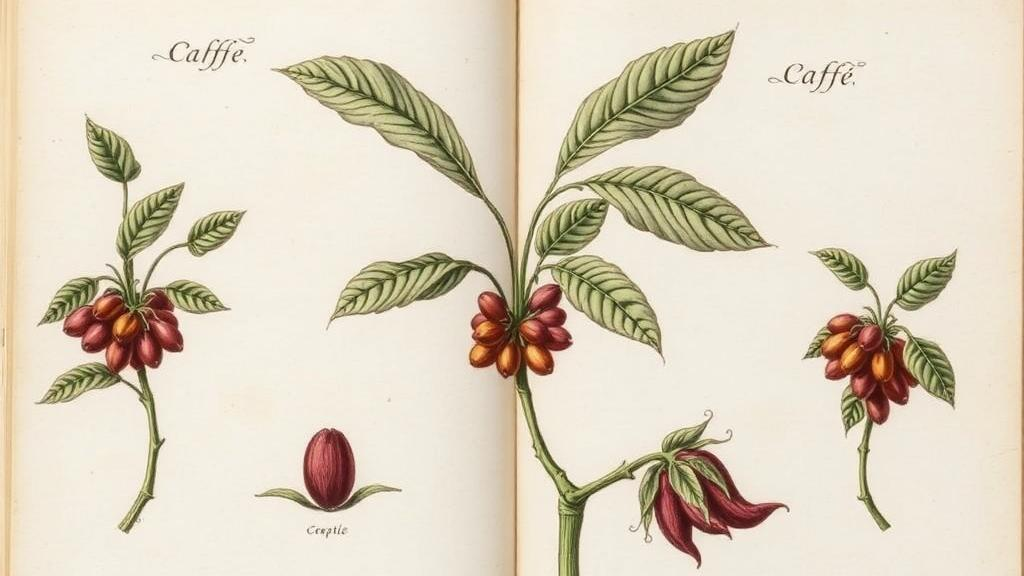
In the late 17th and early 18th centuries, coffee was a novelty sweeping through Europe. The drink, brewed from seeds of a plant native to the highlands of “Arabia Felix” (present-day Yemen), was consumed in Egypt, Syria and Turkey before entering the Western world, and physicians, merchants and naturalists alike clamored to know what the plant actually looked like. Botanical illustration was the primary vehicle for that knowledge, and it is here that a remarkable detective story begins—one that ends, 322 years after publication, with a startling conclusion: none of the engravings in Luigi Ferdinando Marsigli’s 1703 monograph “Notizie, di Costantinopoli; sopra la pianta del caffè” depict coffee plants at all.
Marsigli (1658–1730), the Bolognese Count and polymath of the Enlightenment, was a man of extraordinary breadth. His interests spanned books, manuscripts, geology, mineralogy, cartography, oceanography, military affairs, botany and mycology. In 1685 he published a 47-page treatise entitled “Bevanda asiatica,” referring to coffee as an Asian drink. Although this might sound odd—Coffea arabica is endemic to Africa, not Asia—coffee at the time was sourced from Yemen, a country located in the southwestern region of the Asian continent. The treatise, written in Italian, is divided into three sections: a dedication to Cardinal Francesco Buonvisi, a parallel Italian–Ottoman Turkish translation of a manuscript, and Marsigli’s own hard-won knowledge of coffee preparation.
The manuscript Marsigli acquired in Constantinople (present-day Istanbul) in 1679 was written by Hezârfen Hüseyin Efendi, whose name Marsigli rendered variously as “Cuseim Efendi,” “Cosain Efendi” and “Cossain Effendi.” The manuscript was part of Hüseyin’s medicinal encyclopedia, entitled “Tuhfetü’l-Erîbi’n-Nâfia li’r-Rûhânî ve’t-Tabîb” (“Useful and Skillful Gift for Doctors and All Creatures”), of which nine copies are known. Whether Marsigli translated the manuscript himself or relied on an interpreter remains unclear, but the evidence suggests the latter: Marsigli himself admitted he was “pleased with the few Turkish words that I had learned,” and historical accounts note he was accompanied by Jewish interpreters and dragomans of the Venetian embassy during his first visit to Istanbul.
Hüseyin’s manuscript contains one of the earliest descriptions by someone who had observed coffee plants in situ in Yemen. He reported that the coffee tree grew in only two districts—the county of Usab and the county of Naharii—and described trees, some 20 to 30 years old, with white flowers, very similar to cherry trees, planted in a straight line. When the fruit reached maturity, it became “dark red like the color of a wild cherry, and sweet like it.” Hüseyin also discussed the drying of coffee on flat terraces, dehulling, and the preparation of the drink, noting that the dried peel was boiled in water as a summer refreshment. He further described the drink’s properties: it preserved the stomach, was useful against drunkenness and opium intoxication, removed sleep, and, when drunk moderately, brought happiness rather than melancholy.
Marsigli’s third section of “Bevanda asiatica” deals with “l’arte di cucinar questo frutto”—the art of cooking the coffee fruit—an art he learned in the most unusual way. In 1683, while serving in the army of the Habsburg Holy Roman Empire, he was wounded and became a prisoner of the Ottoman Empire prior to the two-month-long Siege of Vienna. He was held as a slave from July 2, 1683 to March 25, 1684, when ransom was paid for his freedom. Assigned to a cupboard-keeper who ran a public coffee shop, Marsigli had to roast, cook and distribute coffee to buyers. He learned, “at the cost of many lashes,” that roasting must be done with constant motion in a copper pan to a state of perfection manifesting as a dark umber color—beyond black, the grains became like coals, changing the strength, flavor and properties of the drink. He also learned that the roasting does not cover the surface of the grain, and that the middle can remain raw, damaging the flavor when reduced to powder.
The only engraving in “Bevanda asiatica” is a title-page attempt at illustrating a coffee plant. It depicts a landscape with hills and trees, and a terminal branch with two alternate leaves bearing serrated margins. Coffee leaves are not serrated but entire—smooth, without teeth or lobes. Cherry leaves, by contrast, are serrate or serrate-crenate. Three round fruits attached to the branch resemble cherry fruits, not coffee. Yet the engraving also shows three seeds perfectly recognizable as coffee seeds, which makes sense as coffee beans were the marketable product and widely available at the time. The engraver’s signature appears to be “Ac. G. f,” with the “f” an abbreviation for the Latin “fecit”—“made it.”
In 1703, Marsigli published a 14-page coffee monograph, “Notizie, di Costantinopoli; sopra la pianta del caffè,” with a bilingual title reflecting that both Italian and Latin are interspersed throughout. The lower part of the title page bears an engraving very similar to the one in “Bevanda asiatica,” with the same engraver initials. The “Praefatiuncula” was written in Latin by Johann Samuel Schoder, an assistant to Georg Christoph Eimmart, an engraver and astronomer in Nuremberg. Schoder makes clear he is simply relaying Marsigli’s information, noting that Marsigli was “abroad serving his Caesar.” Indeed, in 1703 Marsigli was engaged in the War of the Spanish Succession and would surrender the fortress of Breisach, resulting in his dishonorable discharge in early 1704. A similar delegation of authority had occurred with Marsigli’s 1698 “Dissertazione epistolare del fosforo,” where errors crept in during his absence.
Schoder’s Preface is followed by four pages of coffee plant descriptions and five pages of engravings depicting six supposed coffee plants. The original watercolors used to create these engravings are housed at the Biblioteca Universitaria di Bologna and are presented here for the first time since publication. Five of the depicted plants have alternate leaves with indistinctly lobed or weakly undulate margins, when coffee has opposite, entire leaves. The remaining plant, supposedly depicting an entire coffee tree, exhibits both opposite and alternate leaves with serrated margins. As de Jussieu stated in 1716, coffee leaves should be “without serrations or crenellations in their contours.” None of the six engravings represents a coffee plant.
The watercolors bear handwritten notes in Italian and Ottoman Turkish. Fig. 1A is identified as “Zellebi Caffesi, Caffè Nobilis ò, di Monti di Senaam,” referring to the mountains of Sanaa, while the Ottoman Turkish text reads “ḳahve-i Salāba”—“coffee of Salaba.” Fig. 1B is labeled “Coffee of Bayt al-Faqih,” an important coffee marketplace but not a coffee-growing area. Fig. 2 is labeled “coffee of Yemen.” Fig. 3, described as “Beitulfaki Caffè,” depicts a plant rendered with ample artistic license—taller than the surrounding mountains, with fruits almost as large as the leaves and an enormous trunk. Fig. 4, identified as the third coffee species, describes flowers as “sulfur-yellow and rose pink” and tri-petalous, when Arabica coffee flowers are white and usually have five corolla lobes. Fig. 5 shows leaves and flowers with the Ottoman Turkish text stating “the size of its leaves is like this”—yet none of the descriptive elements matches coffee in any way.
What makes this botanical failure so striking is that the correct depiction of coffee leaves was not rare. Prospero Alpino’s 1592 woodcut in “De plantis Aegypti liber” correctly showed opposite, entire leaves with five to six secondary veins, and this illustration was plagiarized by Parkinson (1640), Vesling (1640), Bauhin and Cherler (1650), Peters (1666), Chabrée (1666, 1677, 1678) and de Blegny (1687), among others. Elegant coffee botanical engravings were published by de la Roque in 1715, followed a year later by de Jussieu. The early 1700s was also a significant period for coffee botany due to de Jussieu’s botanical description, the creation of the genus Coffea by Linnaeus in 1735, and Linnaeus’s comprehensive botanical description in 1737.
The engravings from “Notizie, di Costantinopoli” were subsequently copied by others. In 1704, Michael Bernhard Valentini published the first edition of “Museum Museorum,” including an unsigned engraving copied from Fig. 4. All subsequent editions—the second edition of 1714 and the first and second Latin editions of 1716 and 1732—contained the same figure. In 1705, Jacob Spon published “Bevanda asiatica: hoc est; Pysiologia potus café,” the second edition of his Latin translation of Dufour’s book, which included all the coffee plant engravings from “Notizie, di Costantinopoli.” Spon’s Preface claimed that “very exact images” of the coffee plant “came to us from Arabia, by way of Constantinople,” and that their “genuine expression” should not be doubted. It is possible Spon used the same copper plates as those used in the original monograph.
Contemporary reactions were mixed. Valentini stated in 1714 that Marsigli’s book depicted “various species,” which is botanically impossible—at the time, only one commercially traded coffee species existed in Yemen, i.e., Arabica. In a 1715 letter, Volkamer commented critically that Marsigli’s figures, “lacking a certain character, disappoint the wishes and expectations of the curious.” His own letter included a beautiful engraving of a coffee branch depicting opposite ovate-lanceolate leaves and perfectly identifiable coffee fruits. De la Roque, in 1715, published “Voyage de l’Arabie heureuse” with more accurate botanical engravings, noting that observers “will easily perceive how very different this is from all those, which we have seen in many books.”
In recent times, however, bibliographers have praised Marsigli’s engravings. Hünersdorff and Hasenkamp (2002) called them “among the earliest faithful representations of the coffee plant in a western book,” and Schnyder-v. Waldkirch (1988) asserted that Marsigli’s engravings “significantly clarified Europe’s idea of the coffee plant.” These comments were made by outstanding bibliographers who might not necessarily have been familiar with the botanical characters of the coffee plant. The extreme rarity of “Notizie, di Costantinopoli”—only two copies have been located, one at the Universitätsbibliothek Erlangen-Nürnberg and one sold in 2023—raises the question of whether Marsigli realized the plants were not coffee, resulting in most copies being destroyed.
Linnaeus did not cite either of Marsigli’s coffee-related books in his description of Coffea in “Hortus Cliffortianus” (1737). Almost 25 years later, Linnaeus cited Spon’s 1705 book in the Linnaean dissertation “Potus coffeae” (1761). One wonders what Linnaeus’s response would have been after examining the botanical engravings purportedly representing plants in the genus he had erected. Marsigli’s two coffee-related books present a microcosm of the coffee world in the early 1700s: a popular drink from a distant country was still a novelty, and its botanical identity and medical properties were areas of widespread interest among the cognoscenti. If Marsigli tried to erase the evidence by not distributing “Notizie, di Costantinopoli,” his attempt completely failed when Valentini kept publishing an engraving of Fig. 4 until 1732, and when Spon published all the botanical engravings in 1705.
Subject of Research: History of Botany
Article Title: When is coffee not coffee? Luigi Ferdinando Marsigli's depictions of the coffee plant in “Notizie, di Costantinopoli; sopra la pianta del caffè” (1703)
Article References: Vega, F. E., & Davis, A. P. (2025). When is coffee not coffee? Luigi Ferdinando Marsigli's depictions of the coffee plant in “Notizie, di Costantinopoli; sopra la pianta del caffè” (1703). Italian Botanist, 19, 65-85. https://doi.org/10.3897/italianbotanist.19.146007
Image Credits: AI Generated
DOI: 10.3897/italianbotanist.19.146007
Keywords: coffee, botanical illustration, Luigi Ferdinando Marsigli, Coffea arabica, history of science, 17th century, Ottoman Empire, botany, Luigi, Ferdinando, Marsigli's, depictions
Cite Scienmag News
Drew Townsend. (October 18, 2026). When is coffee not coffee? Luigi Ferdinando Marsigli’s depictions of the coffee plant in “Notizie, di Costantinopoli; sopra la pianta del caffè” (1703). Scienmag. https://scienmag.com/when-is-coffee-not-coffee-luigi-ferdinando-marsiglis-depictions-of-the-coffee-plant-in-notizie-di-costantinopoli-sopra-la-pianta-del-caffe-1703/
Drew Townsend. "When is coffee not coffee? Luigi Ferdinando Marsigli’s depictions of the coffee plant in “Notizie, di Costantinopoli; sopra la pianta del caffè” (1703)." Scienmag, 18 October 2026, https://scienmag.com/when-is-coffee-not-coffee-luigi-ferdinando-marsiglis-depictions-of-the-coffee-plant-in-notizie-di-costantinopoli-sopra-la-pianta-del-caffe-1703/. Accessed 18 October 2026.
Drew Townsend. "When is coffee not coffee? Luigi Ferdinando Marsigli’s depictions of the coffee plant in “Notizie, di Costantinopoli; sopra la pianta del caffè” (1703)." Scienmag. October 18, 2026. https://scienmag.com/when-is-coffee-not-coffee-luigi-ferdinando-marsiglis-depictions-of-the-coffee-plant-in-notizie-di-costantinopoli-sopra-la-pianta-del-caffe-1703/


