


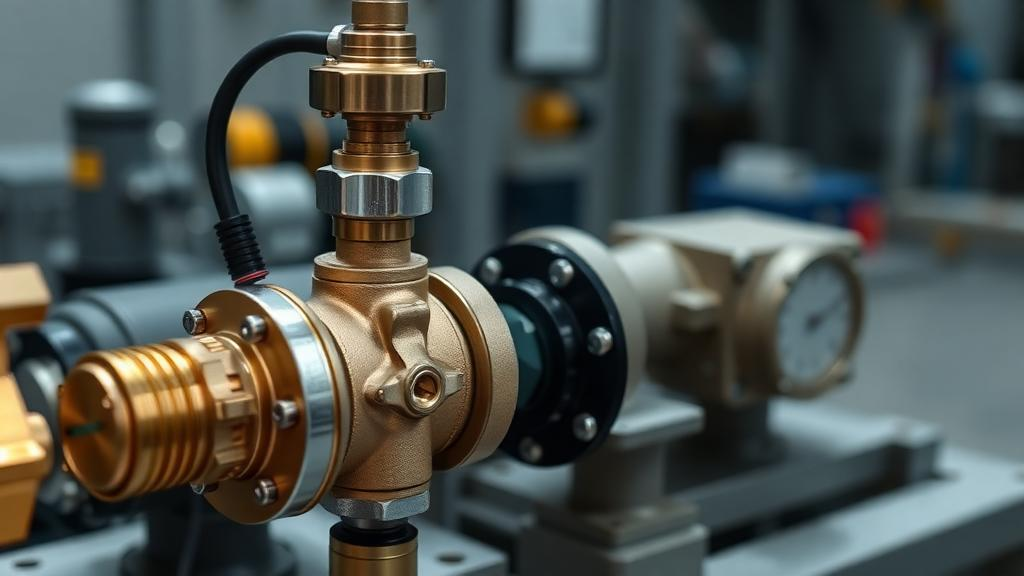
Deep inside every excavator, tractor, and loader sits a component most people never think about: a hydraulic directional valve that decides where pressurized oil flows and how fast a machine’s arm, bucket, or blade responds. Researchers in China have now unveiled a control method that lets this humble valve teach itself to correct its own errors in real time, promising sharper precision and smoother handling for the heavy machinery that builds our world. The study, published in the journal Results in Engineering, tackles a stubborn problem that has limited the accuracy of two-stage hydraulic directional valves for decades.
The valve in question is a two-stage hydraulic directional valve, or TSHDV, a device that uses a small pilot valve to steer a much larger main spool. The pilot stage is deliberately built with what engineers call positive overlap: the spool and sleeve overlap slightly at the neutral position so that oil cannot leak out when the machine idles. That design saves energy and reduces waste, but it comes at a hidden cost. Near the neutral position, the metering edges remain closed and no effective flow path exists between the pilot supply or return ports and the working ports. This region forms a geometric dead zone, meaning a pressure difference between the two main-spool control chambers cannot develop until the pilot spool crosses the corresponding overlap boundary. The result is a delayed main-spool response and reduced position-tracking accuracy, particularly during zero crossings, small-opening operations, and direction reversals.
The dead zone is only the beginning of the trouble. The electromagnetic actuator in the pilot stage has a limited bandwidth, and the flow-pressure-drop relationship at the valve orifice exhibits significant nonlinearity. Meanwhile, the motion of the main spool is jointly affected by hydraulic pressure force, spring force, friction force, and flow force. Add the external mechanical vibration that mobile equipment endures on construction sites, and the control problem becomes fiercely nonlinear, parameter-sensitive, and dependent on operating conditions. In the small-flow region and during switching processes, these coupled effects are particularly evident, making precise spool position control a genuinely hard engineering challenge.
For years, engineers have relied on proportional-integral-derivative control, the workhorse of industrial automation, to regulate spool position. PID control owes its popularity to a simple structure and ease of implementation, but its performance depends strongly on gain tuning, and the dead-zone and flow-pressure nonlinearities of hydraulic valves are not explicitly compensated. More sophisticated approaches such as sliding-mode control and state-feedback control can enhance robustness, but they generally require sufficiently accurate plant models or state information. Adaptive and neural control methods can accommodate certain parameter uncertainties, yet their implementation often involves sophisticated parameterization and the tuning of multiple gains, complicating deployment in embedded valve controllers. Reinforcement learning offers a data-driven alternative, but its performance depends heavily on training data and generalization to conditions never encountered during training.
Earlier compensation methods took a more direct route. Some researchers constructed piecewise mappings of the reference current with self-tuning gains, while others accounted for the micro-flow characteristics of the pilot valve or employed polynomial excitation-current compensation to attenuate dead-zone and hysteresis effects. The study adopts one such approach as a benchmark: dead-zone current offset compensation, or DCOC, which applies fixed current offsets according to offline-calibrated dead-zone thresholds in the positive and negative directions. During calibration, a slowly increasing drive current is applied to each proportional solenoid, and once the main-spool displacement exceeds a prescribed threshold, the corresponding differential current is recorded as the equivalent dead-zone current. DCOC enables the pilot spool to traverse the overlap region more rapidly, but it corrects only the dead-zone thresholds and does not explicitly account for the coupled relationships among valve-orifice flow, pressure, and acting forces.
A more physics-based strategy, known as physics-based inverse compensation, or PBIC, builds a simplified model of the valve and inverts it to compute the current needed for any desired operating state. By assuming the effective areas at the two ends of the main spool are approximately equal and treating the hydraulic fluid as incompressible, the differential flow rate becomes proportional to the main-spool velocity. Setting the dynamic terms to zero yields steady-state force-balance equations for both spools, and inverting the orifice-flow relationship produces the desired pilot-spool displacement, from which the desired current follows. The architecture uses a cascaded design with an outer position-control loop and an inner current-control loop. The trouble is that this inverse mapping remains fixed after identification. When the valve-orifice geometry, electromagnetic characteristics, friction properties, or hydraulic-fluid parameters vary, the control accuracy of both fixed compensation methods deteriorates, and the problem is most pronounced near the dead-zone region and during valve reversals.
The new method, called adaptive residual compensation, or ARC, takes a cleverly modest approach. Rather than reconstructing the nonlinear surrogate models or replacing the nominal inverse mapping, ARC augments the fixed PBIC with a low-dimensional residual current that is updated online using the main-spool tracking error. The residual is represented by just five normalized basis functions built from two scheduling variables: the desired differential flow rate and the measured main-spool position. The linear terms describe the dominant variation of the residual with operating point, the quadratic terms account for directional asymmetry, and the cross term represents coupling between flow demand and spool position. No independent constant term is included because the nominal compensation already handles the dominant dead-zone and static-bias characteristics, so the correction naturally returns to zero at the neutral point. A projection-based adaptive law keeps the parameter estimates within a bounded set, saturation constraints prevent excessive corrections, and an adaptation-gating function suspends parameter updates when the tracking error approaches the measurement-noise level, when excitation is insufficient, or when the current command approaches saturation.
The mathematics behind the method carries real theoretical weight. Using a Lyapunov-based analysis, the researchers established that the tracking error converges asymptotically under ideal conditions, and that the error remains uniformly ultimately bounded when approximation errors and unmodeled disturbances are present. In plain terms, the correction cannot run away with itself: the five-term basis, the projection operator, and the saturation limits together guarantee that the adaptive parameters stay bounded and that the tracking error shrinks to a predictable size. These additional operations require neither extra sensors nor modifications to the valve hardware or the original cascaded control structure, and they impose only a modest increase in computational burden, making the method a practical compromise between adaptability and implementation complexity.
Co-simulations built in AMESim and MATLAB/Simulink put the method through its paces against PID, DCOC, and PBIC under sinusoidal, triangular, and square-wave reference trajectories. Under nominal conditions, all controllers maintained stable operation, but ARC achieved the closest agreement with the reference trajectory, with tracking errors generally confined to a narrower range and error accumulation near the neutral position effectively suppressed. The researchers then reduced the nominal electromagnetic force coefficient by 10 percent to simulate the thermal drift that prolonged energization imposes on proportional solenoids. Under this parameter mismatch, the error metrics and reversal delays of DCOC and PBIC increased noticeably, while ARC maintained relatively small absolute tracking errors and exhibited only limited variation in reversal delay time, demonstrating that the online residual correction reduces the influence of parameter drift on the nominal inverse mapping.
Real hardware sealed the case. The team deployed ARC on an in-house-developed embedded controller based on an S32K144 microcontroller, running with a control cycle of one millisecond, and tested it on a hydraulic test rig equipped with a custom-built linear variable differential transformer displacement sensor accurate to better than 0.1 percent of full scale. Under nominal conditions, the mean absolute tracking error measured just 0.0756 millimeters with a reversal delay of 17 milliseconds. When the solenoid temperature was allowed to climb to approximately 70 degrees Celsius, coil resistances rose roughly linearly with temperature, introducing a mismatch between the actual valve behavior and the nominal inverse mapping. Even so, ARC maintained stable tracking, with errors increasing mainly near the zero-crossing reversals but decaying rapidly without sustained oscillations. The mean absolute error rose only to 0.119 millimeters under the elevated-temperature condition. The authors acknowledge that comparative experiments against the benchmark methods on the test rig remain necessary to quantitatively establish the practical performance advantage, and future work will investigate load-pressure variations, oil temperature, and friction characteristics. Still, the demonstration that a five-parameter self-correction can run on ordinary valve hardware, without extra sensors, marks a meaningful step toward hydraulic machines that stay precise as they heat up, vibrate, and age.
Subject of Research: An adaptive residual compensation method for improving spool position tracking in two-stage hydraulic directional valves
Article Title: An adaptive residual compensation method for improving spool position tracking in two-stage hydraulic directional valves
Article References: Guo, H., Shi, B., Chen, H., Pang, J., & Han, D. (2026). An adaptive residual compensation method for improving spool position tracking in two-stage hydraulic directional valves. Results in Engineering, 32, Article 113519. https://doi.org/10.1016/j.rineng.2026.113519
Image Credits: AI Generated
DOI: 10.1016/j.rineng.2026.113519
Keywords: adaptive, residual, compensation, method, improving, spool, position, tracking, two-stage, hydraulic, directional, valves
Cite Scienmag News
Denise Maddox. (October 18, 2026). Self-learning valve control promises smoother, smarter hydraulic machines. Scienmag. https://scienmag.com/self-learning-valve-control-promises-smoother-smarter-hydraulic-machines/
Denise Maddox. "Self-learning valve control promises smoother, smarter hydraulic machines." Scienmag, 18 October 2026, https://scienmag.com/self-learning-valve-control-promises-smoother-smarter-hydraulic-machines/. Accessed 18 October 2026.
Denise Maddox. "Self-learning valve control promises smoother, smarter hydraulic machines." Scienmag. October 18, 2026. https://scienmag.com/self-learning-valve-control-promises-smoother-smarter-hydraulic-machines/


