


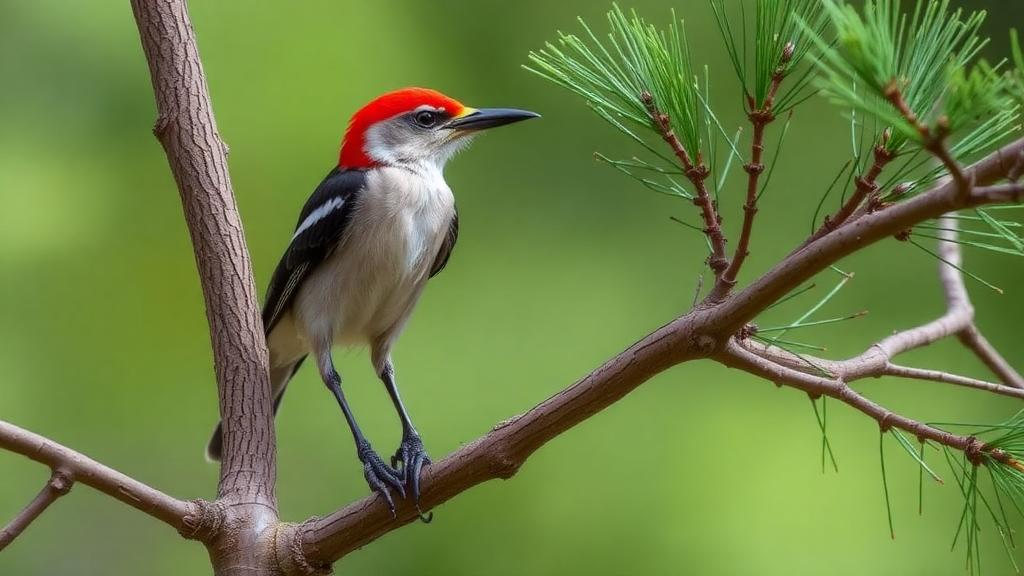
Deep in the Alberta Rockies, on the scar left by a 5,600-hectare prescribed burn in 2009, an unlikely partnership between a bird and two endangered trees is being decoded one call at a time. Clark’s Nutcracker, a crow-sized bird with a remarkable memory for buried seeds, is the sole effective disperser of whitebark pine and limber pine, two five-needle pines listed as endangered in Alberta. A new study published in Nature Conservation used nearly 2,000 hours of automated acoustic recordings to map how these birds moved across burned and unburned landscapes during the critical seasons when seeds are cached and later retrieved, offering recovery planners a data-driven window into where natural regeneration might actually happen.
The research team, led by Vernon S. Peters, deployed six autonomous recording units across the burn area from fall 2018 through spring 2020. Rather than relying on labor-intensive visual surveys in rugged terrain, the researchers used KALEIDOSCOPE PRO acoustic analysis software with an advanced classifier to detect and quantify nutcracker calls across thousands of hours of audio. This passive acoustic approach allowed continuous monitoring across seasons and habitat types that would be nearly impossible to survey on foot at comparable intensity, and it captured the birds’ vocal activity as a proxy for habitat use.
The study was designed around a natural experiment in pine reproductive timing. Both whitebark and limber pine are masting species, meaning they produce cones in intermittently massive crops rather than steady annual amounts. Fall 2018 was a mast year, when cone production surged and nutcrackers descended to harvest and cache seeds. Spring 2019 followed, when those cached seeds would be retrieved, either to be eaten or, crucially, forgotten in ways that allow seedlings to establish. The researchers contrasted habitat use between this mast year and the subsequent non-mast year, between whitebark and limber pine habitat, and between burned and unburned stands, testing whether distance from remaining seed sources shaped visitation patterns.
Model selection using Akaike’s information criterion revealed that nutcracker habitat use depended on masting status, habitat type, burned habitat, distance from seed sources, and interactions among these factors in both fall and spring foraging periods. In the fall of the mast year, when both pine species produced high numbers of cones in close proximity, nutcrackers used whitebark pine habitat more heavily, particularly unburned stands. This pattern suggests concentrated caching behavior, as birds harvest seeds and bury them in sites they may later fail to recover, which is precisely the mechanism these pines depend upon for regeneration.
The spring results told a different and equally important story. Nutcracker habitat use was greater in the non-mast year, particularly in burned whitebark pine habitat. This shift makes ecological sense: after a mast year, birds return to retrieve the seeds they cached, and burned areas may offer favorable conditions for cache recovery. For the pines, lower habitat use the following spring carries a hidden benefit. When caches are retrieved, seeds are eaten rather than dispersed, so reduced nutcracker presence in spring means fewer caches are raided and more seeds survive to germinate. The 2018 mast year thus attracted seed dispersers when it mattered most, and the lower habitat use the following spring protected those caches from seed predation.
One of the most striking findings concerns the relative attractiveness of the two pine species. Whitebark pine attracted more nutcracker habitat use with fewer trees and fewer cones per tree than limber pine. This suggests that whitebark pine, despite its endangered status and often sparse distribution, exerts a disproportionately strong pull on its disperser, possibly through cone characteristics, stand structure, or landscape position. For limber pine, which co-occurs with whitebark at this northern range limit of five-needle pine overlap, the results imply that it may rely on the same nutcracker traffic drawn by whitebark, making the conservation of whitebark stands doubly important for the recovery of both species.
The prescribed burn itself emerged as a long-term asset rather than a temporary disturbance. The 2009 fire created attractive habitat for Clark’s Nutcracker nine to eleven years after the burn, demonstrating that opportunities for seed dispersal persist well beyond the immediate post-fire window. This finding challenges assumptions that nutcracker activity fades quickly after fire and instead shows that burned landscapes continue to function as dispersal corridors and caching grounds during the period when five-needle pine management is actively planned. For recovery strategies that use prescribed fire or manage natural burns, the results indicate that the window for natural regeneration on burns extends across at least a decade.
The study also highlights a critical intersection with disease management. White pine blister rust, caused by the fungal pathogen Cronartribicola, is a major threat to whitebark pine across its range, and current recovery strategies center on planting seedlings bred for rust resistance. The researchers emphasize that continued use of rust-resistant trees by dispersers is essential for natural regeneration to be effective. As existing plantings of rust-resistant seedlings reach cone production age in the future, attracting nutcrackers to those trees will leverage the investment in resistant stock, allowing the birds to disperse seeds from trees that can survive the disease and establish the next generation.
By combining passive acoustics with rigorous model selection, the study provides a template for monitoring disperser behavior across large, remote landscapes without the cost and bias of visual surveys. The approach captures seasonal dynamics that ground-based counts often miss, and it can be scaled to other systems where vocal birds serve as keystone dispersers. As climate change alters fire regimes and masting patterns across western North America, understanding when and where nutcrackers cache seeds becomes increasingly urgent for the survival of whitebark and limber pine at their northern range limit.
The findings carry direct implications for Alberta’s recovery plans for both endangered pines. Burns intended for five-needle pine management should be evaluated not just for immediate planting opportunities but for their capacity to attract nutcrackers during mast years, when cone crops in proximity to burned habitat create the conditions for caching. The study’s evidence that both pine species benefited from attracting dispersers in the 2018 mast year, and from reduced cache predation the following spring, suggests that synchronizing management actions with masting cycles could amplify natural regeneration. In a landscape where these pines face rust, fire exclusion, and climate stress, the humble nutcracker call recorded by a small device on a decade-old burn may prove to be one of the most valuable signals conservationists can listen for.
Subject of Research: Acoustic monitoring of Clark's Nutcracker habitat use during post-fire recovery of endangered whitebark and limber pines
Article Title: Acoustic analysis shows Clark’s Nutcracker seasonal and spatial habitat use during post-fire recovery of two endangered pine species
Article References: Peters, V. S., Vriend, J. L., Proppe, D. S., Buist, E., Greidanus, K., & Peters, C. E. (2026). Acoustic analysis shows Clark’s Nutcracker seasonal and spatial habitat use during post-fire recovery of two endangered pine species. Nature Conservation, 63, 99–126. https://doi.org/10.3897/natureconservation.63.171832
Image Credits: AI Generated
DOI: 10.3897/natureconservation.63.171832
Keywords: Clark's Nutcracker, whitebark pine, limber pine, seed dispersal, post-fire recovery, acoustic monitoring, masting, Alberta, endangered species, forest ecology, prescribed burn, seed caching
Cite Scienmag News
Margaret Porter. (October 18, 2026). Acoustic monitoring reveals how Clark’s Nutcracker shapes post-fire recovery of endangered pines. Scienmag. https://scienmag.com/acoustic-monitoring-reveals-how-clarks-nutcracker-shapes-post-fire-recovery-of-endangered-pines/
Margaret Porter. "Acoustic monitoring reveals how Clark’s Nutcracker shapes post-fire recovery of endangered pines." Scienmag, 18 October 2026, https://scienmag.com/acoustic-monitoring-reveals-how-clarks-nutcracker-shapes-post-fire-recovery-of-endangered-pines/. Accessed 18 October 2026.
Margaret Porter. "Acoustic monitoring reveals how Clark’s Nutcracker shapes post-fire recovery of endangered pines." Scienmag. October 18, 2026. https://scienmag.com/acoustic-monitoring-reveals-how-clarks-nutcracker-shapes-post-fire-recovery-of-endangered-pines/


