


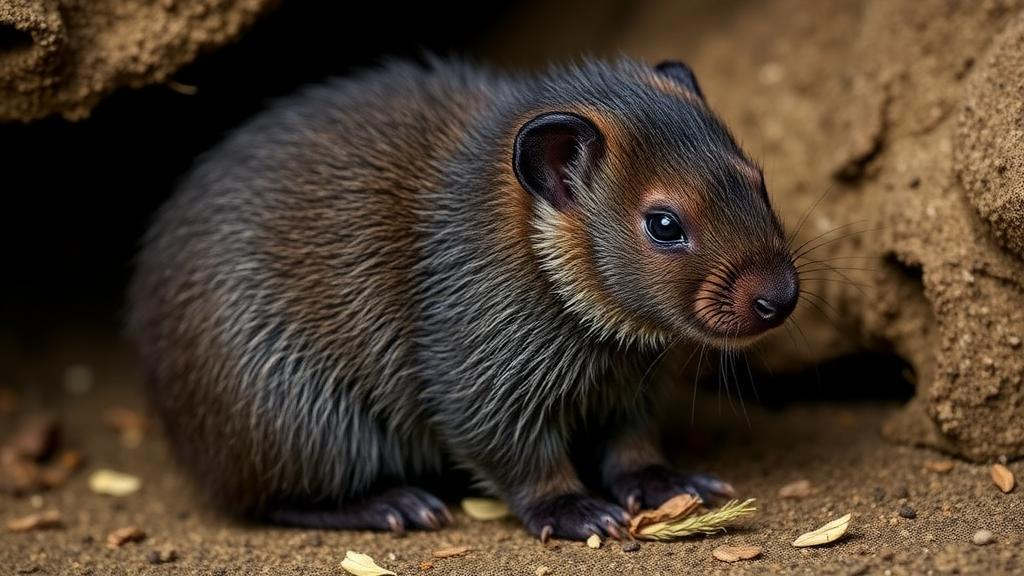
Deep beneath the grasslands and semi-deserts of Eastern Anatolia lives a rodent so strange that cytogeneticists have been fascinated by it for more than half a century. The Transcaucasian mole vole, Ellobius lutescens, spends nearly its entire life underground, digging complex tunnel systems through the soil of Van and Hakkâri provinces. Now a new study has peered into its chromosomes for the first time in Turkish populations, and the results confirm that this subterranean mammal is every bit as unusual inside its cells as it is in its lifestyle.
The research, published in the journal Subterranean Biology, is the first investigation of nucleolar organizer regions (NORs) and C-heterochromatin in Turkish populations of E. lutescens. A team of researchers collected nine specimens — five females and four males — from four different localities in Van and Hakkâri provinces in Eastern Anatolia. Using classic cytogenetic staining techniques on bone marrow cells, they confirmed a chromosome picture that remains one of the rarest in the entire class Mammalia: a diploid number of just 2n = 17, an odd count, and an XO sex chromosome system in which both males and females carry a single X chromosome and no Y chromosome at all.
To appreciate how extraordinary this is, consider that nearly all mammals, humans included, rely on a dimorphic XX/XY system, with females carrying two X chromosomes and males one X and one Y. In E. lutescens, both sexes are XO, meaning sex determination must operate through an entirely different molecular mechanism whose basis remains poorly understood. Among the five recognized species of the genus Ellobius, which ranges from Ukraine across Central Asia to Kazakhstan, Mongolia and China as well as into eastern Turkey and Iran, this lineage has abandoned the conventional mammalian sex chromosome blueprint. Related species show their own variants: E. talpinus has isomorphic XX sex chromosomes in both sexes, while E. tancrei and E. alaicus carry XX configurations with one X functionally inactive. Only E. lutescens, however, combines this with an odd diploid number.
The species was first described by Thomas in 1897 based on specimens collected near Erçek in Van province, and its taxonomic status was debated for decades. Some researchers lumped it with E. fuscocapillus or treated it as a subspecies, while others maintained the two were distinct. The current consensus recognizes E. lutescens as the sole representative of the genus in Turkey, with confirmed populations confined to the eastern part of the country and a broader distribution spanning northwestern Georgia, Iran, Azerbaijan and Armenia.
Life underground has shaped every aspect of the animal’s biology. Its burrow systems, dug 16 to 48 centimeters beneath the surface depending on climatic conditions, consist of multiple interconnected chambers and extensive tunnels, with each family occupying a living area of roughly 12 by 9 meters. Morphologically, the species shows the classic subterranean suite: a cylindrical body, short limbs, no external ear pinnae, soft short fur, extremely small eyes and a very short tail. Physiologically, it tolerates the low oxygen and high carbon dioxide levels of its burrows and is highly sensitive to soil vibrations. These adaptations make it a compelling subject for evolutionary biology, but its chromosomes have attracted attention in their own right since Matthey’s pioneering 1953 study of Iranian specimens.
In the new work, chromosome preparations from colchicine-treated bone marrow cells were analyzed with at least 20 well-spread metaphases per specimen. Silver nitrate staining, following the Howell and Black technique, revealed distinct NORs — the chromosomal loci where ribosomal RNA genes cluster and nucleoli form — at multiple positions. Interstitial NORs were observed on the long arm of chromosome pair number 1, while additional NOR signals appeared at telomeric regions on the short arms of pairs 2 and 3, on the short arms of both homologues of pair 4, and on the long arms of pairs 5 and 7. Notably, no NOR signal was detected on the X chromosome.
That pattern differs strikingly from what was reported for the Tehran population of Iran by Djalali and colleagues in 1986, who found interstitial NORs on two biarmed chromosomes and telomeric NORs on four chromosomes. The Turkish specimens carry interstitial NORs on only one chromosome pair but NOR-bearing signals on as many as eight chromosomes in total — a significantly higher number than the Iranian count. C-banding, performed using Sumner’s 1972 technique, produced an even more remarkable result: no C-band heterochromatin was detected in any chromosome of any examined specimen, including the X. This absence of detectable constitutive heterochromatin matches the findings of Vogel and colleagues in 1988 for the Tehran population, making the C-negative picture a shared trait across the species’ range.
The combination of a stable karyotype — 2n = 17, NF = 34, NFa = 32, XO in both sexes — with population-specific NOR variation provides fresh cytogenetic evidence for divergence between Turkish and Iranian populations. When integrated with previous work, the picture becomes compelling. Kaya and colleagues reported in 2018 clear morphological divergence in skull and mandible shape between Iranian and Turkish populations, proposing that the Zagros and Tendürek mountain ranges act as significant geographical barriers to gene flow. Alireza and colleagues, also in 2018, revealed evolutionary divergence within Iranian populations along the northern and southern slopes of the Zagros. Ellerman had already argued in 1948 that the Turkish population represents the subspecies E. l. lutescens while the Iranian population is E. l. woosnami. The new cytogenetic data, layered onto the morphometric and genetic evidence, support precisely that subspecies-level micro-evolutionary separation, shaped by physical barriers across the species’ range.
The study also updates the known distribution of E. lutescens in Turkey. The southernmost record now extends to Karabey village in the Yüksekova district of Hakkâri province, at 1,870 meters above sea level. Field surveys conducted further south detected no burrow systems or mounds, marking Karabey as the species’ southern limit in the country. For a rodent that rarely surfaces, its chromosomes have now spoken loudly — confirming an ancient and conserved karyotype while revealing the subtle cytogenetic fingerprints of isolation, mountains and time.
Subject of Research: NOR and C-heterochromatin characteristics of Ellobius lutescens Thomas, 1897 (Rodentia, Cricetidae) from Turkey
Article Title: NOR and C-heterochromatin characteristics of Ellobius lutescens Thomas, 1897 ( Rodentia , Cricetidae ) from Turkey
Article References: Yürümez, G. (2025). NOR and C-heterochromatin characteristics of Ellobius lutescens Thomas, 1897 (Rodentia, Cricetidae) from Turkey. Subterranean Biology, 53, 1-11. https://doi.org/10.3897/subtbiol.53.161945
Image Credits: AI Generated
DOI: 10.3897/subtbiol.53.161945
Keywords: C-heterochromatin, characteristics, Ellobius, lutescens, Thomas, Rodentia, Cricetidae, Turkey, scientific research
Cite Scienmag News
Drew Townsend. (October 17, 2026). Mole vole with no Y chromosome reveals hidden chromosomal secrets in Turkey. Scienmag. https://scienmag.com/mole-vole-with-no-y-chromosome-reveals-hidden-chromosomal-secrets-in-turkey/
Drew Townsend. "Mole vole with no Y chromosome reveals hidden chromosomal secrets in Turkey." Scienmag, 17 October 2026, https://scienmag.com/mole-vole-with-no-y-chromosome-reveals-hidden-chromosomal-secrets-in-turkey/. Accessed 17 October 2026.
Drew Townsend. "Mole vole with no Y chromosome reveals hidden chromosomal secrets in Turkey." Scienmag. October 17, 2026. https://scienmag.com/mole-vole-with-no-y-chromosome-reveals-hidden-chromosomal-secrets-in-turkey/


